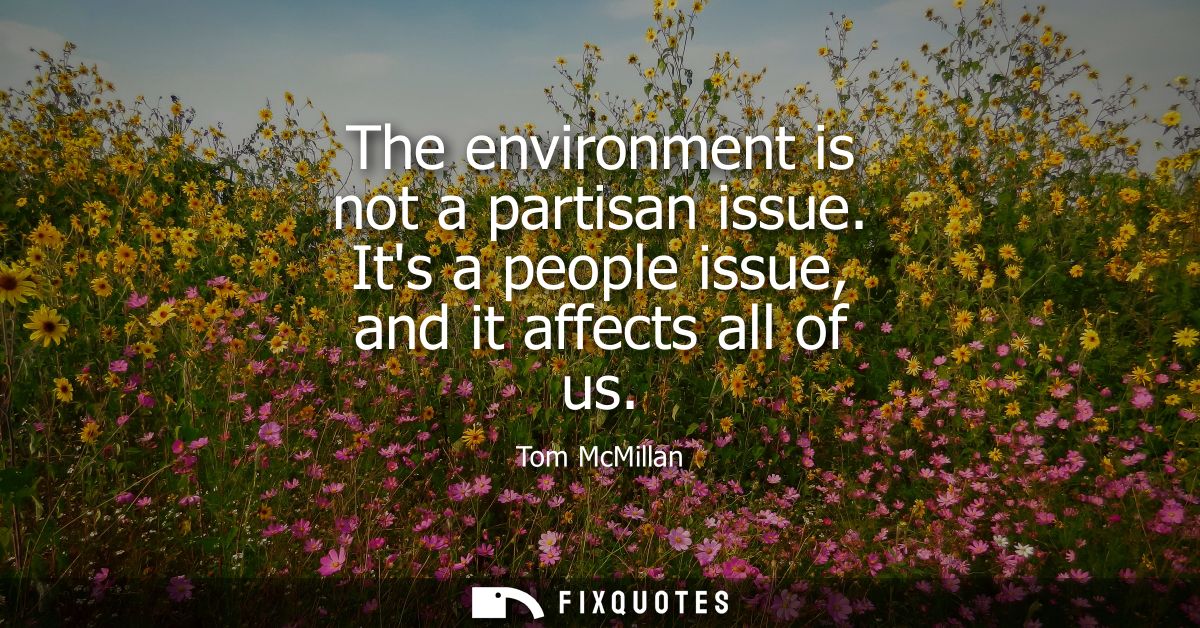
"The environment is not a partisan issue. It's a people issue, and it affects all of us"
About this Quote
The pivot to “a people issue” is doing quiet but heavy work. It’s a reframing that borrows moral authority from public health and basic security, categories where voters tend to tolerate government action without demanding ideological purity tests. “People issue” also subtly demotes the usual political characters - donors, lobbyists, party leaders - and elevates the audience as the only stakeholder that matters. That’s populist, but in a civic-minded way.
The final clause, “it affects all of us,” is the universalizing move that politicians reach for when they need coalition. It’s also strategic ambiguity: “affects” can mean asthma rates, flood insurance, farm yields, military readiness, or just a spoiled vacation. That breadth invites agreement from different constituencies while postponing the fight over remedies.
Context matters because environmental policy is where consensus collapses into compliance costs. McMillan’s intent is to create rhetorical cover for action by making opposition sound like petty tribalism. The subtext: if you’re treating this as partisan, you’re choosing party identity over your constituents’ lungs and livelihoods.
Quote Details
| Topic | Human Rights |
|---|---|
| Source | Help us find the source |
| Cite |
Citation Formats
APA Style (7th ed.)
McMillan, Tom. (2026, January 15). The environment is not a partisan issue. It's a people issue, and it affects all of us. FixQuotes. https://fixquotes.com/quotes/the-environment-is-not-a-partisan-issue-its-a-171877/
Chicago Style
McMillan, Tom. "The environment is not a partisan issue. It's a people issue, and it affects all of us." FixQuotes. January 15, 2026. https://fixquotes.com/quotes/the-environment-is-not-a-partisan-issue-its-a-171877/.
MLA Style (9th ed.)
"The environment is not a partisan issue. It's a people issue, and it affects all of us." FixQuotes, 15 Jan. 2026, https://fixquotes.com/quotes/the-environment-is-not-a-partisan-issue-its-a-171877/. Accessed 25 Mar. 2026.