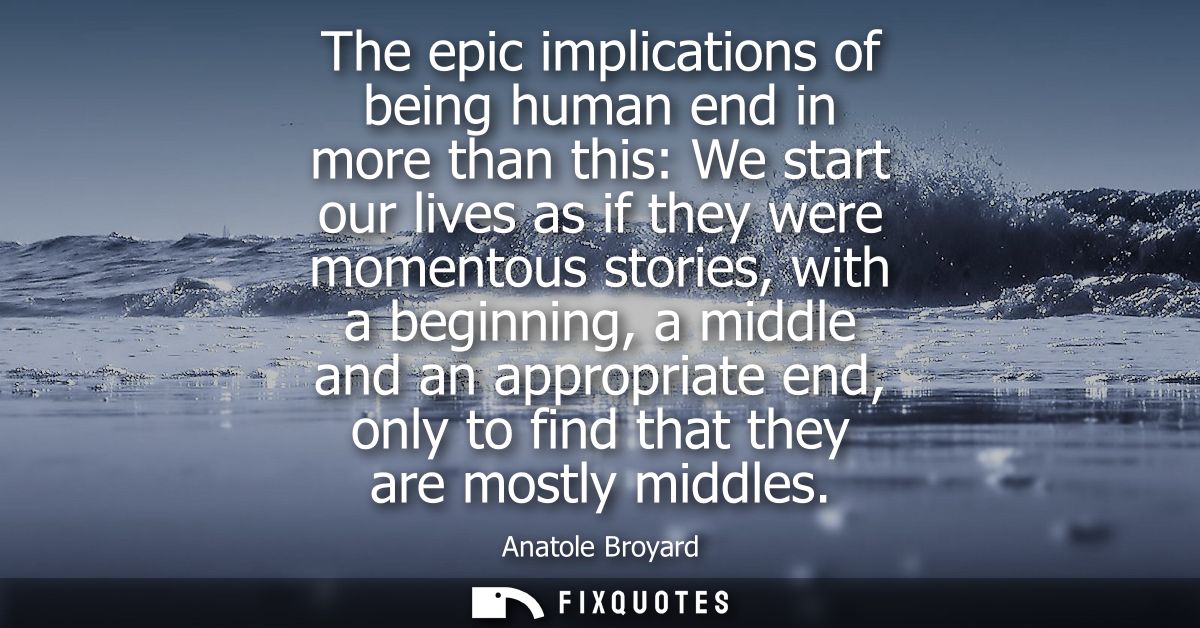
"The epic implications of being human end in more than this: We start our lives as if they were momentous stories, with a beginning, a middle and an appropriate end, only to find that they are mostly middles"
About this Quote
The line “mostly middles” lands because it’s both formal and existential. Formally, it’s a structural critique: stories are engineered to move, but life is engineered to persist. Existentially, it’s an argument against the consolations of plot. Middles are where character is supposed to develop, but they’re also where readers get impatient. Broyard implies we live in the very section we would skim if it were a novel: repetition, maintenance, deferred decisions, background anxiety.
As a critic, Broyard is also critiquing criticism - the tendency to impose narrative coherence after the fact. The “appropriate end” reads like a jab at tasteful interpretations of a life, the kind that retrofit purpose onto messy days. Context matters: Broyard wrote with unusual intensity about illness and mortality late in life, and this sounds like someone refusing the sentimental script. Not despair, exactly; more like a demand that we stop treating living as mere setup for meaning, and start paying attention to the present tense where we actually reside.
Quote Details
| Topic | Meaning of Life |
|---|---|
| Source | Help us find the source |
| Cite |
Citation Formats
APA Style (7th ed.)
Broyard, Anatole. (2026, January 16). The epic implications of being human end in more than this: We start our lives as if they were momentous stories, with a beginning, a middle and an appropriate end, only to find that they are mostly middles. FixQuotes. https://fixquotes.com/quotes/the-epic-implications-of-being-human-end-in-more-133748/
Chicago Style
Broyard, Anatole. "The epic implications of being human end in more than this: We start our lives as if they were momentous stories, with a beginning, a middle and an appropriate end, only to find that they are mostly middles." FixQuotes. January 16, 2026. https://fixquotes.com/quotes/the-epic-implications-of-being-human-end-in-more-133748/.
MLA Style (9th ed.)
"The epic implications of being human end in more than this: We start our lives as if they were momentous stories, with a beginning, a middle and an appropriate end, only to find that they are mostly middles." FixQuotes, 16 Jan. 2026, https://fixquotes.com/quotes/the-epic-implications-of-being-human-end-in-more-133748/. Accessed 12 Mar. 2026.