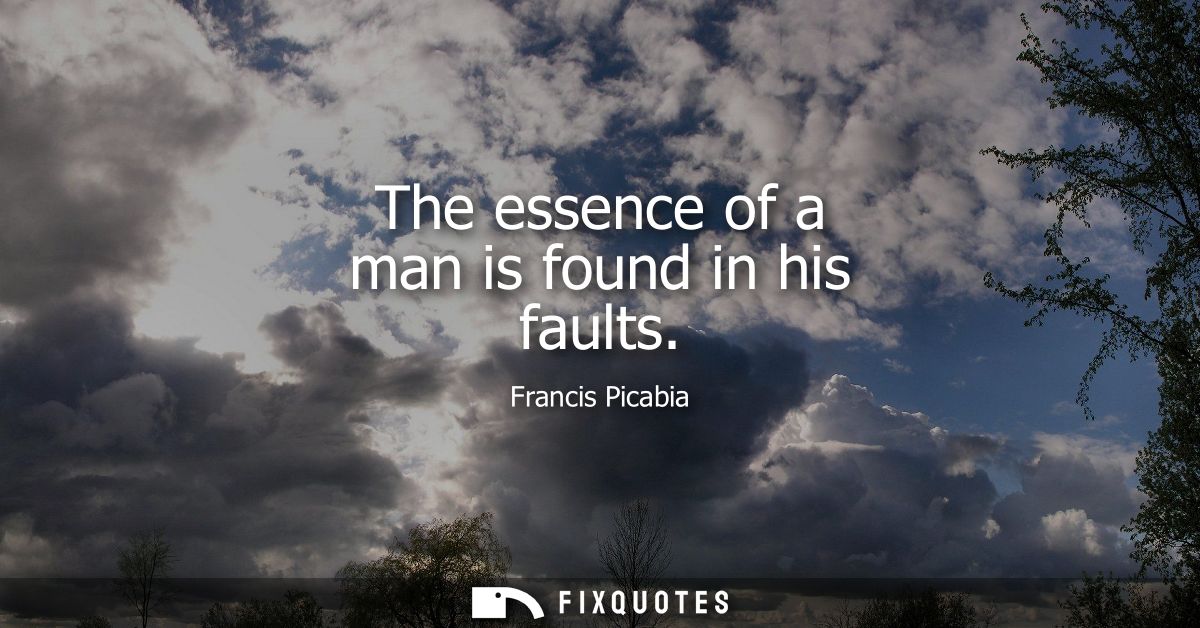
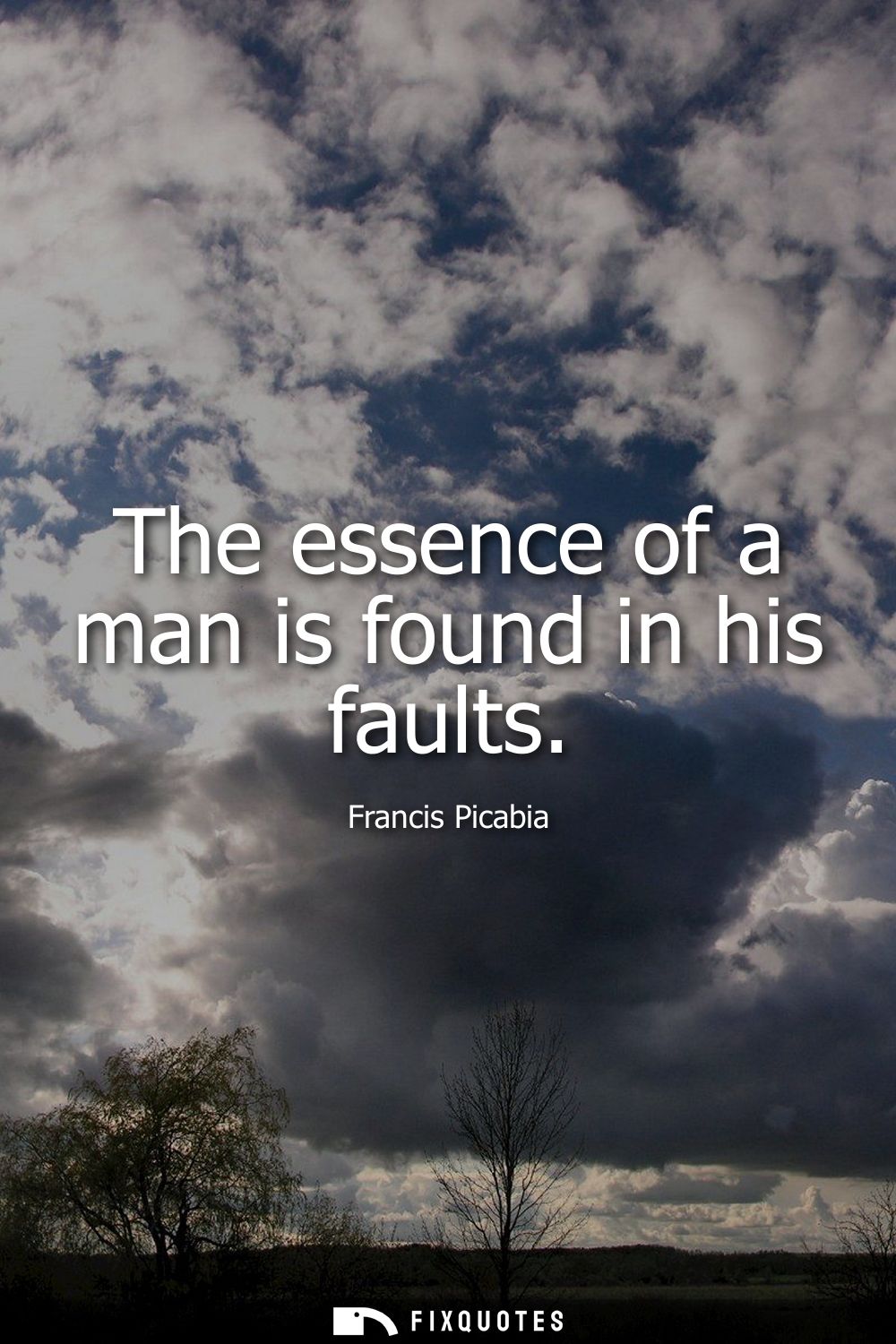
"The essence of a man is found in his faults"
About this Quote
Perfection is a dead language; flaws are where the plot happens. Picabia’s line turns the traditional moral ledger on its head, arguing that a person’s “essence” isn’t revealed by polished virtues but by the glitches they can’t fully edit out. Faults are not just mistakes; they’re signatures. They show what someone wants, what they fear, what they’re willing to risk, and how they rationalize the mess after.
The intent feels pointedly anti-heroic, which tracks with Picabia’s artistic life: a shape-shifter who moved through Impressionism, Cubism, and Dada with an almost gleeful refusal to be pinned down. In the Dada-era air of skepticism toward bourgeois sincerity, “faults” become an x-ray tool. Virtues can be rehearsed for society; faults tend to surface when the performance breaks. That’s the subtext: identity is most legible under pressure, in contradiction, in the small betrayals of our own ideals.
There’s also a sly defense mechanism embedded here. If essence lives in faults, then inconsistency and provocation aren’t moral failures; they’re evidence of being real, perhaps even of being alive. Coming from an artist who cultivated irreverence and scandal, the quote doubles as an aesthetic manifesto: art, like character, gains its electricity from friction. Smooth surfaces don’t tell you much. A crack does.
Contextually, early 20th-century Europe was watching supposedly “civilized” values collapse into mechanized war and propaganda. In that wreckage, celebrating faults isn’t nihilism so much as a refusal of fake purity. The honest self is the one that leaks.
The intent feels pointedly anti-heroic, which tracks with Picabia’s artistic life: a shape-shifter who moved through Impressionism, Cubism, and Dada with an almost gleeful refusal to be pinned down. In the Dada-era air of skepticism toward bourgeois sincerity, “faults” become an x-ray tool. Virtues can be rehearsed for society; faults tend to surface when the performance breaks. That’s the subtext: identity is most legible under pressure, in contradiction, in the small betrayals of our own ideals.
There’s also a sly defense mechanism embedded here. If essence lives in faults, then inconsistency and provocation aren’t moral failures; they’re evidence of being real, perhaps even of being alive. Coming from an artist who cultivated irreverence and scandal, the quote doubles as an aesthetic manifesto: art, like character, gains its electricity from friction. Smooth surfaces don’t tell you much. A crack does.
Contextually, early 20th-century Europe was watching supposedly “civilized” values collapse into mechanized war and propaganda. In that wreckage, celebrating faults isn’t nihilism so much as a refusal of fake purity. The honest self is the one that leaks.
Quote Details
| Topic | Wisdom |
|---|---|
| Source | Help us find the source |
| Cite |
Citation Formats
APA Style (7th ed.)
Picabia, Francis. (2026, January 17). The essence of a man is found in his faults. FixQuotes. https://fixquotes.com/quotes/the-essence-of-a-man-is-found-in-his-faults-58312/
Chicago Style
Picabia, Francis. "The essence of a man is found in his faults." FixQuotes. January 17, 2026. https://fixquotes.com/quotes/the-essence-of-a-man-is-found-in-his-faults-58312/.
MLA Style (9th ed.)
"The essence of a man is found in his faults." FixQuotes, 17 Jan. 2026, https://fixquotes.com/quotes/the-essence-of-a-man-is-found-in-his-faults-58312/. Accessed 3 Apr. 2026.
More Quotes by Francis
Add to List