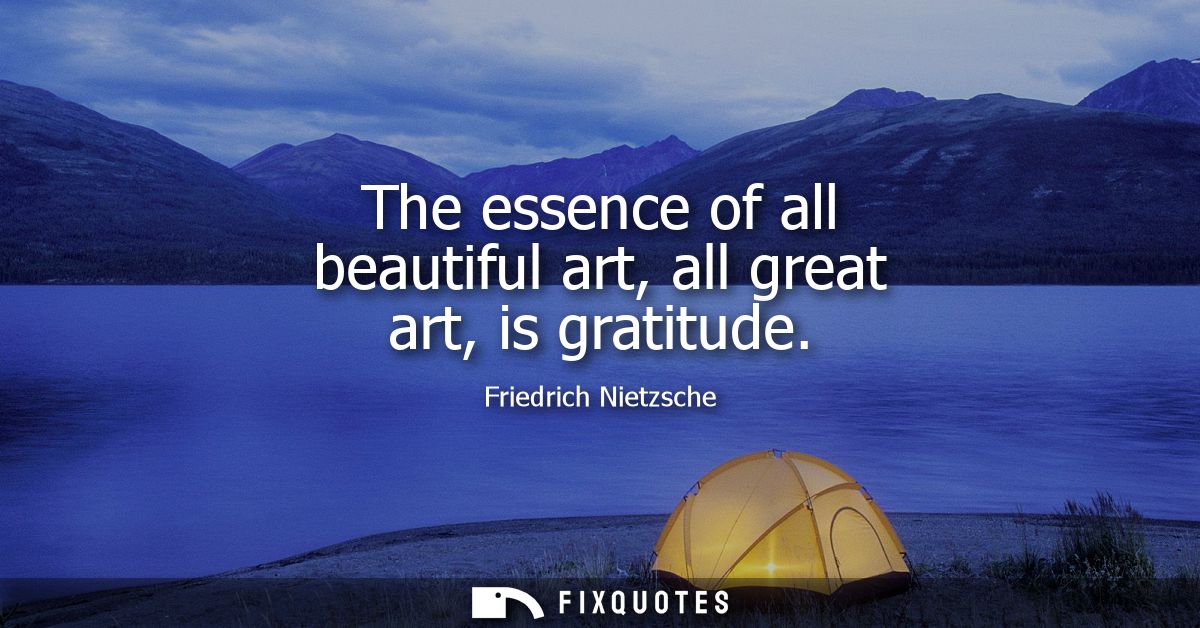
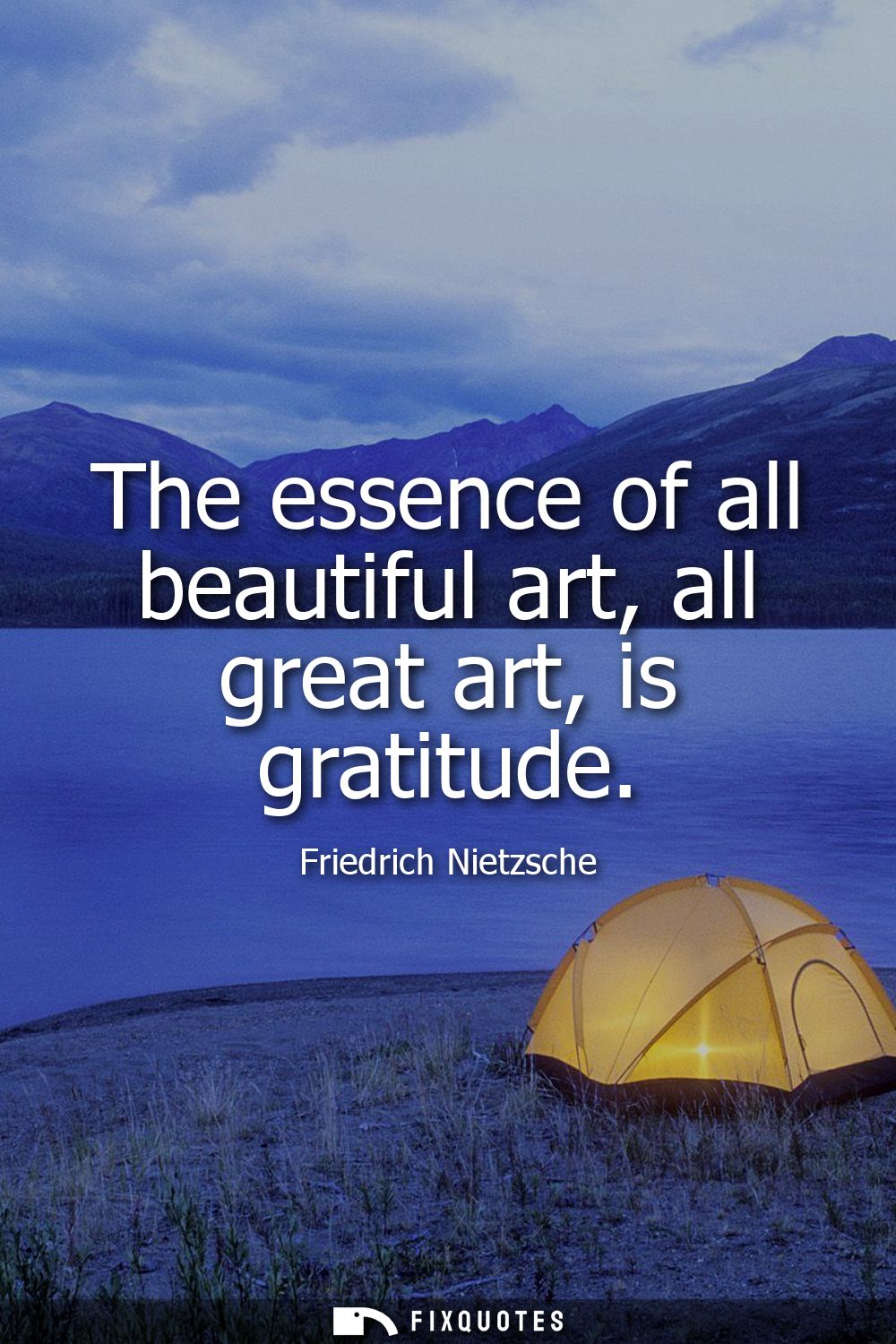
"The essence of all beautiful art, all great art, is gratitude"
About this Quote
Nietzsche, the philosopher most famous for swinging a hammer at morality, sneaks something almost tender into this line: great art isn’t born from complaint but from a charged “yes” to existence. “Gratitude” here doesn’t mean politeness or spiritual serenity. It’s closer to his hard-won affirmation, the kind that can look straight at suffering and still refuse the comfort of resentment. That’s the subtext: the artist’s deepest enemy is not pain but the moralized sulk that turns pain into an accusation against life.
The sentence is engineered to provoke. Nietzsche is baiting the Romantic cliché that art is the refined byproduct of misery. He flips the script: misery may supply raw material, but greatness comes from transfiguring it - metabolizing wounds into form, rhythm, intensity. Gratitude becomes a criterion for strength. Weak spirits demand the world justify itself; strong spirits repay the world by creating something that makes it feel worth inhabiting.
Context matters. Nietzsche writes in a Europe saturated with Christian valuations - humility, guilt, salvation - and his philosophy is an extended attempt to unseat them. In that landscape, “gratitude” reads like a hostile takeover of a moral virtue: he takes a word associated with piety and reroutes it into aesthetic power. Great art, in this framing, isn’t therapy or confession; it’s an act of sovereignty. The artist doesn’t beg reality for meaning. The artist returns reality, amplified, as a gift.
The sentence is engineered to provoke. Nietzsche is baiting the Romantic cliché that art is the refined byproduct of misery. He flips the script: misery may supply raw material, but greatness comes from transfiguring it - metabolizing wounds into form, rhythm, intensity. Gratitude becomes a criterion for strength. Weak spirits demand the world justify itself; strong spirits repay the world by creating something that makes it feel worth inhabiting.
Context matters. Nietzsche writes in a Europe saturated with Christian valuations - humility, guilt, salvation - and his philosophy is an extended attempt to unseat them. In that landscape, “gratitude” reads like a hostile takeover of a moral virtue: he takes a word associated with piety and reroutes it into aesthetic power. Great art, in this framing, isn’t therapy or confession; it’s an act of sovereignty. The artist doesn’t beg reality for meaning. The artist returns reality, amplified, as a gift.
Quote Details
| Topic | Gratitude |
|---|---|
| Source | Help us find the source |
| Cite |
Citation Formats
APA Style (7th ed.)
Nietzsche, Friedrich. (2026, January 14). The essence of all beautiful art, all great art, is gratitude. FixQuotes. https://fixquotes.com/quotes/the-essence-of-all-beautiful-art-all-great-art-is-172644/
Chicago Style
Nietzsche, Friedrich. "The essence of all beautiful art, all great art, is gratitude." FixQuotes. January 14, 2026. https://fixquotes.com/quotes/the-essence-of-all-beautiful-art-all-great-art-is-172644/.
MLA Style (9th ed.)
"The essence of all beautiful art, all great art, is gratitude." FixQuotes, 14 Jan. 2026, https://fixquotes.com/quotes/the-essence-of-all-beautiful-art-all-great-art-is-172644/. Accessed 5 Feb. 2026.
More Quotes by Friedrich
Add to List