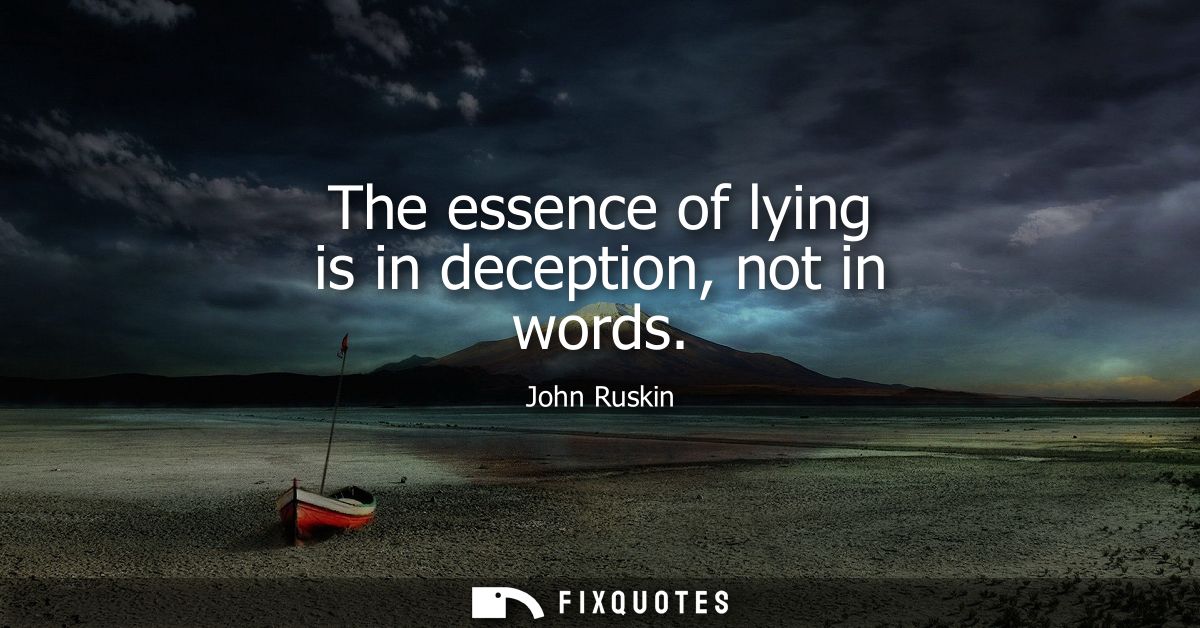
"The essence of lying is in deception, not in words"
About this Quote
Ruskin’s line is a moral razor aimed at an easy alibi: that dishonesty lives in phrasing, technicalities, or the lawyerly refuge of “I never actually said that.” He strips lying down to its operational core, treating it less as a verbal offense than as an ethical act with a target. The emphasis on “essence” signals a critic’s instinct to define terms precisely, but the punch is cultural: language doesn’t corrupt reality on its own; people do, by using language (or silence, or omission) as a tool.
The subtext is an attack on the respectable liar. Victorian public life prized propriety, euphemism, and decorum, creating plenty of room for deception that could stay clean on the surface. Ruskin flips that social etiquette into an indictment: you can speak true words and still lie if your aim is to mislead. A selective statistic, a carefully cropped confession, a “technically accurate” denial - these are not loopholes but the very architecture of deceit.
It also hints at Ruskin’s larger preoccupation with sincerity in art, labor, and public virtue. He distrusted systems that rewarded appearances over integrity, whether in industrial capitalism’s glossy products or in institutional rhetoric. By relocating the crime from vocabulary to intention, he makes lying harder to outsource. The ethical question isn’t “Were the words false?” but “Were you trying to bend someone’s understanding?” That standard still lands because it names the modern vice we keep pretending is just messaging.
The subtext is an attack on the respectable liar. Victorian public life prized propriety, euphemism, and decorum, creating plenty of room for deception that could stay clean on the surface. Ruskin flips that social etiquette into an indictment: you can speak true words and still lie if your aim is to mislead. A selective statistic, a carefully cropped confession, a “technically accurate” denial - these are not loopholes but the very architecture of deceit.
It also hints at Ruskin’s larger preoccupation with sincerity in art, labor, and public virtue. He distrusted systems that rewarded appearances over integrity, whether in industrial capitalism’s glossy products or in institutional rhetoric. By relocating the crime from vocabulary to intention, he makes lying harder to outsource. The ethical question isn’t “Were the words false?” but “Were you trying to bend someone’s understanding?” That standard still lands because it names the modern vice we keep pretending is just messaging.
Quote Details
| Topic | Honesty & Integrity |
|---|---|
| Source | Help us find the source |
| Cite |
Citation Formats
APA Style (7th ed.)
Ruskin, John. (2026, January 15). The essence of lying is in deception, not in words. FixQuotes. https://fixquotes.com/quotes/the-essence-of-lying-is-in-deception-not-in-words-41398/
Chicago Style
Ruskin, John. "The essence of lying is in deception, not in words." FixQuotes. January 15, 2026. https://fixquotes.com/quotes/the-essence-of-lying-is-in-deception-not-in-words-41398/.
MLA Style (9th ed.)
"The essence of lying is in deception, not in words." FixQuotes, 15 Jan. 2026, https://fixquotes.com/quotes/the-essence-of-lying-is-in-deception-not-in-words-41398/. Accessed 24 Mar. 2026.
More Quotes by John
Add to List