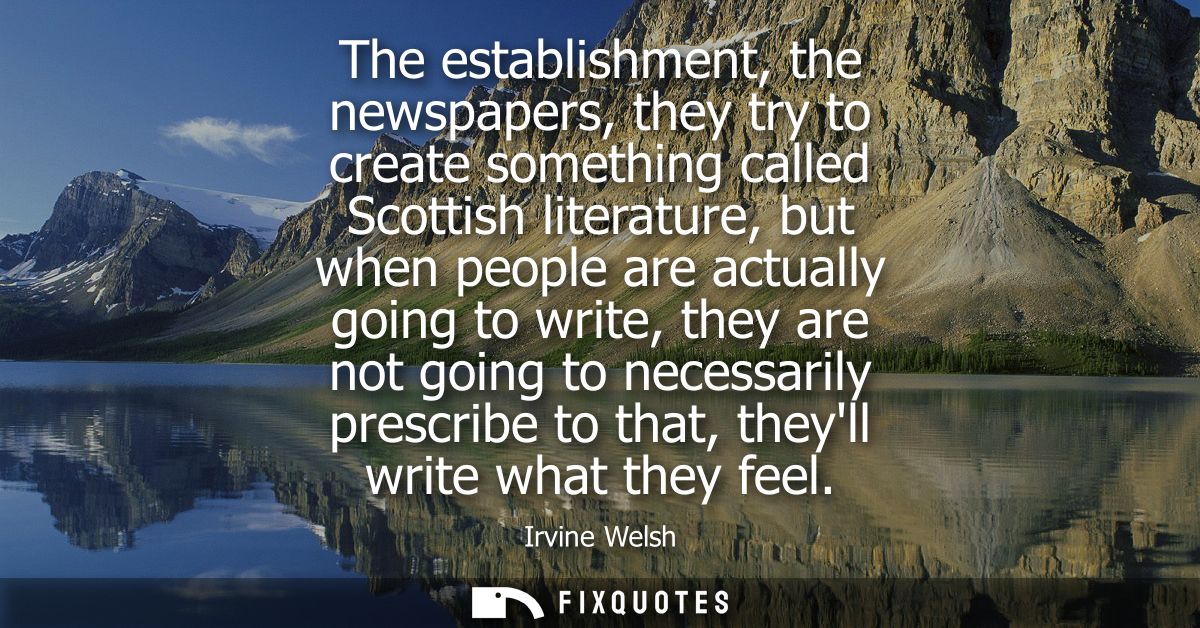
"The establishment, the newspapers, they try to create something called Scottish literature, but when people are actually going to write, they are not going to necessarily prescribe to that, they'll write what they feel"
About this Quote
The real provocation is his refusal of prescription. Welsh’s fiction (especially the Trainspotting era) arrived with dialect, class anger, and chemical-stained realism that embarrassed polite gatekeepers while electrifying readers who rarely saw themselves on the page. So when he says writers “write what they feel,” it’s not a Hallmark defense of authenticity; it’s a class and power argument. Feeling here means lived experience that doesn’t ask permission from London-centric publishing norms or Edinburgh’s respectable cultural institutions. It’s also an anti-myth move: Scotland doesn’t need to perform tartan melancholy or noble grit to qualify as “Scottish.”
Subtext: national identity is often curated by people who don’t bear the costs of it. Welsh insists literature is messier than nation-branding, and that the most Scottish thing a writer can do is ignore the memo. The irony is that this defiance itself becomes a signature style the culture industry later tries to package. Welsh knows that game, and he’s still refusing to play it quietly.
Quote Details
| Topic | Writing |
|---|---|
| Source | Help us find the source |
| Cite |
Citation Formats
APA Style (7th ed.)
Welsh, Irvine. (2026, January 17). The establishment, the newspapers, they try to create something called Scottish literature, but when people are actually going to write, they are not going to necessarily prescribe to that, they'll write what they feel. FixQuotes. https://fixquotes.com/quotes/the-establishment-the-newspapers-they-try-to-67558/
Chicago Style
Welsh, Irvine. "The establishment, the newspapers, they try to create something called Scottish literature, but when people are actually going to write, they are not going to necessarily prescribe to that, they'll write what they feel." FixQuotes. January 17, 2026. https://fixquotes.com/quotes/the-establishment-the-newspapers-they-try-to-67558/.
MLA Style (9th ed.)
"The establishment, the newspapers, they try to create something called Scottish literature, but when people are actually going to write, they are not going to necessarily prescribe to that, they'll write what they feel." FixQuotes, 17 Jan. 2026, https://fixquotes.com/quotes/the-establishment-the-newspapers-they-try-to-67558/. Accessed 3 Apr. 2026.