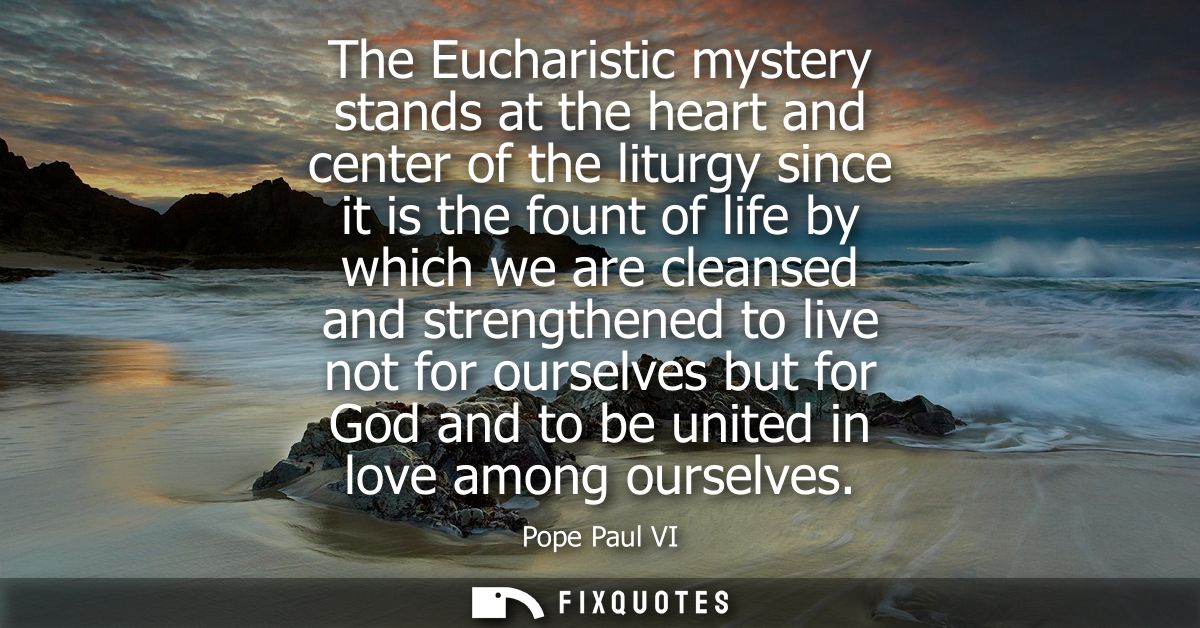
"The Eucharistic mystery stands at the heart and center of the liturgy since it is the fount of life by which we are cleansed and strengthened to live not for ourselves but for God and to be united in love among ourselves"
About this Quote
Pope Paul VI stacks the deck early: the Eucharist is not one devotional option among many but the gravitational center of Catholic life, the place the liturgy draws its meaning from and returns to. Calling it a "mystery" is doing strategic work. It signals that the Eucharist can be named, preached, and ritualized, but never reduced to a merely rational explanation or a private feeling. In an era increasingly allergic to thick claims about reality, Paul VI insists the Church’s core act is precisely the kind of thing modernity can’t easily domesticate.
The phrase "fount of life" pushes the sacrament beyond symbolism. It’s a source, not a reminder; something that acts on the person, cleansing and strengthening. That double verb matters: purification (a moral and spiritual reset) is paired with stamina (a capacity to endure and serve). The subtext is corrective. Paul VI is warning against two temptations: a liturgy treated as aesthetic performance and a faith reduced to ethical self-improvement. Either way, the self stays at the center.
His most pointed move is the line "not for ourselves but for God" followed immediately by "united in love among ourselves". Worship that doesn’t rewire social life is, in his view, incomplete; community without God at the center becomes mere clubbiness or politics. Coming from a pope steering the Church through Vatican II’s reforms, this reads like a compass setting: renew the liturgy, yes, but keep the Eucharist as the engine that produces both holiness and solidarity, not just new forms.
The phrase "fount of life" pushes the sacrament beyond symbolism. It’s a source, not a reminder; something that acts on the person, cleansing and strengthening. That double verb matters: purification (a moral and spiritual reset) is paired with stamina (a capacity to endure and serve). The subtext is corrective. Paul VI is warning against two temptations: a liturgy treated as aesthetic performance and a faith reduced to ethical self-improvement. Either way, the self stays at the center.
His most pointed move is the line "not for ourselves but for God" followed immediately by "united in love among ourselves". Worship that doesn’t rewire social life is, in his view, incomplete; community without God at the center becomes mere clubbiness or politics. Coming from a pope steering the Church through Vatican II’s reforms, this reads like a compass setting: renew the liturgy, yes, but keep the Eucharist as the engine that produces both holiness and solidarity, not just new forms.
Quote Details
| Topic | Faith |
|---|
More Quotes by Pope
Add to List