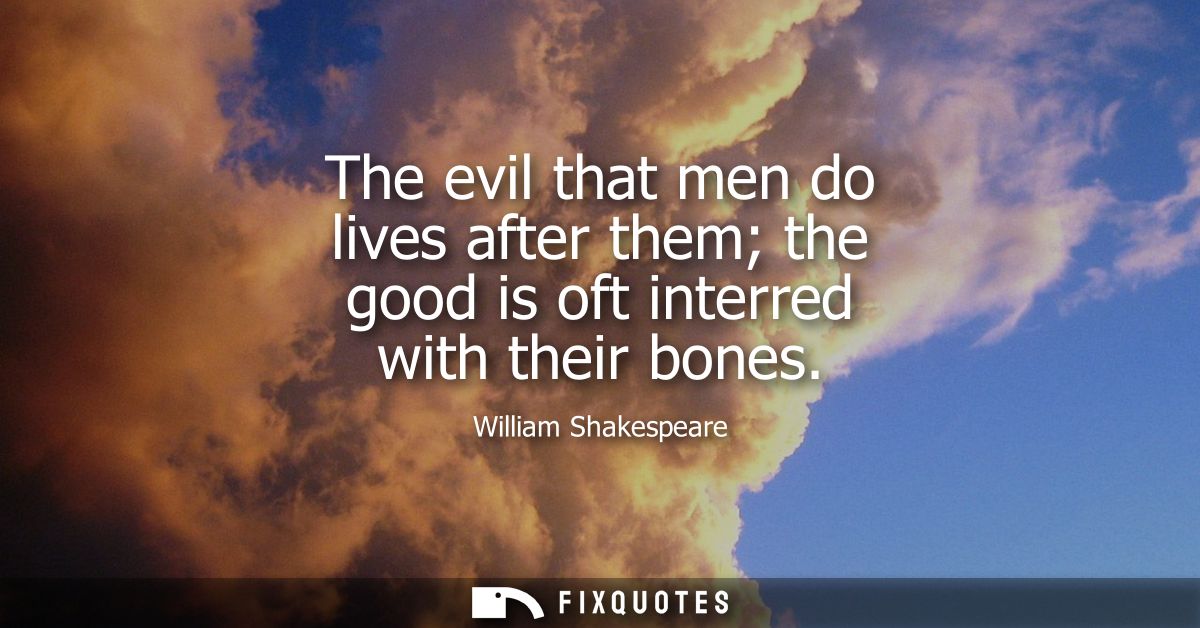
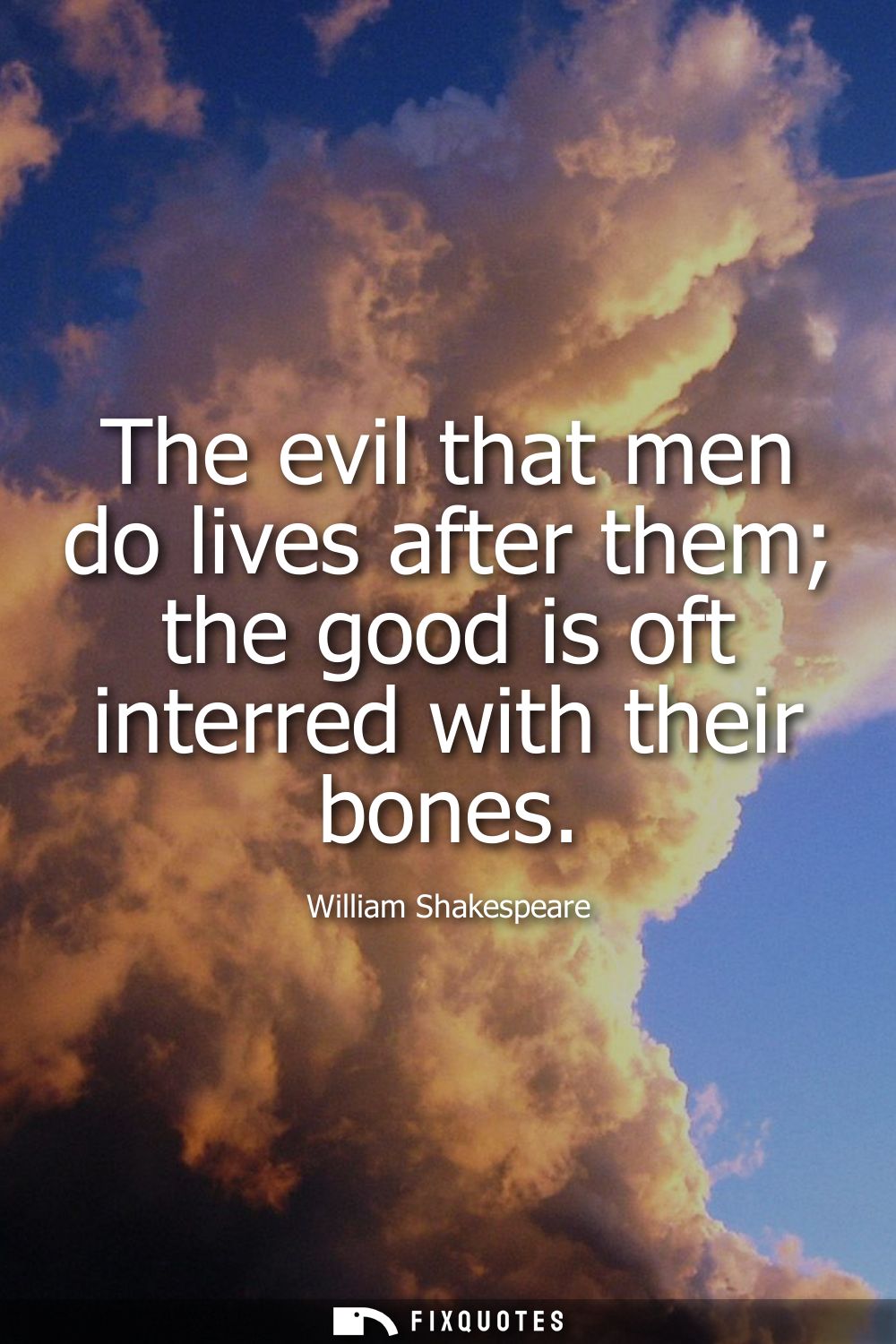
"The evil that men do lives after them; The good is oft interred with their bones"
About this Quote
The phrasing weaponizes the afterlife of reputation. “Lives after them” gives wrongdoing a grotesque animation, as if it keeps walking around long after the body stops. “Oft interred” is colder: goodness doesn’t merely fade; it’s buried, sealed, ceremonially forgotten. Shakespeare knows that moral accounting isn’t done in private consciences but in public storytelling, where outrage is portable and praise is local.
Context sharpens the cynicism. Antony delivers the line during a funeral oration engineered to look restrained. He’s constrained by political danger, so he smuggles his argument inside a seemingly modest observation. The subtext is a dare to the crowd: if you let this murder be remembered as “good,” you’ll be participating in the burial of goodness itself. The brilliance is how it flatters the audience into indignation while maintaining plausible innocence.
It works because it understands a grim constant of politics: history is less a ledger than a jury, and scandal is the evidence that never stops being admissible.
Quote Details
| Topic | Legacy & Remembrance |
|---|---|
| Source | Julius Caesar, William Shakespeare — Act 3, Scene 2 (Mark Antony's funeral speech). |
| Cite |
Citation Formats
APA Style (7th ed.)
Shakespeare, William. (2026, February 16). The evil that men do lives after them; The good is oft interred with their bones. FixQuotes. https://fixquotes.com/quotes/the-evil-that-men-do-lives-after-them-the-good-is-27585/
Chicago Style
Shakespeare, William. "The evil that men do lives after them; The good is oft interred with their bones." FixQuotes. February 16, 2026. https://fixquotes.com/quotes/the-evil-that-men-do-lives-after-them-the-good-is-27585/.
MLA Style (9th ed.)
"The evil that men do lives after them; The good is oft interred with their bones." FixQuotes, 16 Feb. 2026, https://fixquotes.com/quotes/the-evil-that-men-do-lives-after-them-the-good-is-27585/. Accessed 29 Mar. 2026.