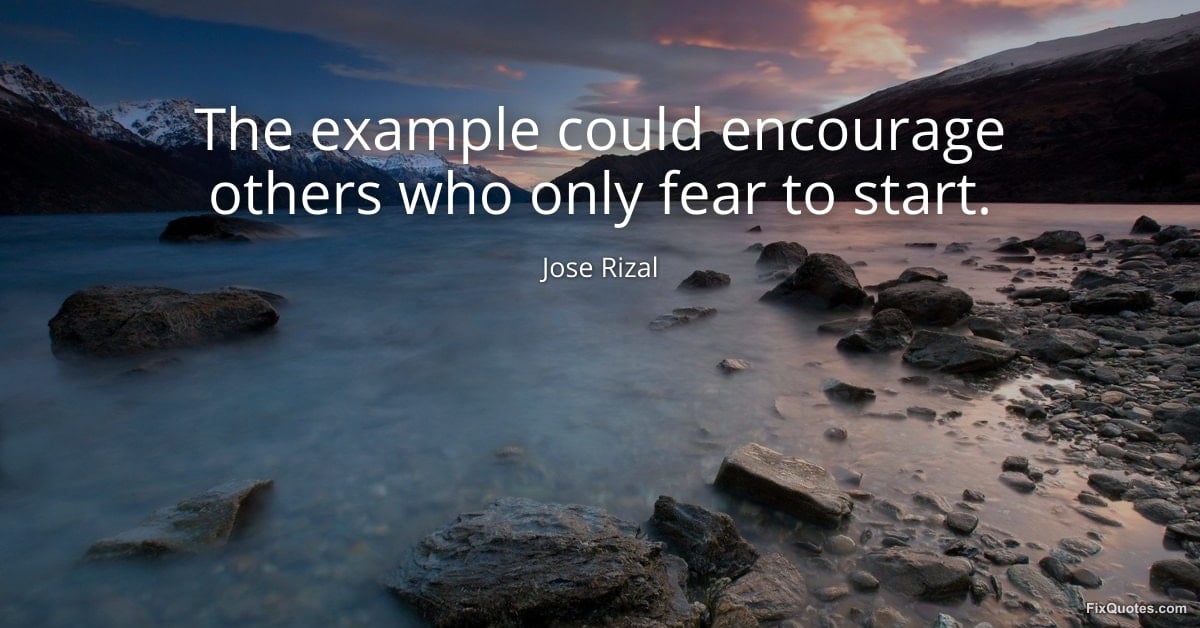
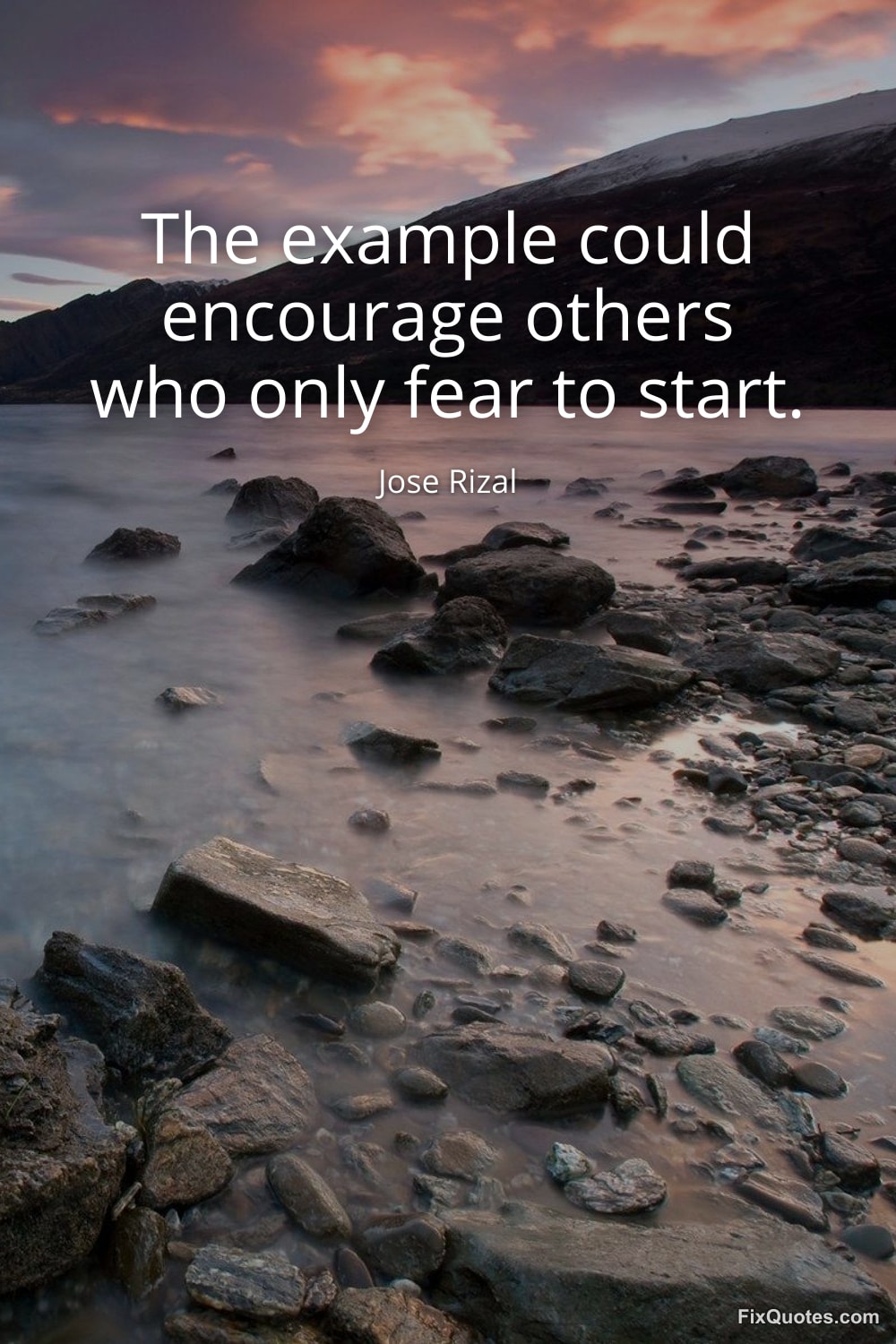
"The example could encourage others who only fear to start"
About this Quote
Bravery, here, is framed less as a heroic trait than as a contagious act of proof. Rizal’s line turns “example” into a political technology: not a speech, not a manifesto, but a visible first move that breaks the spell of collective hesitation. The key target is “others who only fear to start” - people whose restraint isn’t ignorance or agreement with oppression, but the paralysis of being first. He’s diagnosing a social physics of risk: everyone waits because the initial cost is highest, and regimes (colonial or otherwise) survive by keeping that cost abstract and terrifying.
Rizal wrote as a novelist-essayist under Spanish colonial rule in the Philippines, in a world where dissent could mean surveillance, exile, or execution. That context makes “encourage” do quiet, dangerous work. It suggests a strategy for reform and resistance that doesn’t rely on mass awakening all at once; it relies on a spark that makes fear look surmountable. The subtext is also self-addressed: a writer trying to justify the public role of the intellectual, not as a distant critic but as someone willing to place skin in the game. For Rizal, an “example” could be a book, a refusal, an organizing act - anything that converts private discontent into public possibility.
The sentence is spare on purpose. No ideology is named, no enemy is specified. That ambiguity broadens its reach while slipping past censors: a portable ethic of initiation that can travel from colonial Manila to any room where people are waiting for someone else to go first.
Rizal wrote as a novelist-essayist under Spanish colonial rule in the Philippines, in a world where dissent could mean surveillance, exile, or execution. That context makes “encourage” do quiet, dangerous work. It suggests a strategy for reform and resistance that doesn’t rely on mass awakening all at once; it relies on a spark that makes fear look surmountable. The subtext is also self-addressed: a writer trying to justify the public role of the intellectual, not as a distant critic but as someone willing to place skin in the game. For Rizal, an “example” could be a book, a refusal, an organizing act - anything that converts private discontent into public possibility.
The sentence is spare on purpose. No ideology is named, no enemy is specified. That ambiguity broadens its reach while slipping past censors: a portable ethic of initiation that can travel from colonial Manila to any room where people are waiting for someone else to go first.
Quote Details
| Topic | Motivational |
|---|---|
| Source | Later attribution: Noli Me Tangere (Jose Rizal, Raul L. Locsin, 1997) modern compilationISBN: 9780824819170 · ID: ueKpRngzXccC
Evidence:
A Novel Jose Rizal, Raul L. Locsin. which the eagle's nest is sheltered , swaying majestically . I brought it from the ... The example could encourage others who only fear to start . " Ibarra considered these alternatives , saw his ... |
| Cite |
Citation Formats
APA Style (7th ed.)
Rizal, Jose. (2026, February 8). The example could encourage others who only fear to start. FixQuotes. https://fixquotes.com/quotes/the-example-could-encourage-others-who-only-fear-173367/
Chicago Style
Rizal, Jose. "The example could encourage others who only fear to start." FixQuotes. February 8, 2026. https://fixquotes.com/quotes/the-example-could-encourage-others-who-only-fear-173367/.
MLA Style (9th ed.)
"The example could encourage others who only fear to start." FixQuotes, 8 Feb. 2026, https://fixquotes.com/quotes/the-example-could-encourage-others-who-only-fear-173367/. Accessed 2 Apr. 2026.
More Quotes by Jose
Add to List