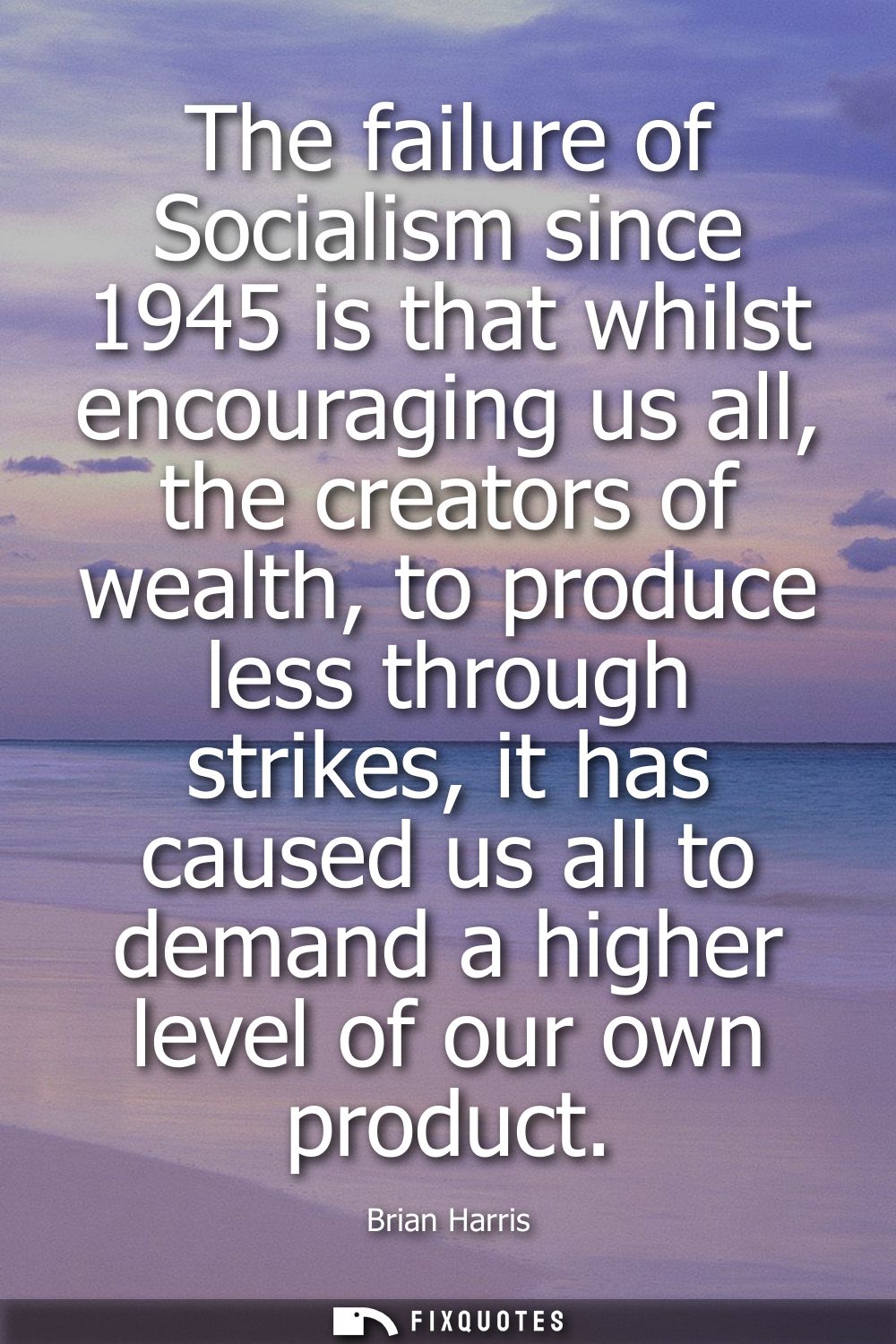
"The failure of Socialism since 1945 is that whilst encouraging us all, the creators of wealth, to produce less through strikes, it has caused us all to demand a higher level of our own product"
About this Quote
The sentence is engineered around a tidy contradiction: socialism “encouraging…to produce less through strikes” while also making “us all demand a higher level of our own product.” The subtext is that labor militancy is indulgent and self-defeating, an attempt to have comfort without cost. Strikes, in this framing, aren’t leverage in a bargaining relationship; they’re treated as sabotage of the common store. Harris borrows the language of collective responsibility to argue against collective action.
The context cue “since 1945” matters. Postwar Britain and Western Europe saw the welfare state expand alongside strong unions, nationalization, and periodic industrial conflict, then the 1970s stagflation and “winter of discontent” narratives that right-leaning writers used to indict labor power. Harris’s line rides that current: it converts a complex economic era into a moral fable about wanting “more” while doing “less.” It’s persuasive because it reduces systemic questions (productivity, capital investment, management, global shocks) to a personal vice, then recruits the reader into the “we” who has allegedly been wronged.
Quote Details
| Topic | Wealth |
|---|---|
| Source | Help us find the source |
| Cite |
Citation Formats
APA Style (7th ed.)
Harris, Brian. (2026, January 16). The failure of Socialism since 1945 is that whilst encouraging us all, the creators of wealth, to produce less through strikes, it has caused us all to demand a higher level of our own product. FixQuotes. https://fixquotes.com/quotes/the-failure-of-socialism-since-1945-is-that-132009/
Chicago Style
Harris, Brian. "The failure of Socialism since 1945 is that whilst encouraging us all, the creators of wealth, to produce less through strikes, it has caused us all to demand a higher level of our own product." FixQuotes. January 16, 2026. https://fixquotes.com/quotes/the-failure-of-socialism-since-1945-is-that-132009/.
MLA Style (9th ed.)
"The failure of Socialism since 1945 is that whilst encouraging us all, the creators of wealth, to produce less through strikes, it has caused us all to demand a higher level of our own product." FixQuotes, 16 Jan. 2026, https://fixquotes.com/quotes/the-failure-of-socialism-since-1945-is-that-132009/. Accessed 4 Apr. 2026.