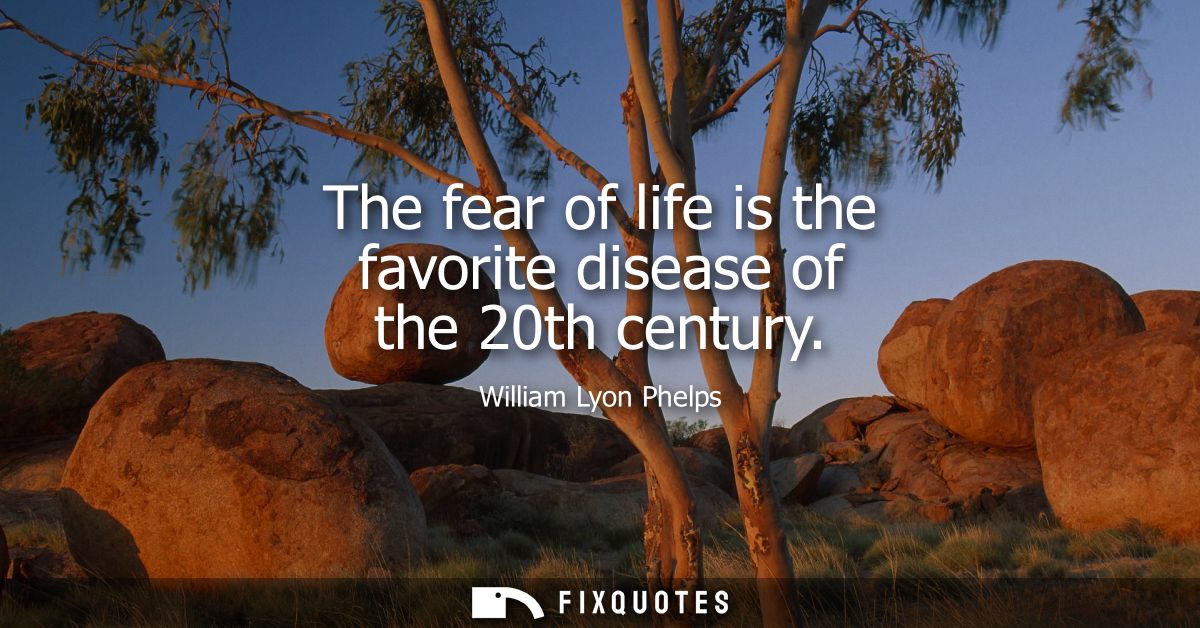
"The fear of life is the favorite disease of the 20th century"
About this Quote
A “favorite disease” isn’t just common; it’s chosen, indulged, almost worn like a badge. That sly medical metaphor lets William Lyon Phelps diagnose an era without sounding like he’s merely scolding it. “Fear of life” names something broader than anxiety about death. It’s recoil from the mess of modern living: risk, ambiguity, desire, conflict, the obligation to decide. Phelps frames that recoil as pathology, implying it spreads socially, gets normalized, even becomes fashionable.
The 20th century was a perfect incubator. Mass war, industrial accidents, economic whiplash, and the rise of large institutions all trained people to think in systems and statistics rather than personal agency. Add the new, relentless feedback loops of mass media and advertising, and you get a culture that can feel perpetually on alert, perpetually behind, perpetually measured. “Fear of life” becomes the hidden cost of a world promising safety through expertise, rules, and managed emotion. Phelps, as an educator, would have seen it in miniature: students hedging against failure, avoiding conviction, preferring cynicism to commitment because cynicism can’t be disproved.
The jab lands because it flips the century’s self-image. The 1900s liked to call itself modern, progressive, brave. Phelps suggests its signature trait is not daring but avoidance: choosing the comfort of caution over the vulnerability of participation. The subtext is a plea for a more muscular kind of living - not reckless, but unafraid to be implicated, to act without guarantees, to accept that vitality always comes with exposure.
The 20th century was a perfect incubator. Mass war, industrial accidents, economic whiplash, and the rise of large institutions all trained people to think in systems and statistics rather than personal agency. Add the new, relentless feedback loops of mass media and advertising, and you get a culture that can feel perpetually on alert, perpetually behind, perpetually measured. “Fear of life” becomes the hidden cost of a world promising safety through expertise, rules, and managed emotion. Phelps, as an educator, would have seen it in miniature: students hedging against failure, avoiding conviction, preferring cynicism to commitment because cynicism can’t be disproved.
The jab lands because it flips the century’s self-image. The 1900s liked to call itself modern, progressive, brave. Phelps suggests its signature trait is not daring but avoidance: choosing the comfort of caution over the vulnerability of participation. The subtext is a plea for a more muscular kind of living - not reckless, but unafraid to be implicated, to act without guarantees, to accept that vitality always comes with exposure.
Quote Details
| Topic | Fear |
|---|---|
| Source | Unverified source: Essays on Things (William Lyon Phelps, 1930)
Evidence: The fear of life is the favourite disease of the twentieth century. (Chapter IX, “One Day at a Time” (book page 47 in the Gutenberg/HathiTrust scan; printed pages in that chapter run 45–50)). This sentence appears in William Lyon Phelps’s essay “One Day at a Time” within his book Essays on Things... Other candidates (1) Motivational Phrases for All of Life's Challenges! (K. J. Roberts, 2011) compilation95.0% K. J. Roberts. The fear of life is the favorite Disease of the 20th century . William Lyon Phelps You must never make... |
| Cite |
Citation Formats
APA Style (7th ed.)
Phelps, William Lyon. (2026, February 24). The fear of life is the favorite disease of the 20th century. FixQuotes. https://fixquotes.com/quotes/the-fear-of-life-is-the-favorite-disease-of-the-64121/
Chicago Style
Phelps, William Lyon. "The fear of life is the favorite disease of the 20th century." FixQuotes. February 24, 2026. https://fixquotes.com/quotes/the-fear-of-life-is-the-favorite-disease-of-the-64121/.
MLA Style (9th ed.)
"The fear of life is the favorite disease of the 20th century." FixQuotes, 24 Feb. 2026, https://fixquotes.com/quotes/the-fear-of-life-is-the-favorite-disease-of-the-64121/. Accessed 27 Mar. 2026.
More Quotes by William
Add to List