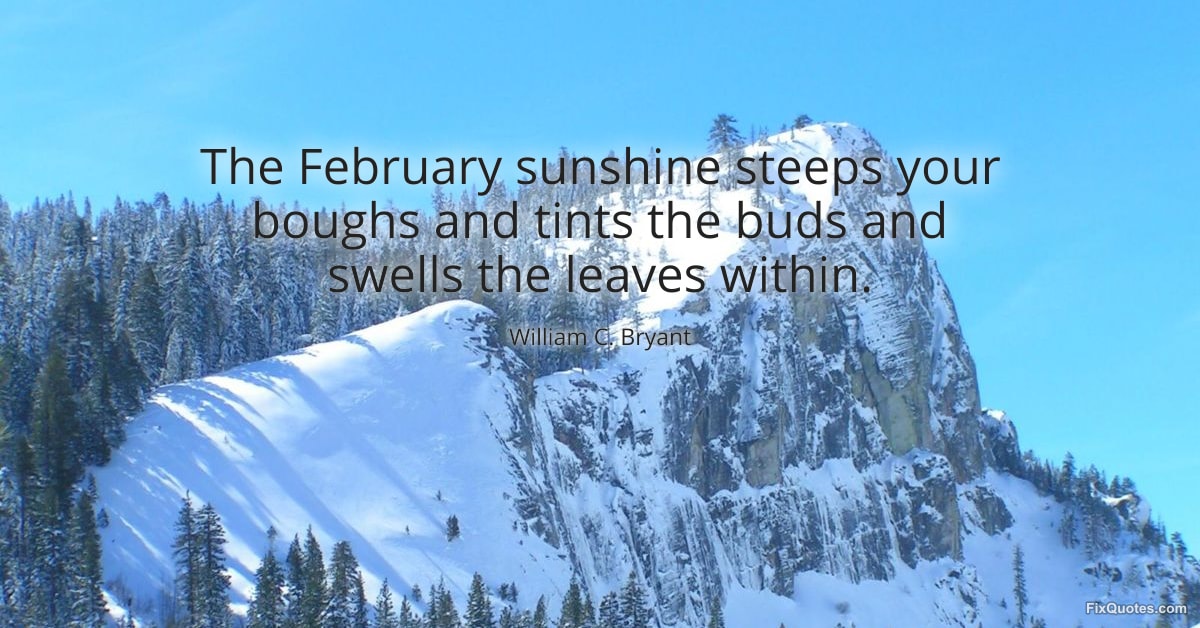
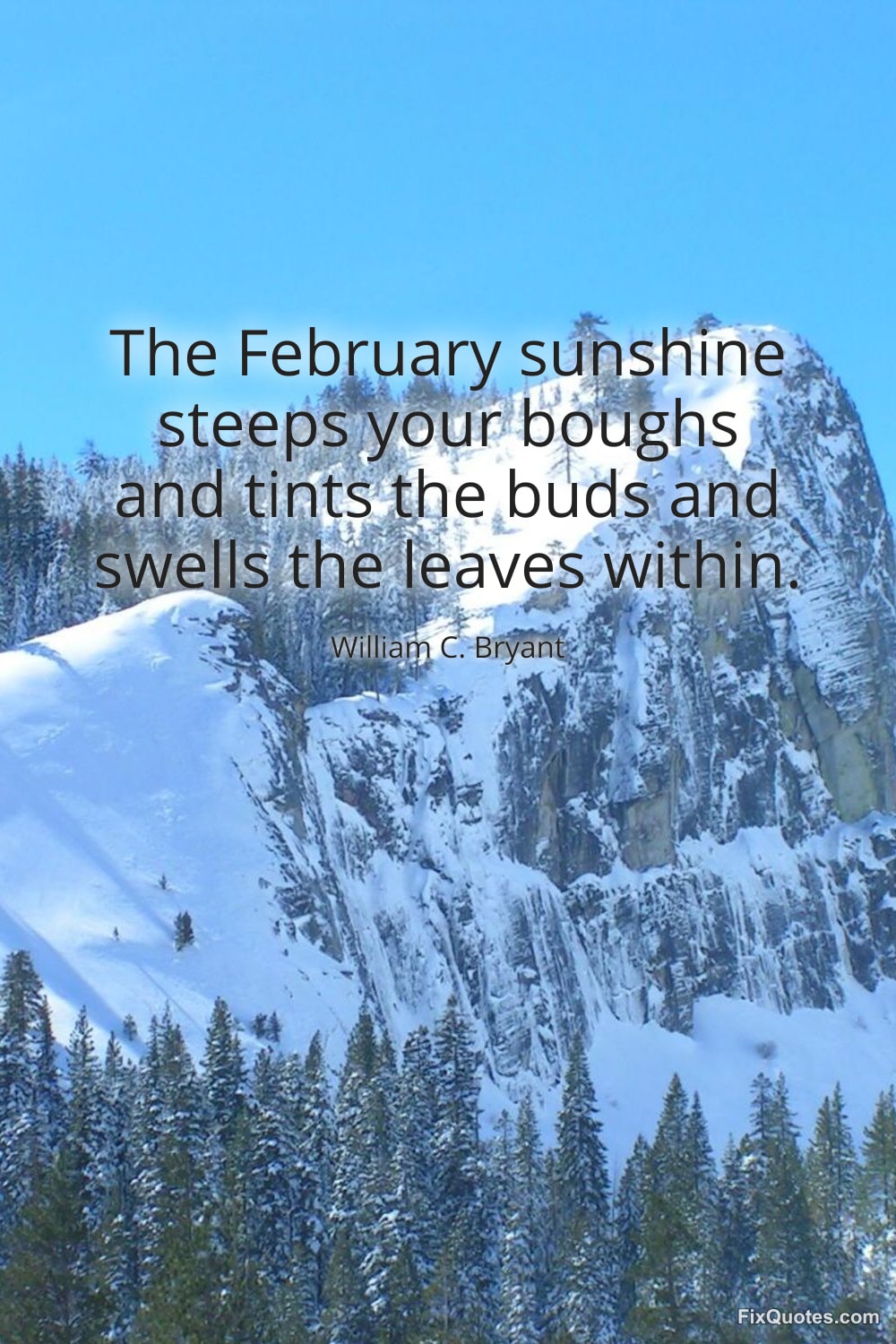
"The February sunshine steeps your boughs and tints the buds and swells the leaves within"
About this Quote
The subtext is Bryant’s favorite argument: nature as moral instruction without the sermon. February becomes the proof that revival begins before it’s obvious, that change is often biochemical before it’s public. “Tints” and “swells” are gentle, domestic verbs; they refuse drama. Even the alliteration and soft consonants (boughs/buds) create a hush, as if the speaker is leaning in so as not to disturb the work being done.
Contextually, Bryant - a major American Romantic steeped in the New England seasonal imagination - writes in a culture that prized nature as both refuge and authority. The line reads like an antidote to political noise and urban acceleration: a reminder that the world’s most reliable revolutions happen quietly, on a timetable that doesn’t care about our impatience.
Quote Details
| Topic | Spring |
|---|---|
| Source | Verified source: Among the Trees (William C. Bryant, 1874)
Evidence: The February sunshine steeps your boughs And tints the buds and swells the leaves within;. This line is from William Cullen Bryant’s poem “Among the Trees.” Many quote sites shorten the attribution to “William C. Bryant,” but the poet’s standard name is William Cullen Bryant (1794–1878). A standalone 1874 publication of “Among the Trees” is cataloged by Google Books with publisher G. P. Putnam’s Sons. I also verified the exact wording in a full-text transcription of the poem (non-primary transcription) to confirm line breaks and punctuation. I did not find, within this search pass, an earlier first-publication appearance (e.g., magazine printing or inclusion in an earlier collected volume) that can be confirmed from a digitized primary source scan; therefore, the ‘first published’ claim cannot be made with high confidence from the evidence gathered here. Other candidates (1) The Complete Poems of William Cullen Bryant (William Cullen Bryant, 1894) compilation95.0% William Cullen Bryant Harry C. Edwards. AMONG THE TREES . And health to the belovèd sufferers . But ye , while ... Th... |
| Cite |
Citation Formats
APA Style (7th ed.)
Bryant, William C. (2026, February 23). The February sunshine steeps your boughs and tints the buds and swells the leaves within. FixQuotes. https://fixquotes.com/quotes/the-february-sunshine-steeps-your-boughs-and-96501/
Chicago Style
Bryant, William C. "The February sunshine steeps your boughs and tints the buds and swells the leaves within." FixQuotes. February 23, 2026. https://fixquotes.com/quotes/the-february-sunshine-steeps-your-boughs-and-96501/.
MLA Style (9th ed.)
"The February sunshine steeps your boughs and tints the buds and swells the leaves within." FixQuotes, 23 Feb. 2026, https://fixquotes.com/quotes/the-february-sunshine-steeps-your-boughs-and-96501/. Accessed 20 Mar. 2026.