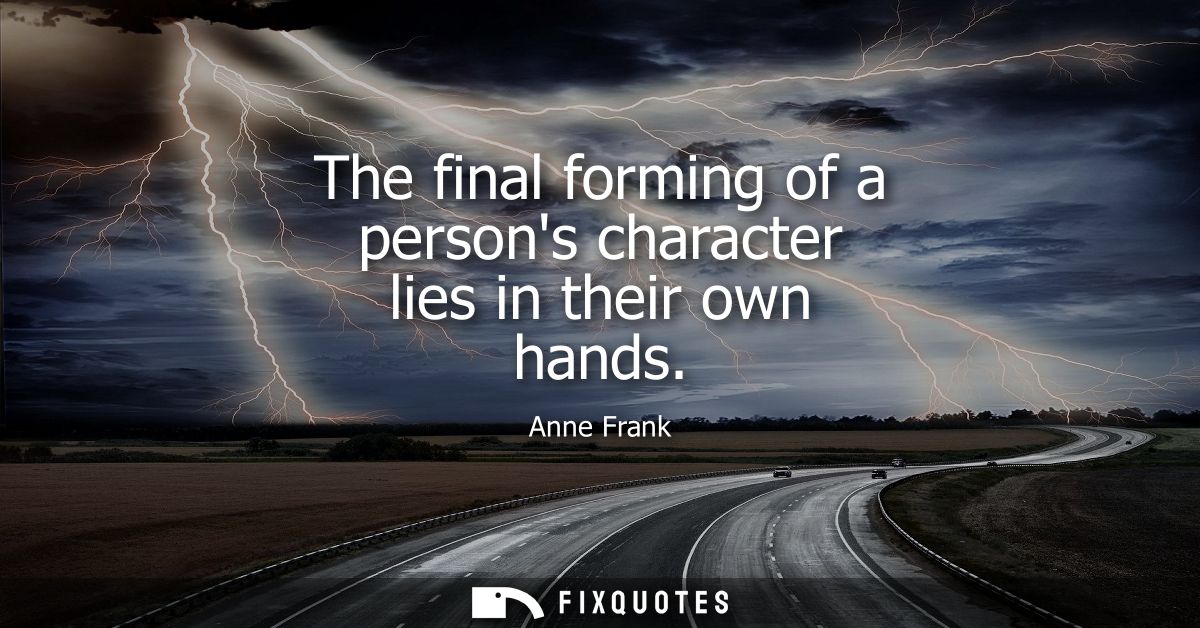
"The final forming of a person's character lies in their own hands"
About this Quote
A teenager in hiding insisting on personal agency is not cute optimism; it is a defiant kind of realism. Anne Frank writes this with the knowledge that almost everything around her is being decided by other people: governments, soldiers, informants, the random cruelty of paperwork and raids. Against that machinery, “the final forming” is a pointed phrase. She concedes the pressure of circumstance while reserving one stubborn territory the Nazis can’t fully occupy: the self that chooses how to respond.
The line’s intent is self-discipline as survival. It’s a private pep talk, but also a moral stake in the ground: if you can’t control the plot, you can still control the person you become inside it. “Lies in their own hands” borrows the language of craft and labor, like character is something shaped day by day, not granted by birth or revoked by terror. That framing matters in a diary, a genre built on the daily accumulation of small choices and shifting moods.
The subtext carries a quiet rebuke to fatalism. Frank is pushing back against the idea that suffering automatically ennobles or that oppression automatically corrupts. Character, she implies, is neither a halo nor a scar; it’s a practice. In context, written amid confinement and fear, the sentence becomes less motivational poster and more ethical refusal: they can narrow her world, but they don’t get the last word on who she is.
The line’s intent is self-discipline as survival. It’s a private pep talk, but also a moral stake in the ground: if you can’t control the plot, you can still control the person you become inside it. “Lies in their own hands” borrows the language of craft and labor, like character is something shaped day by day, not granted by birth or revoked by terror. That framing matters in a diary, a genre built on the daily accumulation of small choices and shifting moods.
The subtext carries a quiet rebuke to fatalism. Frank is pushing back against the idea that suffering automatically ennobles or that oppression automatically corrupts. Character, she implies, is neither a halo nor a scar; it’s a practice. In context, written amid confinement and fear, the sentence becomes less motivational poster and more ethical refusal: they can narrow her world, but they don’t get the last word on who she is.
Quote Details
| Topic | Self-Improvement |
|---|---|
| Source | The Diary of a Young Girl — Anne Frank (diary entry; original Dutch edition 1947). Commonly cited as appearing in her diary. |
| Cite |
Citation Formats
APA Style (7th ed.)
Frank, Anne. (2026, January 17). The final forming of a person's character lies in their own hands. FixQuotes. https://fixquotes.com/quotes/the-final-forming-of-a-persons-character-lies-in-29872/
Chicago Style
Frank, Anne. "The final forming of a person's character lies in their own hands." FixQuotes. January 17, 2026. https://fixquotes.com/quotes/the-final-forming-of-a-persons-character-lies-in-29872/.
MLA Style (9th ed.)
"The final forming of a person's character lies in their own hands." FixQuotes, 17 Jan. 2026, https://fixquotes.com/quotes/the-final-forming-of-a-persons-character-lies-in-29872/. Accessed 22 Mar. 2026.
More Quotes by Anne
Add to List