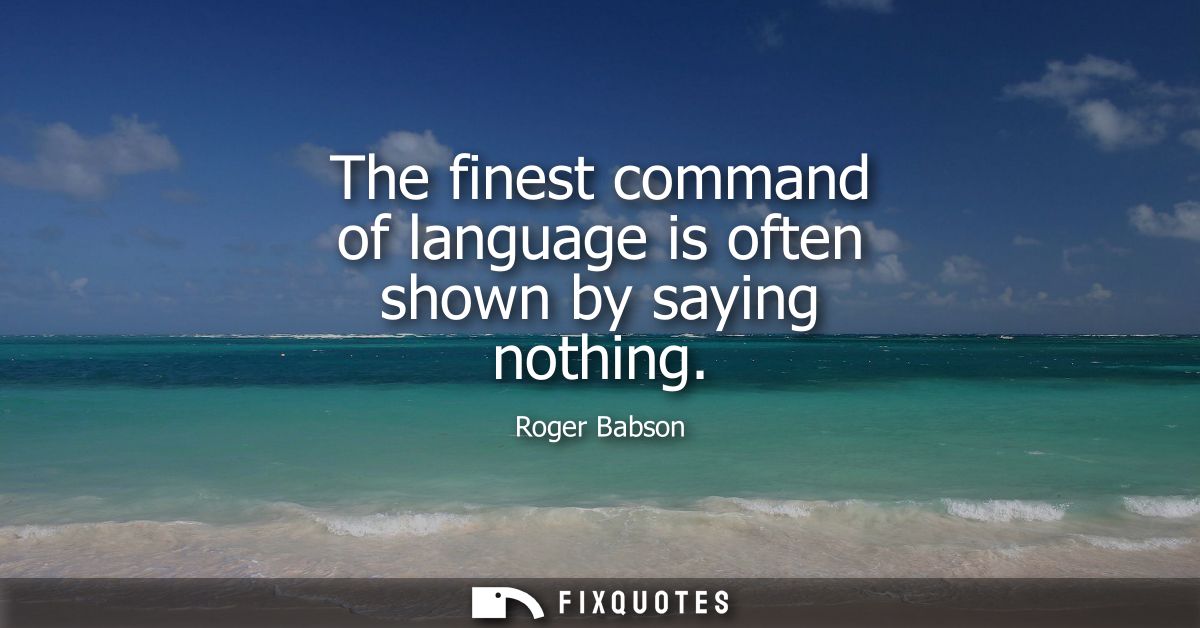
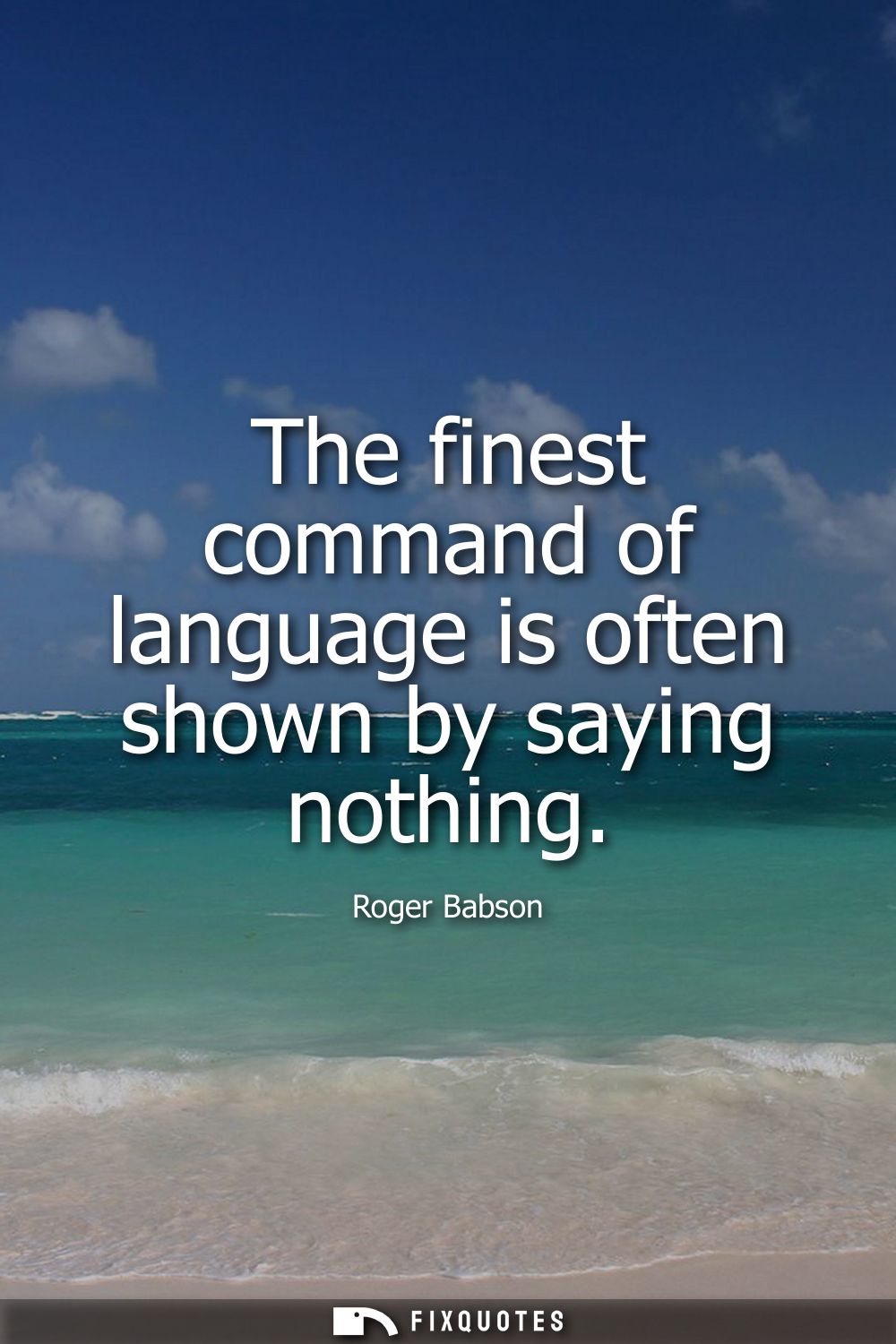
"The finest command of language is often shown by saying nothing"
About this Quote
Babson’s line flatters the quiet person in the room, but it’s also a rebuke to a culture that confuses verbal output with competence. “Finest command of language” is a sly inversion: mastery isn’t measured by how many words you can deploy, but by the discipline to withhold them. The phrasing turns silence into an active verb. Saying nothing isn’t absence; it’s a choice made by someone who knows what language can do when it’s released carelessly.
The intent reads pedagogical and managerial at once. As an educator (and a figure shaped by early 20th-century American practicality), Babson is pointing to restraint as a tool of authority. Silence can create space for others to think, force a speaker to confront their own assumptions, or keep power from leaking into defensiveness. In classrooms, meetings, negotiations, “nothing” can be a calibrated prompt: it lets the other side fill the void, revealing priorities and insecurities.
The subtext is less serene. Silence also functions as a social weapon: a way to refuse engagement, to set terms, to maintain superiority. Babson’s aphorism borrows the prestige of eloquence to justify non-eloquence, which is why it lands. It gives the introvert a halo and the disciplined communicator a standard: the real flex isn’t the perfect sentence, it’s knowing when the sentence would make things worse.
The intent reads pedagogical and managerial at once. As an educator (and a figure shaped by early 20th-century American practicality), Babson is pointing to restraint as a tool of authority. Silence can create space for others to think, force a speaker to confront their own assumptions, or keep power from leaking into defensiveness. In classrooms, meetings, negotiations, “nothing” can be a calibrated prompt: it lets the other side fill the void, revealing priorities and insecurities.
The subtext is less serene. Silence also functions as a social weapon: a way to refuse engagement, to set terms, to maintain superiority. Babson’s aphorism borrows the prestige of eloquence to justify non-eloquence, which is why it lands. It gives the introvert a halo and the disciplined communicator a standard: the real flex isn’t the perfect sentence, it’s knowing when the sentence would make things worse.
Quote Details
| Topic | Wisdom |
|---|---|
| Source | Help us find the source |
| Cite |
Citation Formats
APA Style (7th ed.)
Babson, Roger. (2026, January 15). The finest command of language is often shown by saying nothing. FixQuotes. https://fixquotes.com/quotes/the-finest-command-of-language-is-often-shown-by-160854/
Chicago Style
Babson, Roger. "The finest command of language is often shown by saying nothing." FixQuotes. January 15, 2026. https://fixquotes.com/quotes/the-finest-command-of-language-is-often-shown-by-160854/.
MLA Style (9th ed.)
"The finest command of language is often shown by saying nothing." FixQuotes, 15 Jan. 2026, https://fixquotes.com/quotes/the-finest-command-of-language-is-often-shown-by-160854/. Accessed 7 Feb. 2026.
More Quotes by Roger
Add to List