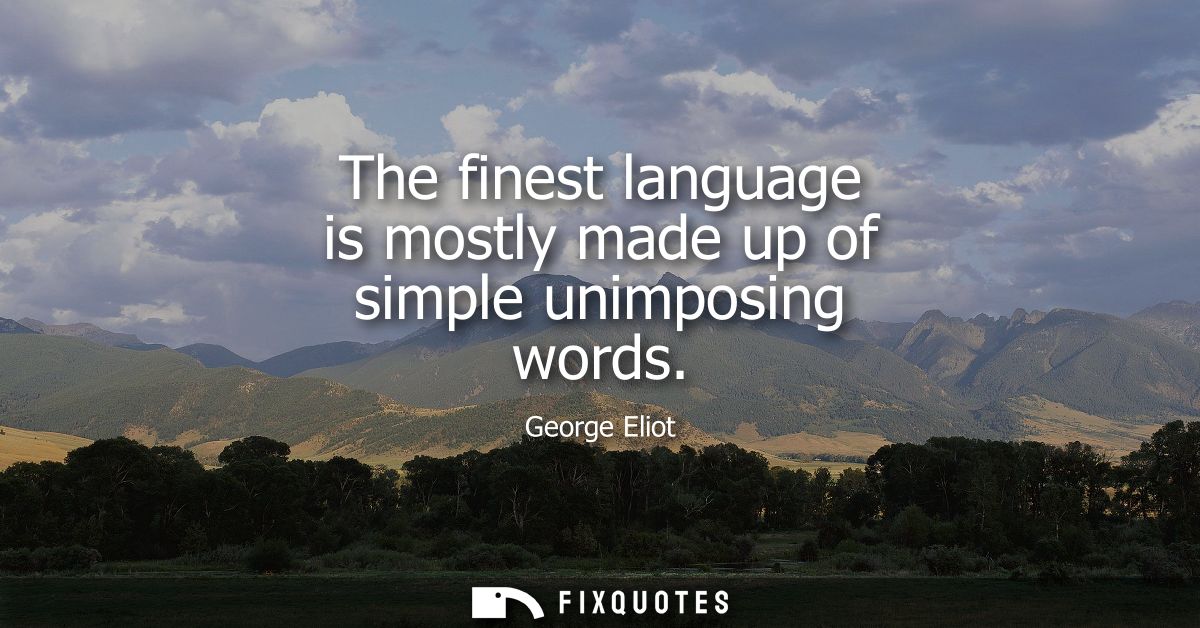
"The finest language is mostly made up of simple unimposing words"
About this Quote
Eliot’s barb lands because it refuses the Victorian era’s favorite costume: grandeur for grandeur’s sake. “Finest language” sounds like a prize for ornament, but she pivots hard to “simple unimposing words,” downgrading the chandelier vocabulary that signaled class, education, and moral authority in her time. The line is a quiet manifesto for realism. Eliot built whole moral universes out of ordinary lives; she’s arguing that prose should do the same, letting the weight come from accuracy and feeling rather than from showy diction.
The intent isn’t anti-intellectual so much as anti-pretension. “Mostly” matters: she’s not banning the occasional technical term or poetic flourish. She’s insisting that the engine of great writing is the common word placed with uncommon exactness. That’s a craft claim and a political one. In a culture where polished speech could function like a gatekeeping credential, praising “unimposing” language is a way of shifting authority away from performance and toward perception.
Subtext: plainness is not the absence of style; it’s a style disciplined enough to disappear. Simple words are also the words we share, the ones that travel across households and social ranks. Eliot’s sentence flatters the reader’s ear while warning the writer: if you need elaborate vocabulary to sound profound, you probably aren’t. The finest language, she implies, doesn’t announce itself. It convinces you it was inevitable.
The intent isn’t anti-intellectual so much as anti-pretension. “Mostly” matters: she’s not banning the occasional technical term or poetic flourish. She’s insisting that the engine of great writing is the common word placed with uncommon exactness. That’s a craft claim and a political one. In a culture where polished speech could function like a gatekeeping credential, praising “unimposing” language is a way of shifting authority away from performance and toward perception.
Subtext: plainness is not the absence of style; it’s a style disciplined enough to disappear. Simple words are also the words we share, the ones that travel across households and social ranks. Eliot’s sentence flatters the reader’s ear while warning the writer: if you need elaborate vocabulary to sound profound, you probably aren’t. The finest language, she implies, doesn’t announce itself. It convinces you it was inevitable.
Quote Details
| Topic | Writing |
|---|---|
| Source | Help us find the source |
| Cite |
Citation Formats
APA Style (7th ed.)
Eliot, George. (2026, January 17). The finest language is mostly made up of simple unimposing words. FixQuotes. https://fixquotes.com/quotes/the-finest-language-is-mostly-made-up-of-simple-28257/
Chicago Style
Eliot, George. "The finest language is mostly made up of simple unimposing words." FixQuotes. January 17, 2026. https://fixquotes.com/quotes/the-finest-language-is-mostly-made-up-of-simple-28257/.
MLA Style (9th ed.)
"The finest language is mostly made up of simple unimposing words." FixQuotes, 17 Jan. 2026, https://fixquotes.com/quotes/the-finest-language-is-mostly-made-up-of-simple-28257/. Accessed 3 Apr. 2026.
More Quotes by George
Add to List