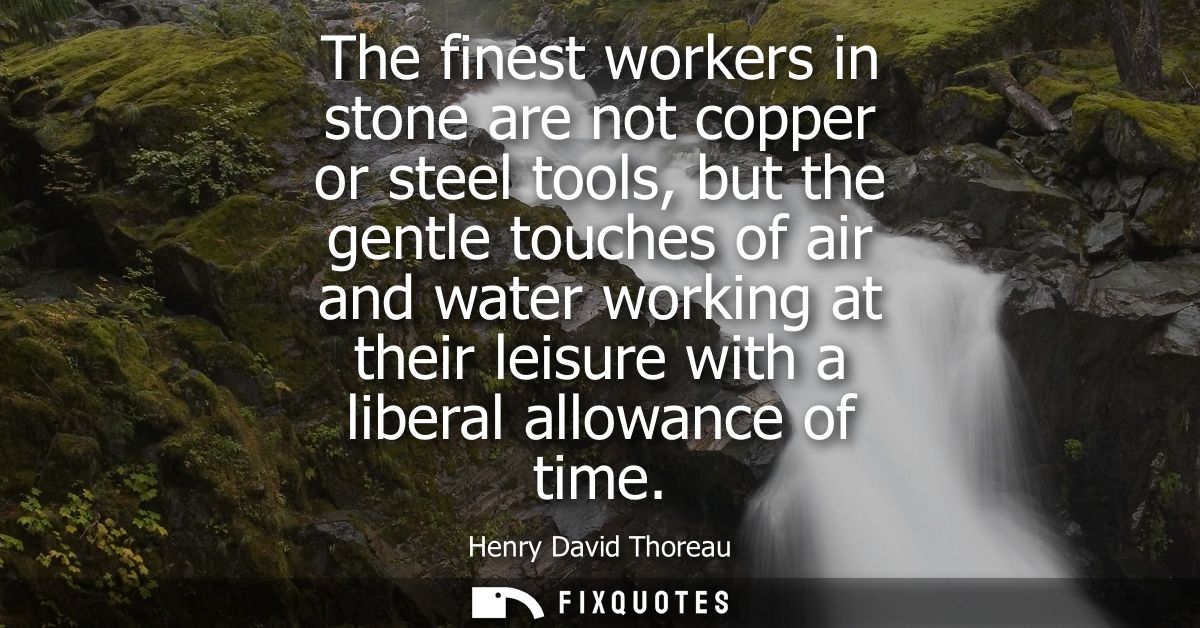
"The finest workers in stone are not copper or steel tools, but the gentle touches of air and water working at their leisure with a liberal allowance of time"
About this Quote
Thoreau’s best trick is making slowness feel like a dare. By crediting “air and water” as the master craftsmen of stone, he demotes the usual heroes of progress - copper, steel, the human hand - and elevates forces that don’t look like force at all. The line flatters patience into a kind of power: nature doesn’t win by brute strength, it wins by refusing the schedule.
The intent is less geology than ethics. Thoreau is smuggling a critique of industrial confidence into a pastoral image: if the era’s shiny tools promise instant transformation, erosion offers a rebuke that’s both quieter and more absolute. Stone yields, not to the loudest impact, but to repetition plus time. That “liberal allowance of time” is doing cultural work. It implies that modern life is stingy with time, hoarding it, treating it as fuel to burn rather than a medium things need in order to become true.
The subtext also carries a spiritual and political edge typical of Thoreau. The same author who distrusted institutions and refused to cooperate with the state is hinting that the most consequential changes may be noncompliant, incremental, almost invisible. Air and water “at their leisure” suggest an alternate model of agency: persistent, unbothered, hard to police.
Context matters: mid-19th century America was accelerating - railroads, factories, extraction, expansion. Thoreau answers that acceleration with a counter-myth of shaping: real workmanship isn’t speed and spectacle, it’s the long, indifferent art of time.
The intent is less geology than ethics. Thoreau is smuggling a critique of industrial confidence into a pastoral image: if the era’s shiny tools promise instant transformation, erosion offers a rebuke that’s both quieter and more absolute. Stone yields, not to the loudest impact, but to repetition plus time. That “liberal allowance of time” is doing cultural work. It implies that modern life is stingy with time, hoarding it, treating it as fuel to burn rather than a medium things need in order to become true.
The subtext also carries a spiritual and political edge typical of Thoreau. The same author who distrusted institutions and refused to cooperate with the state is hinting that the most consequential changes may be noncompliant, incremental, almost invisible. Air and water “at their leisure” suggest an alternate model of agency: persistent, unbothered, hard to police.
Context matters: mid-19th century America was accelerating - railroads, factories, extraction, expansion. Thoreau answers that acceleration with a counter-myth of shaping: real workmanship isn’t speed and spectacle, it’s the long, indifferent art of time.
Quote Details
| Topic | Nature |
|---|---|
| Source | Help us find the source |
More Quotes by Henry
Add to List