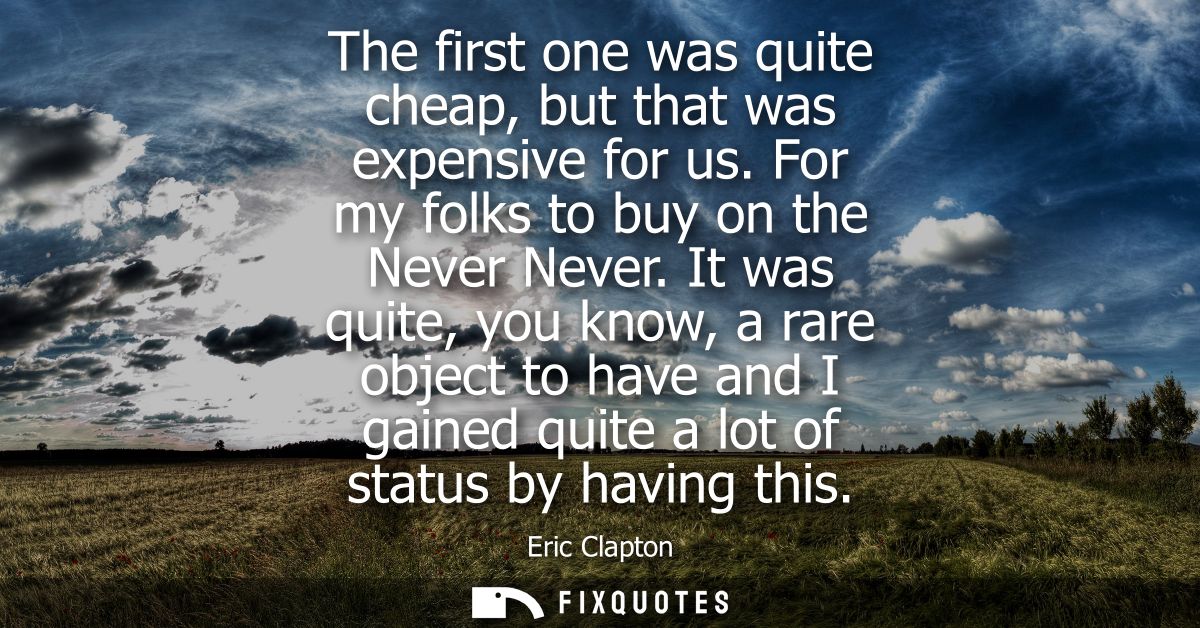
"The first one was quite cheap, but that was expensive for us. For my folks to buy on the Never Never. It was quite, you know, a rare object to have and I gained quite a lot of status by having this"
About this Quote
“Never Never” (hire purchase, payment plans) carries a faint shame and a lot of truth. It’s a working-class workaround dressed up as consumer normality, and Clapton doesn’t romanticize it. He lets the phrase do the work: the guitar arrives already haunted by debt, by parents stretching themselves, by the quiet pressure not to waste the opportunity. You can hear the emotional double-entry bookkeeping underneath the casual delivery.
Then comes the social alchemy: a “rare object,” “status,” “quite a lot.” The repetition of “quite” is doing cultural work too, as if understatement is the only acceptable way to admit how badly the object mattered. The guitar is less a tool than a passport, a physical credential in a world where belonging is policed by what you can show, hold, play. Clapton frames the instrument as early branding before branding was a word: an item that confers identity, credibility, and a place in a peer hierarchy. In that light, the quote isn’t nostalgia; it’s a clear-eyed account of how aspiration gets financed, and how quickly music becomes a social language.
Quote Details
| Topic | Money |
|---|---|
| Source | Help us find the source |
| Cite |
Citation Formats
APA Style (7th ed.)
Clapton, Eric. (2026, January 18). The first one was quite cheap, but that was expensive for us. For my folks to buy on the Never Never. It was quite, you know, a rare object to have and I gained quite a lot of status by having this. FixQuotes. https://fixquotes.com/quotes/the-first-one-was-quite-cheap-but-that-was-7072/
Chicago Style
Clapton, Eric. "The first one was quite cheap, but that was expensive for us. For my folks to buy on the Never Never. It was quite, you know, a rare object to have and I gained quite a lot of status by having this." FixQuotes. January 18, 2026. https://fixquotes.com/quotes/the-first-one-was-quite-cheap-but-that-was-7072/.
MLA Style (9th ed.)
"The first one was quite cheap, but that was expensive for us. For my folks to buy on the Never Never. It was quite, you know, a rare object to have and I gained quite a lot of status by having this." FixQuotes, 18 Jan. 2026, https://fixquotes.com/quotes/the-first-one-was-quite-cheap-but-that-was-7072/. Accessed 14 Mar. 2026.