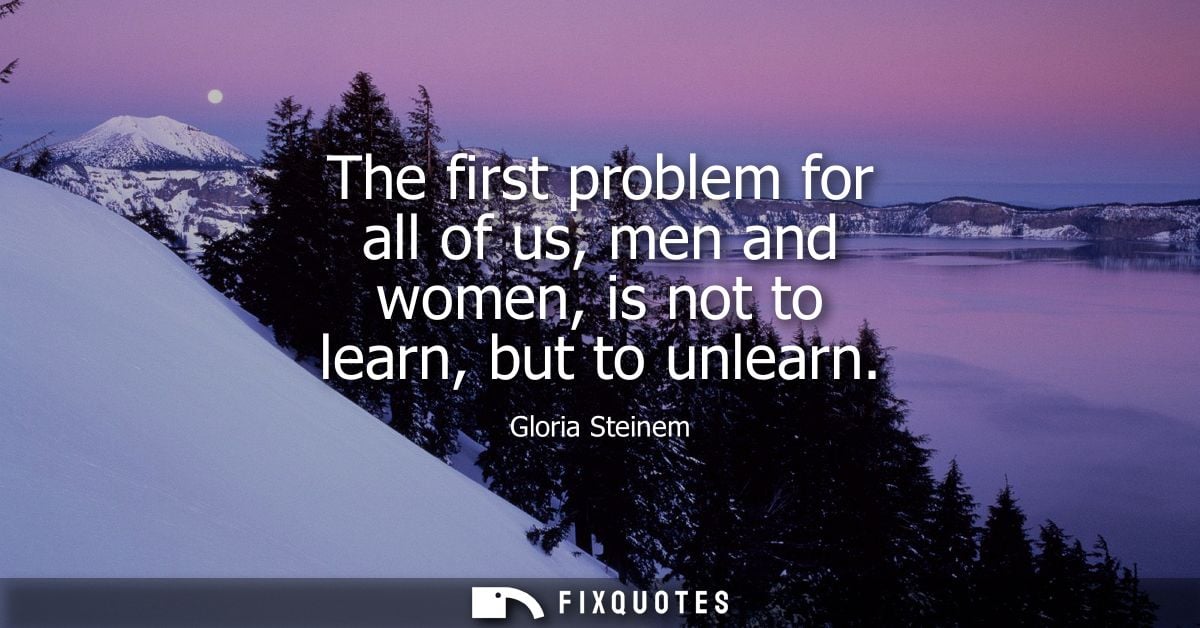
"The first problem for all of us, men and women, is not to learn, but to unlearn"
About this Quote
The syntax does quiet, strategic work. “The first problem” frames social transformation as triage; before you chase new theories, you have to stop the bleeding from old ones. “For all of us, men and women” is coalition language with an edge: patriarchy isn’t just something men do to women, it’s a training program everyone graduates from. That universality isn’t sentimental; it’s accusatory. If everyone’s been schooled in these assumptions, then everyone has homework.
The subtext is about power and comfort. Learning can flatter the learner; unlearning threatens identity. It asks people to admit that what they were praised for - being “ladylike,” being “a real man,” being “not political” - was a script. In the context of second-wave feminism’s push against institutions (work, marriage, media), Steinem’s point is tactical: you don’t win by sprinkling new facts over old hierarchies. You win by making the inherited story feel untenable, then offering something better to replace it.
Quote Details
| Topic | Change |
|---|---|
| Source | Later attribution: Problem Solving (J.G. Ferguson Publishing Company, Dan..., 2004) modern compilationISBN: 9780816055227 · ID: Rc8KI_gBq7YC
Evidence:
... The first problem for all of us, men and women, is not to learn, but to unlearn. —Gloria Steinem, author and feminist leader Learn to Avoid Hasty Generalizations Kathy is failing history. Alfred is failing history. Even Zack, Brad ... |
| Cite |
Citation Formats
APA Style (7th ed.)
Steinem, Gloria. (2026, February 25). The first problem for all of us, men and women, is not to learn, but to unlearn. FixQuotes. https://fixquotes.com/quotes/the-first-problem-for-all-of-us-men-and-women-is-48532/
Chicago Style
Steinem, Gloria. "The first problem for all of us, men and women, is not to learn, but to unlearn." FixQuotes. February 25, 2026. https://fixquotes.com/quotes/the-first-problem-for-all-of-us-men-and-women-is-48532/.
MLA Style (9th ed.)
"The first problem for all of us, men and women, is not to learn, but to unlearn." FixQuotes, 25 Feb. 2026, https://fixquotes.com/quotes/the-first-problem-for-all-of-us-men-and-women-is-48532/. Accessed 3 Apr. 2026.