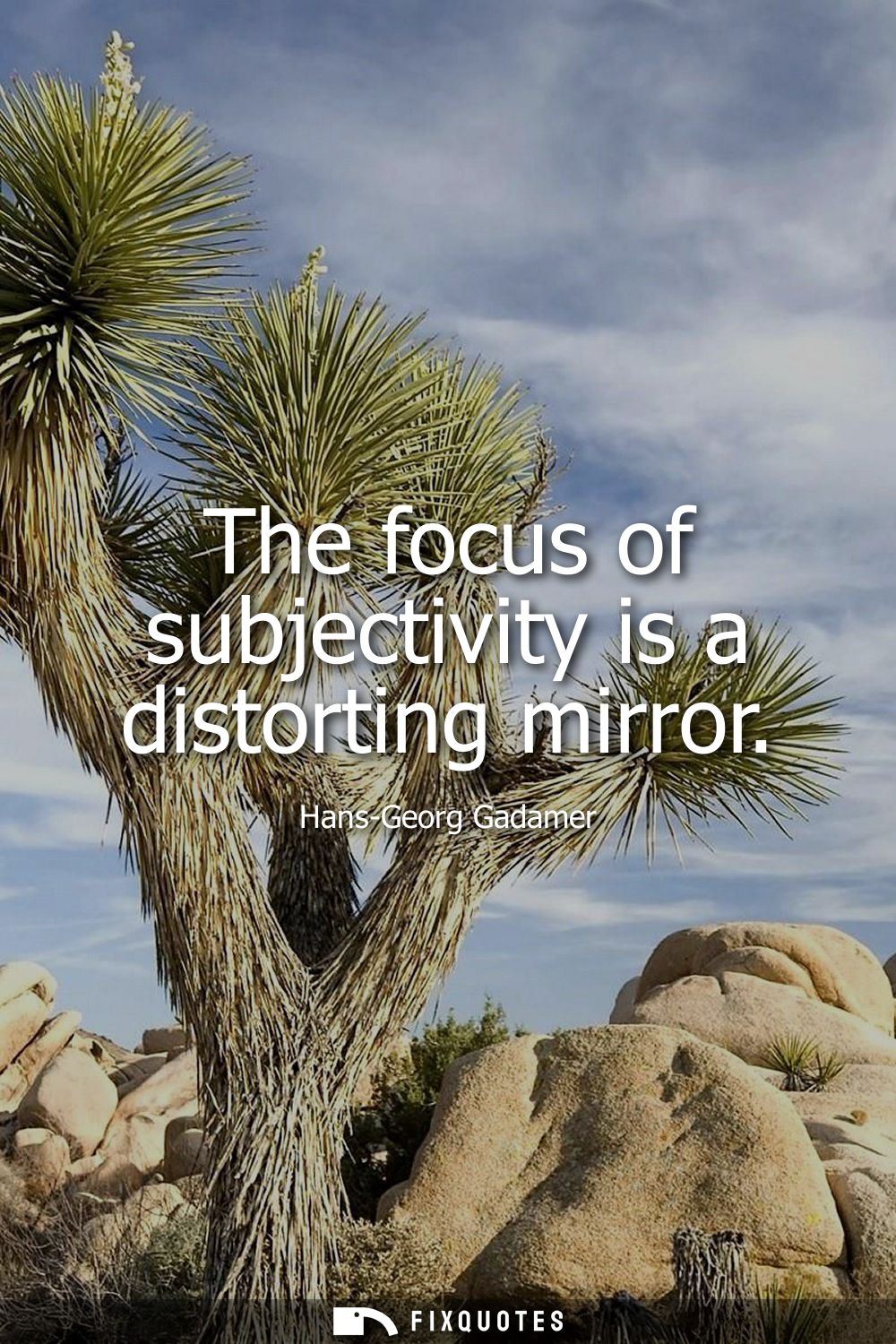
"The focus of subjectivity is a distorting mirror"
About this Quote
Gadamer lands the line like a quiet warning to anyone tempted by the romance of pure “authentic” experience. Subjectivity feels like the closest thing we have to truth - first-person, unmediated, indisputable. He calls it a “focus” to puncture that fantasy: the self doesn’t just witness the world, it concentrates it, like a lens. And concentrated vision is never neutral. It sharpens some features, blurs others, and warps proportions until what’s nearest to “me” looks huge and what’s distant looks negligible.
The “distorting mirror” is doing double duty. It’s not just that we misperceive; it’s that our self-understanding gets folded into what we think we’re seeing. A mirror suggests reflection and recognition, but distortion suggests vanity, anxiety, and miscalibration - the funhouse effect of taking our perspective as the measure of reality. Gadamer’s target isn’t ordinary bias so much as the philosophical tradition that imagines an isolated subject securing certainty by turning inward. He’s writing against the modern obsession with method and control (think Descartes to positivism), insisting that understanding is always interpretive, historically situated, and shaped by what he calls “prejudices” in the older sense: inherited assumptions that make understanding possible even as they limit it.
The subtext is bracingly democratic: no one gets to step outside interpretation, not the scientist, not the critic, not the philosopher. Clarity doesn’t come from purging subjectivity; it comes from testing it in dialogue - with texts, with others, with the stubbornness of tradition and language that refuses to be fully owned.
The “distorting mirror” is doing double duty. It’s not just that we misperceive; it’s that our self-understanding gets folded into what we think we’re seeing. A mirror suggests reflection and recognition, but distortion suggests vanity, anxiety, and miscalibration - the funhouse effect of taking our perspective as the measure of reality. Gadamer’s target isn’t ordinary bias so much as the philosophical tradition that imagines an isolated subject securing certainty by turning inward. He’s writing against the modern obsession with method and control (think Descartes to positivism), insisting that understanding is always interpretive, historically situated, and shaped by what he calls “prejudices” in the older sense: inherited assumptions that make understanding possible even as they limit it.
The subtext is bracingly democratic: no one gets to step outside interpretation, not the scientist, not the critic, not the philosopher. Clarity doesn’t come from purging subjectivity; it comes from testing it in dialogue - with texts, with others, with the stubbornness of tradition and language that refuses to be fully owned.
Quote Details
| Topic | Truth |
|---|---|
| Source | Help us find the source |
| Cite |
Citation Formats
APA Style (7th ed.)
Gadamer, Hans-Georg. (2026, January 16). The focus of subjectivity is a distorting mirror. FixQuotes. https://fixquotes.com/quotes/the-focus-of-subjectivity-is-a-distorting-mirror-130952/
Chicago Style
Gadamer, Hans-Georg. "The focus of subjectivity is a distorting mirror." FixQuotes. January 16, 2026. https://fixquotes.com/quotes/the-focus-of-subjectivity-is-a-distorting-mirror-130952/.
MLA Style (9th ed.)
"The focus of subjectivity is a distorting mirror." FixQuotes, 16 Jan. 2026, https://fixquotes.com/quotes/the-focus-of-subjectivity-is-a-distorting-mirror-130952/. Accessed 9 Mar. 2026.
More Quotes by Hans-Georg
Add to List