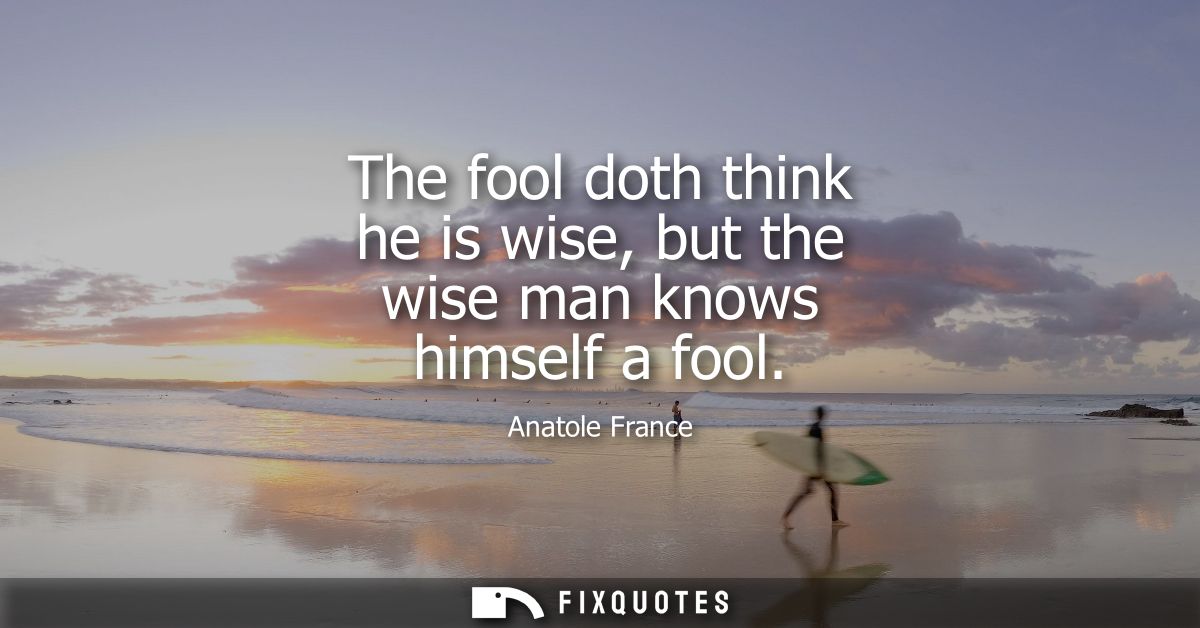
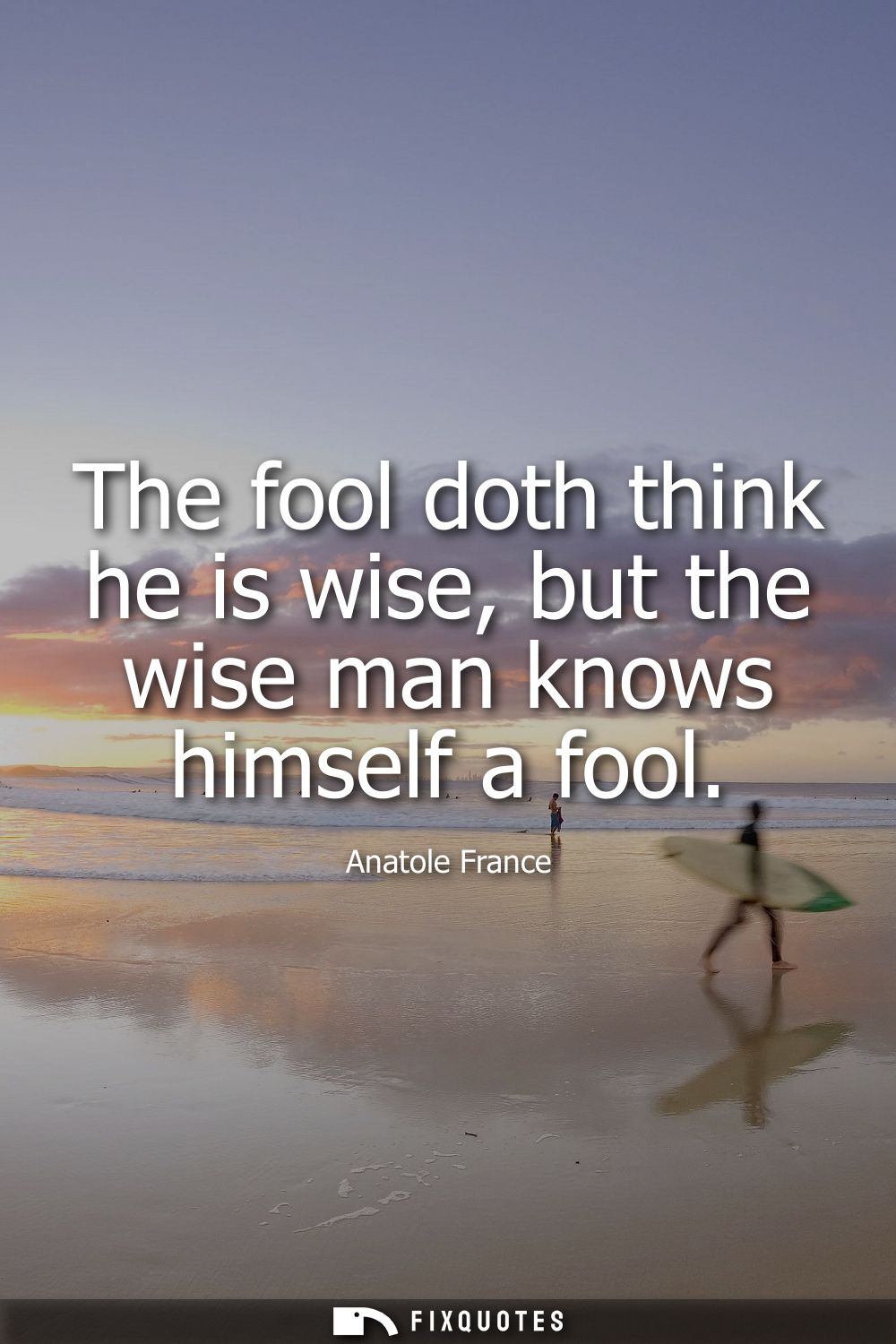
"The fool doth think he is wise, but the wise man knows himself a fool"
About this Quote
France was writing in a fin-de-siecle culture intoxicated with progress stories, scientific certainty, and the self-assurance of institutions. As a novelist steeped in irony and political disillusionment (his Dreyfusard commitments matter here), he had reason to distrust anyone who sounded too sure. The line reads like a diagnosis of public life: dogmatists flourish because certainty performs well, while actual intelligence tends to hesitate, qualify, and revise. Wisdom becomes less a trophy than a posture of permanent self-interrogation.
The subtext is quietly corrosive. It’s not praising self-deprecation for its own sake; it’s warning that certainty is often a comfort object - a way to avoid the discomfort of complexity, fallibility, and moral ambiguity. France’s intent lands as social critique: the people most eager to declare “I understand” are often the least equipped to, and the people worth listening to are the ones who can admit, without theatrics, how much they don’t know.
Quote Details
| Topic | Wisdom |
|---|---|
| Source | Shakespeare — As You Like It, Act V, Scene I (Touchstone). Line appears in the play; text printed in the First Folio (1623). |
| Cite |
Citation Formats
APA Style (7th ed.)
France, Anatole. (2026, January 15). The fool doth think he is wise, but the wise man knows himself a fool. FixQuotes. https://fixquotes.com/quotes/the-fool-doth-think-he-is-wise-but-the-wise-man-32971/
Chicago Style
France, Anatole. "The fool doth think he is wise, but the wise man knows himself a fool." FixQuotes. January 15, 2026. https://fixquotes.com/quotes/the-fool-doth-think-he-is-wise-but-the-wise-man-32971/.
MLA Style (9th ed.)
"The fool doth think he is wise, but the wise man knows himself a fool." FixQuotes, 15 Jan. 2026, https://fixquotes.com/quotes/the-fool-doth-think-he-is-wise-but-the-wise-man-32971/. Accessed 20 Mar. 2026.