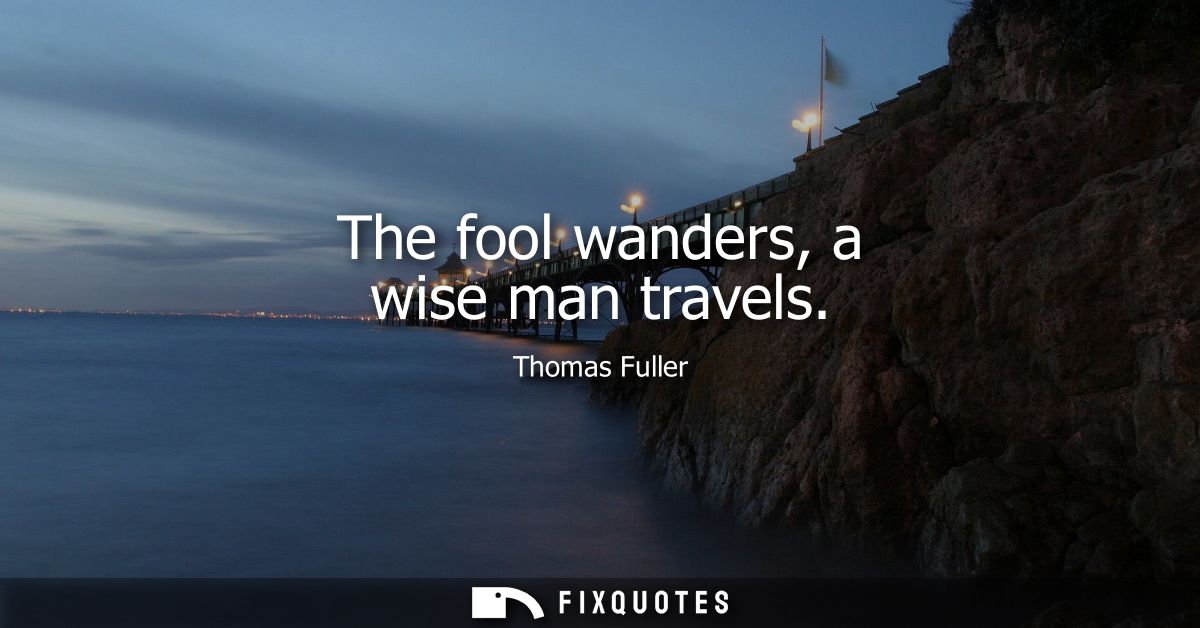
"The fool wanders, a wise man travels"
About this Quote
A moralist’s blade disguised as travel advice: Fuller isn’t praising movement, he’s policing motive. In seven words he builds a hierarchy that feels obvious only because it’s rhetorically tidy. “Wanders” suggests drift, appetite, distraction, the kind of motion that produces stories but not growth. “Travels” carries purpose, itinerary, and the period’s prized idea that experience should be converted into instruction. The line flatters the reader into choosing the better noun, then quietly implies that most people don’t.
Fuller, a 17th-century English clergyman writing in an age of sermons, civil strife, and expanding horizons, treats the world as a classroom with exams. This is Protestant self-discipline in miniature: not just where you go, but what you do with what you see. The fool consumes novelty; the wise man metabolizes it. Even the grammar performs the ethic. “A” fool versus “a” wise man: archetypes, not individuals. You’re meant to locate yourself in the parable and correct course.
The subtext also carries a social tell. Travel in Fuller’s England was becoming both more imaginable (through trade, exploration, and print) and more suspect (as vanity, Catholic contamination, or idle gentlemanly tourism). His distinction reassures the anxious: travel is acceptable if it returns as knowledge, piety, or practical wisdom. It’s a quote that sounds like freedom and reads like accountability.
That’s why it still lands in an era of cheap flights and algorithmic “must-sees.” Fuller anticipates the modern fear that movement can be a kind of evasion. The wise don’t just go somewhere else; they come back different on purpose.
Fuller, a 17th-century English clergyman writing in an age of sermons, civil strife, and expanding horizons, treats the world as a classroom with exams. This is Protestant self-discipline in miniature: not just where you go, but what you do with what you see. The fool consumes novelty; the wise man metabolizes it. Even the grammar performs the ethic. “A” fool versus “a” wise man: archetypes, not individuals. You’re meant to locate yourself in the parable and correct course.
The subtext also carries a social tell. Travel in Fuller’s England was becoming both more imaginable (through trade, exploration, and print) and more suspect (as vanity, Catholic contamination, or idle gentlemanly tourism). His distinction reassures the anxious: travel is acceptable if it returns as knowledge, piety, or practical wisdom. It’s a quote that sounds like freedom and reads like accountability.
That’s why it still lands in an era of cheap flights and algorithmic “must-sees.” Fuller anticipates the modern fear that movement can be a kind of evasion. The wise don’t just go somewhere else; they come back different on purpose.
Quote Details
| Topic | Wisdom |
|---|---|
| Source | Later attribution: The Wisdom Challenge (Dan Britton, Ron Forseth, 2021) modern compilationISBN: 9781424560844 · ID: 5nL-DwAAQBAJ
Evidence: ... The fool wanders , a wise man travels . THOMAS FULLER My Verse Proverbs 16 niv To humans belong the plans of the heart , but from the Lord comes the proper answer of the tongue . All a person's ways seem pure to them , but motives are ... Other candidates (1) Gnomologia: Adagies and Proverbs; Wise Sentences and Witt... (Thomas Fuller, 1732)50.0% The Fool wanders, the wiſe Man travels. (Entry/Sentence no. 4540 (page number not reliably extractable from the IA OC... |
| Cite |
Citation Formats
APA Style (7th ed.)
Fuller, Thomas. (2026, February 17). The fool wanders, a wise man travels. FixQuotes. https://fixquotes.com/quotes/the-fool-wanders-a-wise-man-travels-10338/
Chicago Style
Fuller, Thomas. "The fool wanders, a wise man travels." FixQuotes. February 17, 2026. https://fixquotes.com/quotes/the-fool-wanders-a-wise-man-travels-10338/.
MLA Style (9th ed.)
"The fool wanders, a wise man travels." FixQuotes, 17 Feb. 2026, https://fixquotes.com/quotes/the-fool-wanders-a-wise-man-travels-10338/. Accessed 6 Apr. 2026.
More Quotes by Thomas
Add to List