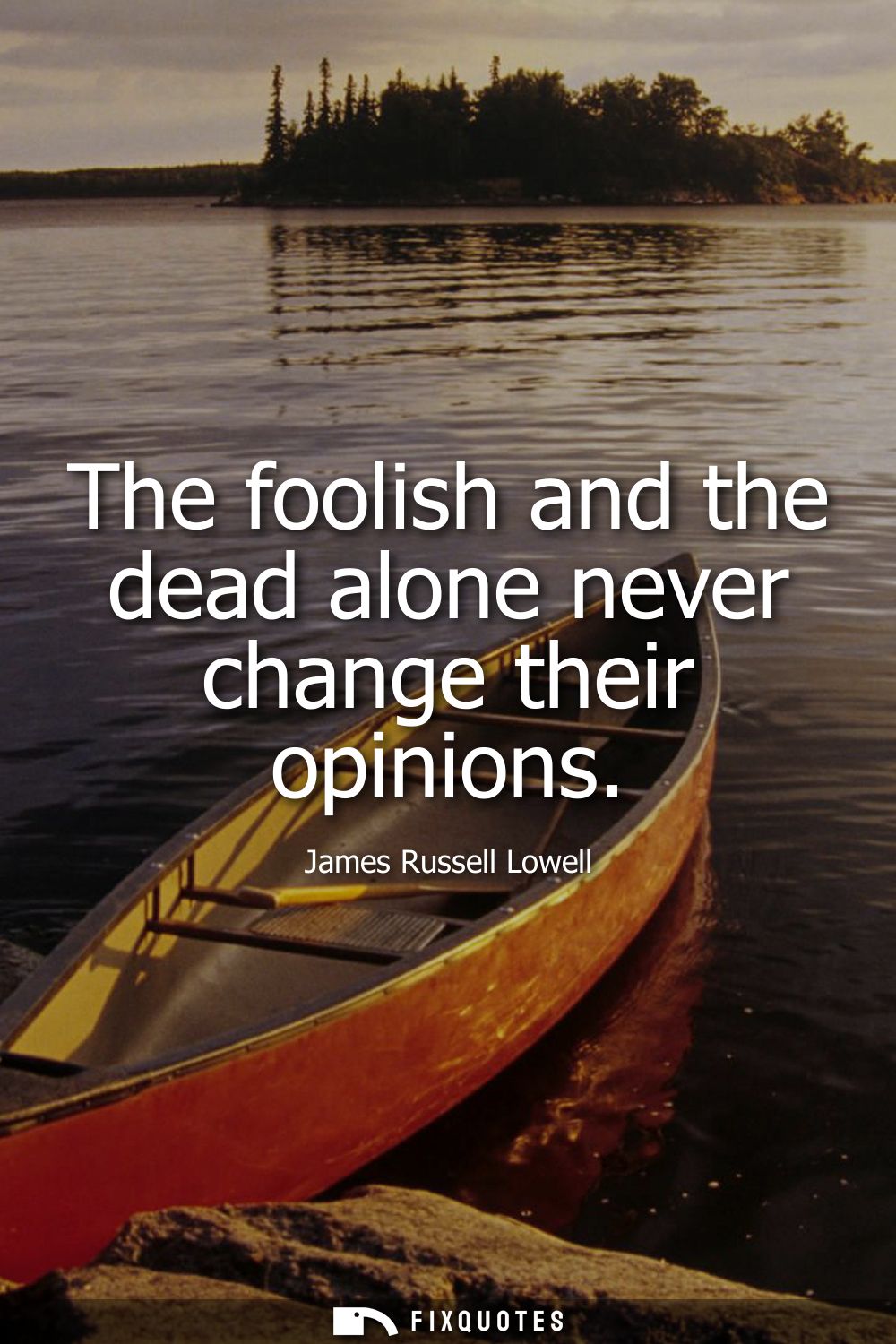
"The foolish and the dead alone never change their opinions"
About this Quote
Stubbornness gets dressed up as principle all the time; Lowell strips it back to the bone. By pairing “the foolish” with “the dead,” he makes inflexibility sound less like moral backbone and more like a symptom of non-function. The line’s bite comes from its false gentleness: “alone” suggests a tiny club, but it’s a club nobody wants to join. You either adjust your mind to new evidence or you’ve effectively opted out of the living world.
The craft is in the insult’s architecture. “Foolish” is a judgment about reasoning; “dead” is a state beyond argument. Lowell yokes them together to imply that refusing to revise your beliefs is not just an error but a kind of intellectual rigor mortis. It’s a devastating compression: one clause, two categories, no escape hatch. If you want to be seen as alive - awake, responsive, morally serious - you must be capable of changing.
Context matters: Lowell wrote in a 19th-century America where public life was riven by reform movements, abolitionist debate, and rapid social change. A poet steeped in civic argument, he understood how “opinions” harden into identities, and how that hardening can serve power. The subtext isn’t “flip-flop constantly.” It’s a demand for humility: treat your views as provisional, keep them answerable to reality, and don’t confuse consistency with virtue. The line still lands because it targets a timeless vanity: the desire to be right more than the desire to be true.
The craft is in the insult’s architecture. “Foolish” is a judgment about reasoning; “dead” is a state beyond argument. Lowell yokes them together to imply that refusing to revise your beliefs is not just an error but a kind of intellectual rigor mortis. It’s a devastating compression: one clause, two categories, no escape hatch. If you want to be seen as alive - awake, responsive, morally serious - you must be capable of changing.
Context matters: Lowell wrote in a 19th-century America where public life was riven by reform movements, abolitionist debate, and rapid social change. A poet steeped in civic argument, he understood how “opinions” harden into identities, and how that hardening can serve power. The subtext isn’t “flip-flop constantly.” It’s a demand for humility: treat your views as provisional, keep them answerable to reality, and don’t confuse consistency with virtue. The line still lands because it targets a timeless vanity: the desire to be right more than the desire to be true.
Quote Details
| Topic | Change |
|---|---|
| Source | Help us find the source |
| Cite |
Citation Formats
APA Style (7th ed.)
Lowell, James Russell. (2026, January 17). The foolish and the dead alone never change their opinions. FixQuotes. https://fixquotes.com/quotes/the-foolish-and-the-dead-alone-never-change-their-28970/
Chicago Style
Lowell, James Russell. "The foolish and the dead alone never change their opinions." FixQuotes. January 17, 2026. https://fixquotes.com/quotes/the-foolish-and-the-dead-alone-never-change-their-28970/.
MLA Style (9th ed.)
"The foolish and the dead alone never change their opinions." FixQuotes, 17 Jan. 2026, https://fixquotes.com/quotes/the-foolish-and-the-dead-alone-never-change-their-28970/. Accessed 12 Feb. 2026.
More Quotes by James
Add to List