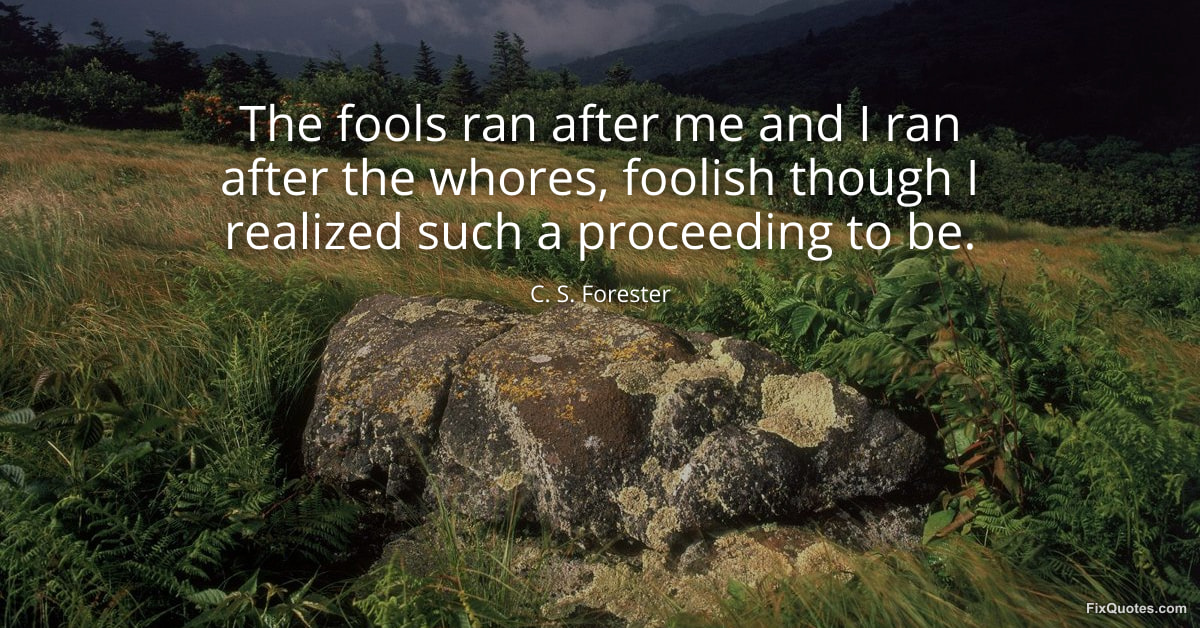
"The fools ran after me and I ran after the whores, foolish though I realized such a proceeding to be"
About this Quote
“Fools” and “whores” are blunt categories, less about individual people than about roles in a transactional world. Calling the pursuers “fools” flatters the speaker for a beat, then the second clause flips that smugness into self-exposure. The admission “foolish though I realized such a proceeding to be” adds a crucial modern note: self-awareness doesn’t redeem him, it damns him. He knows the script, names it as stupid, and runs anyway. That’s not confession as moral cleansing; it’s confession as diagnosis.
Forester, best known for writing about duty, hierarchy, and masculine codes (especially in naval settings), often tracks the gap between self-command and private weakness. This line reads like the off-deck corollary to military order: even men trained to calculate risk will volunteer for emotional or sexual humiliation. The intent isn’t titillation so much as demystification - a crisp portrait of how status, longing, and shame circulate in the same closed loop.
Quote Details
| Topic | Sarcastic |
|---|---|
| Source | Help us find the source |
| Cite |
Citation Formats
APA Style (7th ed.)
Forester, C. S. (2026, January 17). The fools ran after me and I ran after the whores, foolish though I realized such a proceeding to be. FixQuotes. https://fixquotes.com/quotes/the-fools-ran-after-me-and-i-ran-after-the-whores-40340/
Chicago Style
Forester, C. S. "The fools ran after me and I ran after the whores, foolish though I realized such a proceeding to be." FixQuotes. January 17, 2026. https://fixquotes.com/quotes/the-fools-ran-after-me-and-i-ran-after-the-whores-40340/.
MLA Style (9th ed.)
"The fools ran after me and I ran after the whores, foolish though I realized such a proceeding to be." FixQuotes, 17 Jan. 2026, https://fixquotes.com/quotes/the-fools-ran-after-me-and-i-ran-after-the-whores-40340/. Accessed 7 Apr. 2026.