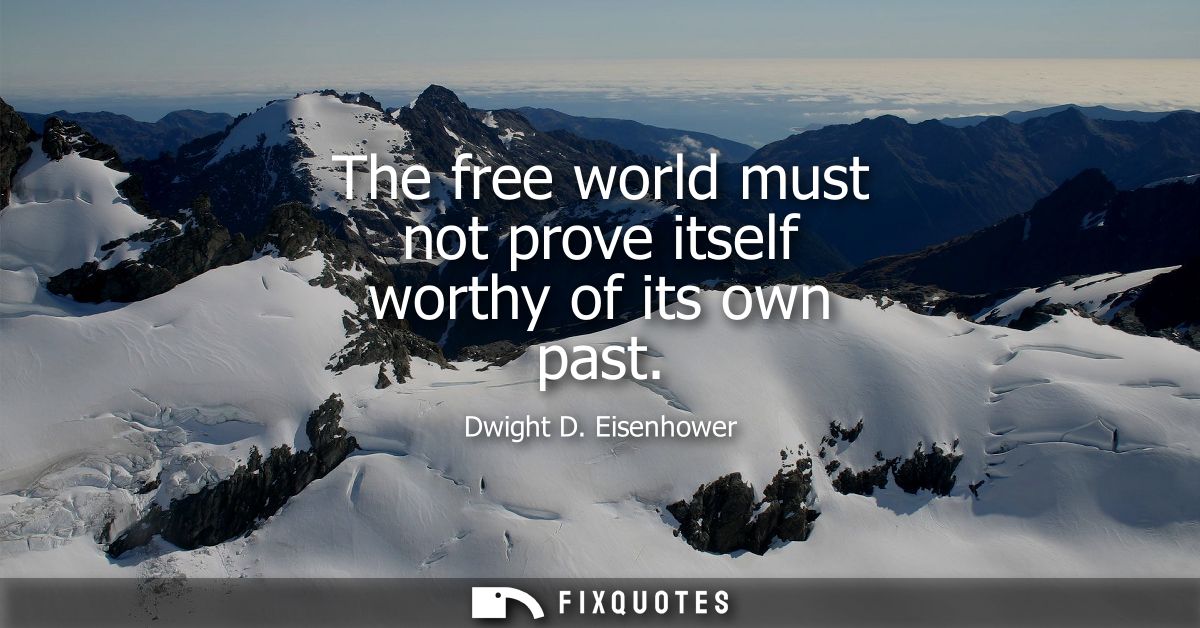
"The free world must not prove itself worthy of its own past"
About this Quote
Eisenhower twists the usual patriotic script by turning “worthy” into a trap. Leaders love to invoke the past as a moral credential: we fought the good war, we built the alliance, therefore we are righteous. His line refuses that easy inheritance. “The free world must not prove itself worthy of its own past” reads like a warning against governing by nostalgia - or worse, by guilt. If you accept the premise that today’s legitimacy depends on matching yesterday’s heroics, you start needing crises to validate yourself. You go looking for tests, for enemies, for dramatic reenactments of World War II-scale clarity.
The subtext is deeply Cold War: freedom as an identity was becoming a brand that required constant performance. Eisenhower, the general turned president, knew how seductive wartime unity can be and how distorting it becomes in peacetime. “Free world” is broad enough to flatter allies and discipline them; it implies a club with standards. But he’s arguing those standards shouldn’t be set by mythic memory. Past victories can’t be the measuring stick for present policy, because the past was built on conditions you can’t recreate without catastrophe.
There’s also a quiet rebuke to domestic politics. Invoking “our past” is how hawks pressure restraint into looking like weakness. Eisenhower’s rhetoric takes the air out of that maneuver: the aim of a free society isn’t to keep proving its toughness, it’s to keep living free - even when that looks less cinematic than the last war.
The subtext is deeply Cold War: freedom as an identity was becoming a brand that required constant performance. Eisenhower, the general turned president, knew how seductive wartime unity can be and how distorting it becomes in peacetime. “Free world” is broad enough to flatter allies and discipline them; it implies a club with standards. But he’s arguing those standards shouldn’t be set by mythic memory. Past victories can’t be the measuring stick for present policy, because the past was built on conditions you can’t recreate without catastrophe.
There’s also a quiet rebuke to domestic politics. Invoking “our past” is how hawks pressure restraint into looking like weakness. Eisenhower’s rhetoric takes the air out of that maneuver: the aim of a free society isn’t to keep proving its toughness, it’s to keep living free - even when that looks less cinematic than the last war.
Quote Details
| Topic | Freedom |
|---|---|
| Source | Help us find the source |
| Cite |
Citation Formats
APA Style (7th ed.)
Eisenhower, Dwight D. (2026, January 14). The free world must not prove itself worthy of its own past. FixQuotes. https://fixquotes.com/quotes/the-free-world-must-not-prove-itself-worthy-of-16946/
Chicago Style
Eisenhower, Dwight D. "The free world must not prove itself worthy of its own past." FixQuotes. January 14, 2026. https://fixquotes.com/quotes/the-free-world-must-not-prove-itself-worthy-of-16946/.
MLA Style (9th ed.)
"The free world must not prove itself worthy of its own past." FixQuotes, 14 Jan. 2026, https://fixquotes.com/quotes/the-free-world-must-not-prove-itself-worthy-of-16946/. Accessed 12 Feb. 2026.
More Quotes by Dwight
Add to List