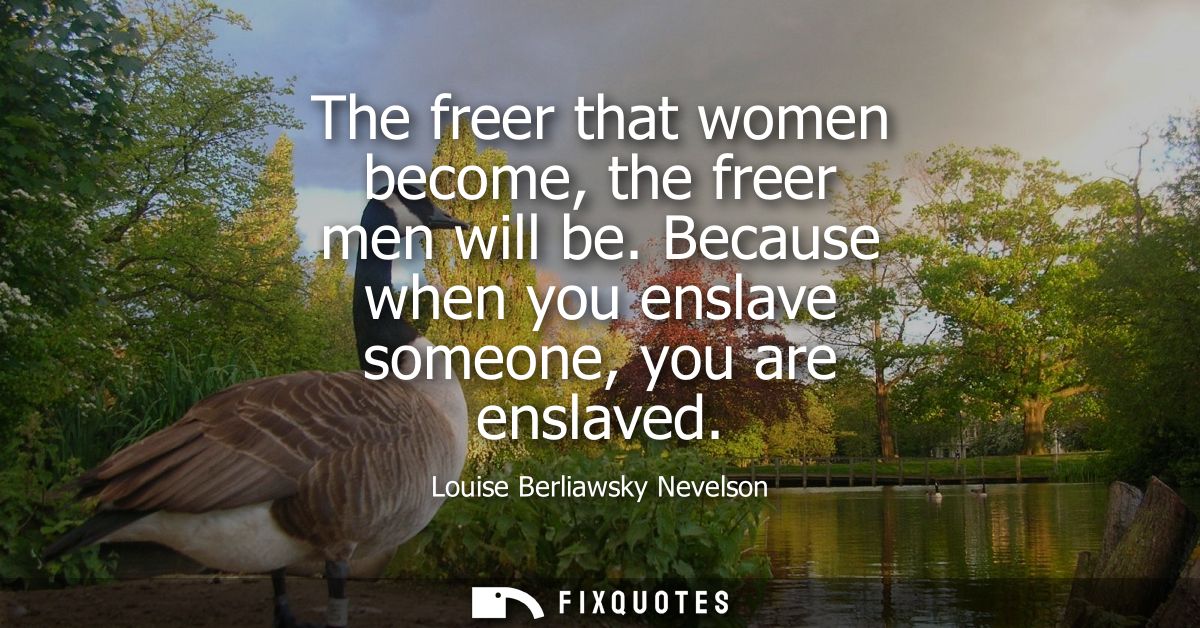
"The freer that women become, the freer men will be, because when you enslave someone, you are enslaved"
About this Quote
The intent is both moral and pragmatic. She’s not arguing that men should be nicer; she’s arguing that patriarchy is an identity trap. If masculinity is defined by control, then men have to keep performing control - emotionally, sexually, domestically - even when it makes them smaller. The subtext is almost psychological: the oppressor internalizes the logic of oppression, living with paranoia, rigidity, and the constant need to reassert status.
Context matters. Nevelson came up as a woman in a modernist art world that loved “genius” but treated female ambition as a social error. She built monumental, black-painted assemblages from discarded wood - work that literalizes reclamation and reinvention. That practice echoes the quote: liberation isn’t abstract; it’s material, spatial, lived. The line reads like a response to gatekeeping in studios, galleries, marriages: freedom expands when you stop treating other people as raw material for your comfort. It’s not sentimental. It’s a warning about the spiritual debt incurred when you make someone else smaller to feel large.
Quote Details
| Topic | Freedom |
|---|---|
| Source | Help us find the source |
| Cite |
Citation Formats
APA Style (7th ed.)
Nevelson, Louise Berliawsky. (2026, February 16). The freer that women become, the freer men will be, because when you enslave someone, you are enslaved. FixQuotes. https://fixquotes.com/quotes/the-freer-that-women-become-the-freer-men-will-be-169564/
Chicago Style
Nevelson, Louise Berliawsky. "The freer that women become, the freer men will be, because when you enslave someone, you are enslaved." FixQuotes. February 16, 2026. https://fixquotes.com/quotes/the-freer-that-women-become-the-freer-men-will-be-169564/.
MLA Style (9th ed.)
"The freer that women become, the freer men will be, because when you enslave someone, you are enslaved." FixQuotes, 16 Feb. 2026, https://fixquotes.com/quotes/the-freer-that-women-become-the-freer-men-will-be-169564/. Accessed 8 Apr. 2026.