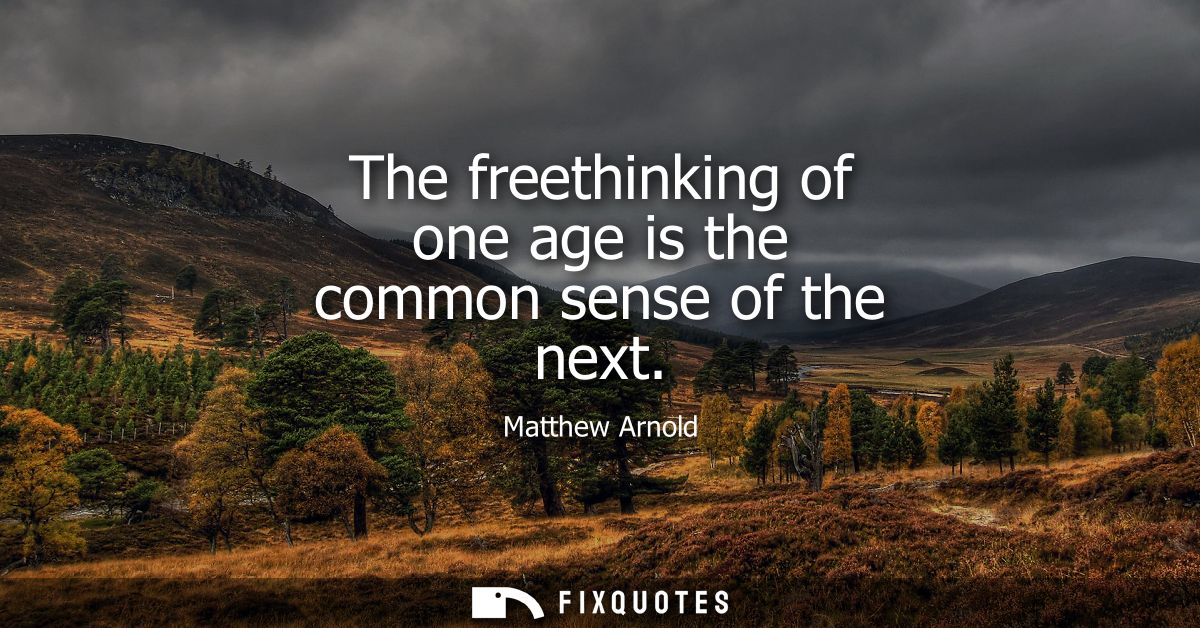
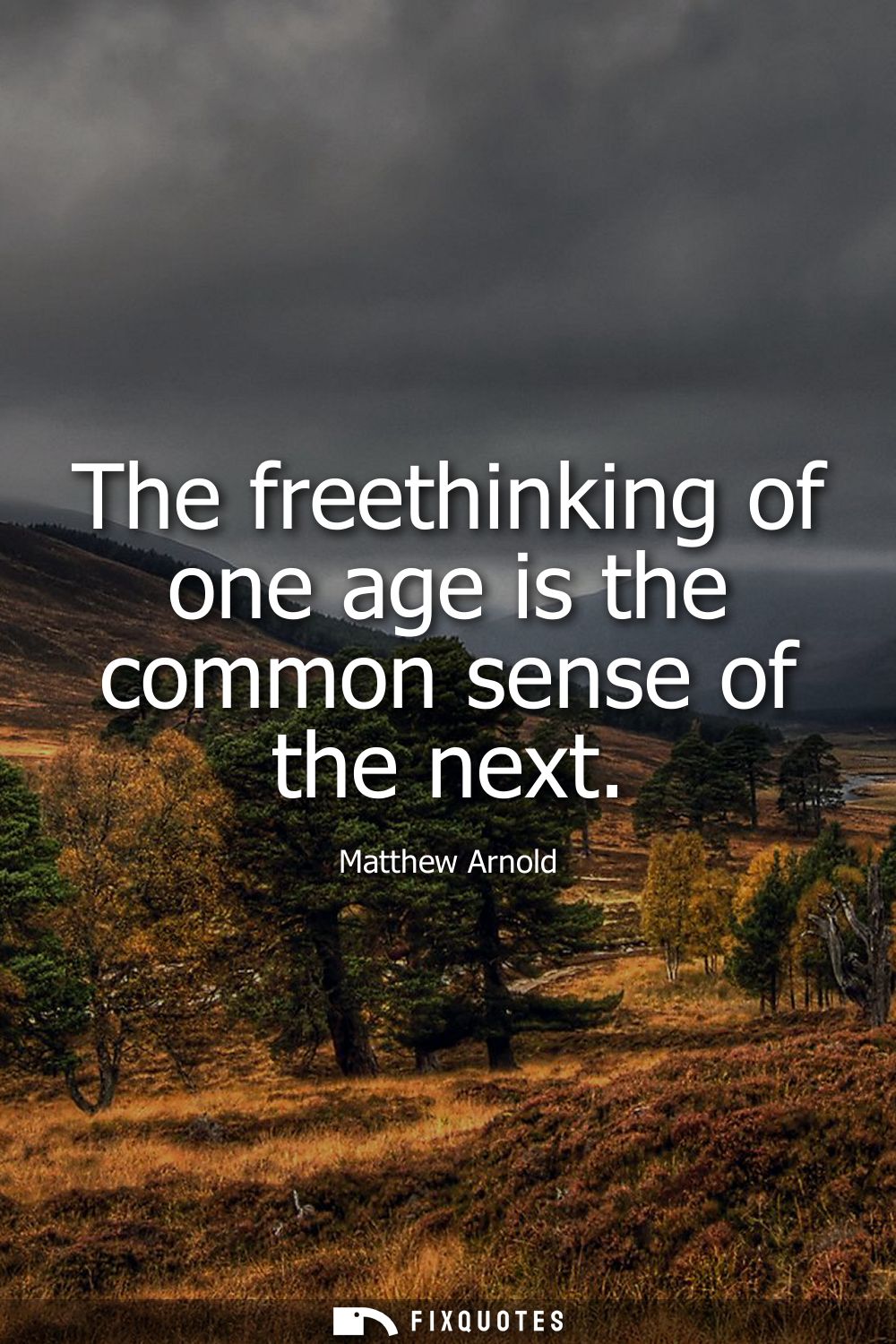
"The freethinking of one age is the common sense of the next"
About this Quote
Arnold’s line is a neat piece of cultural judo: it flips “freethinking” from a romantic badge of rebellion into a historical placeholder. Today’s scandal, he implies, is often just tomorrow’s bland baseline. The wit isn’t showy, but it’s surgical. He’s not praising iconoclasts so much as demystifying them, treating dissent as a stage in the life cycle of ideas rather than a personality type.
The intent sits in Arnold’s larger Victorian anxiety about authority and social cohesion. In an era jolted by Darwin, biblical criticism, industrial upheaval, and expanding literacy, “common sense” was no longer a stable inheritance; it was a moving target. Arnold, the poet-critic who argued for “culture” as a civilizing force, understood that societies don’t simply replace one orthodoxy with freedom. They replace one orthodoxy with another, usually after a lag in which the old guard calls the new view dangerous simply because it’s new.
The subtext is both consoling and chastening. Consoling: if you feel alone in your thinking, history may vindicate you. Chastening: your brave new idea might age into a dull convention, and your grandchildren will treat it like obvious housekeeping. It also needles “common sense” itself, exposing it as an aesthetic of inevitability rather than a reliable measure of truth. Arnold’s point isn’t that progress is automatic, but that consensus is often just yesterday’s controversy with the edges sanded off.
The intent sits in Arnold’s larger Victorian anxiety about authority and social cohesion. In an era jolted by Darwin, biblical criticism, industrial upheaval, and expanding literacy, “common sense” was no longer a stable inheritance; it was a moving target. Arnold, the poet-critic who argued for “culture” as a civilizing force, understood that societies don’t simply replace one orthodoxy with freedom. They replace one orthodoxy with another, usually after a lag in which the old guard calls the new view dangerous simply because it’s new.
The subtext is both consoling and chastening. Consoling: if you feel alone in your thinking, history may vindicate you. Chastening: your brave new idea might age into a dull convention, and your grandchildren will treat it like obvious housekeeping. It also needles “common sense” itself, exposing it as an aesthetic of inevitability rather than a reliable measure of truth. Arnold’s point isn’t that progress is automatic, but that consensus is often just yesterday’s controversy with the edges sanded off.
Quote Details
| Topic | Wisdom |
|---|---|
| Source | Help us find the source |
| Cite |
Citation Formats
APA Style (7th ed.)
Arnold, Matthew. (2026, January 17). The freethinking of one age is the common sense of the next. FixQuotes. https://fixquotes.com/quotes/the-freethinking-of-one-age-is-the-common-sense-76214/
Chicago Style
Arnold, Matthew. "The freethinking of one age is the common sense of the next." FixQuotes. January 17, 2026. https://fixquotes.com/quotes/the-freethinking-of-one-age-is-the-common-sense-76214/.
MLA Style (9th ed.)
"The freethinking of one age is the common sense of the next." FixQuotes, 17 Jan. 2026, https://fixquotes.com/quotes/the-freethinking-of-one-age-is-the-common-sense-76214/. Accessed 14 Feb. 2026.
More Quotes by Matthew
Add to List