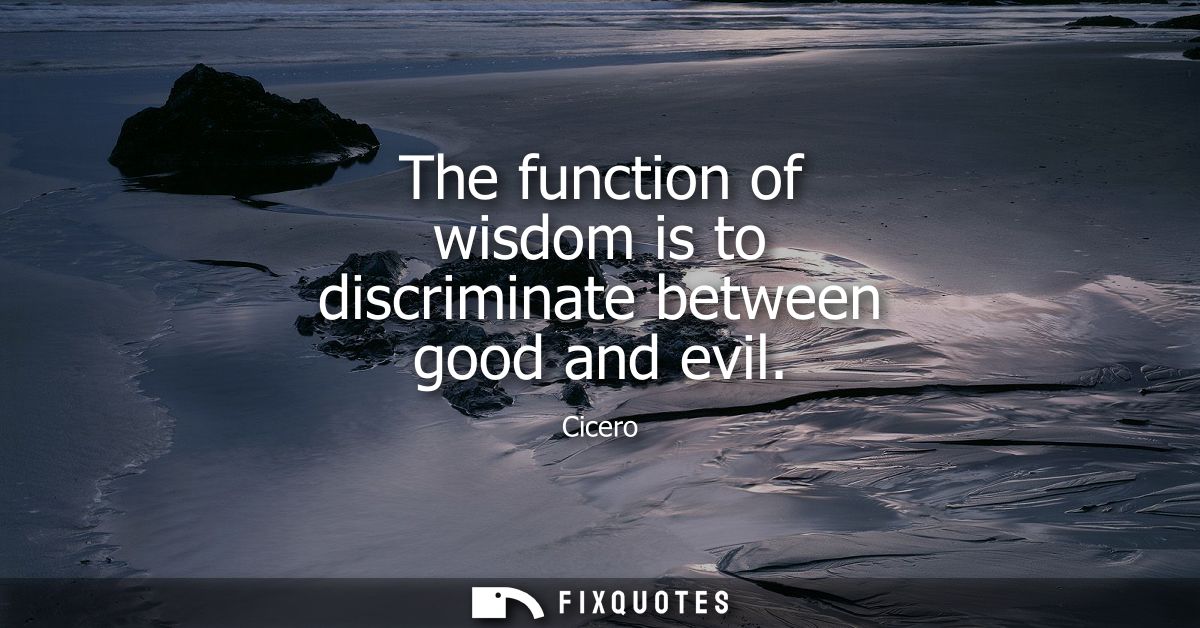
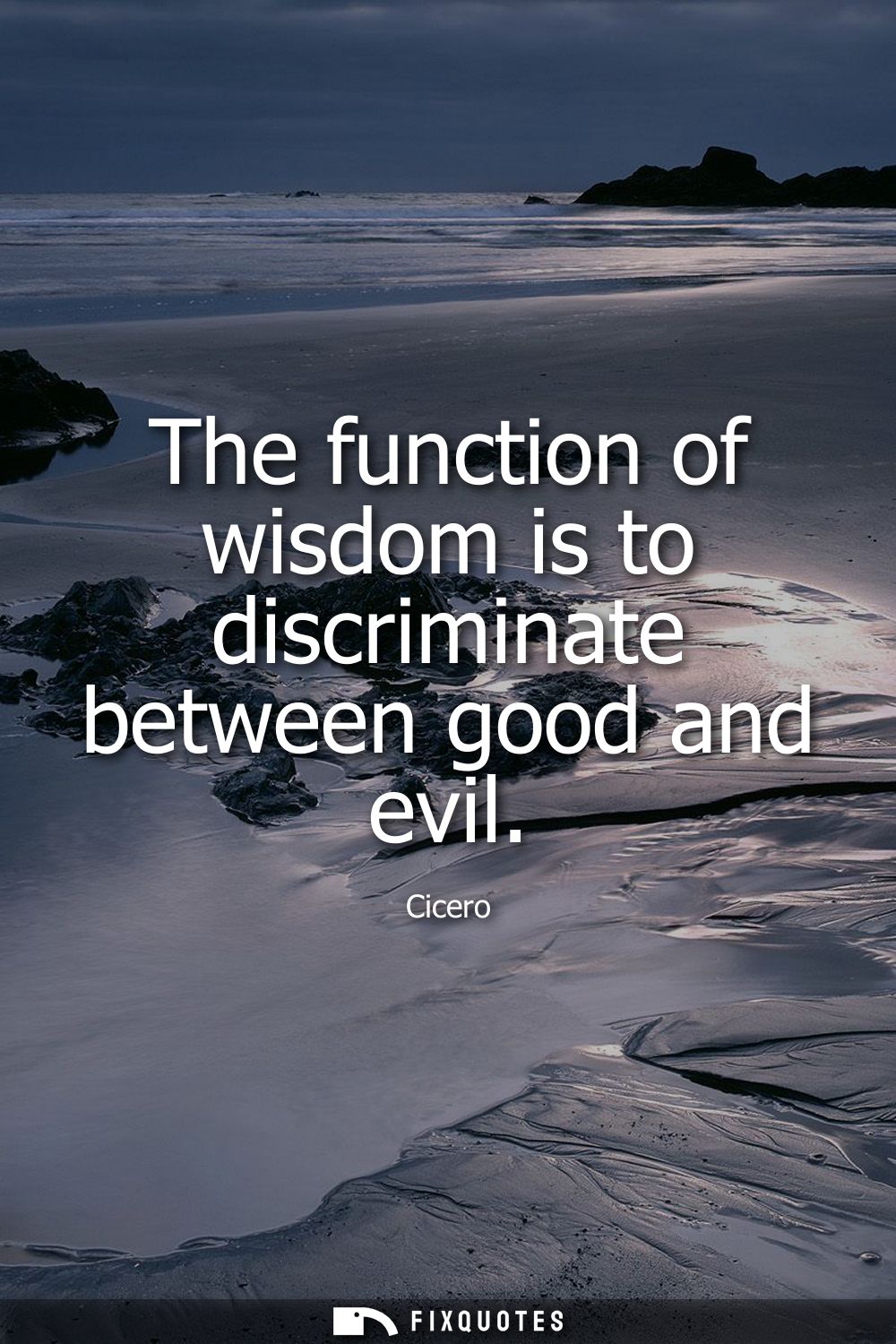
"The function of wisdom is to discriminate between good and evil"
About this Quote
Wisdom, for Cicero, isn’t a mood or a vibe; it’s a civic tool with teeth. “The function of wisdom” frames sapientia as an instrument with a job description, not a private hobby. In Roman public life, that matters: Cicero is writing from a world where moral philosophy isn’t sealed in a lecture hall but dragged into courts, senates, and the messy theater of power. A society coming apart needs more than cleverness. It needs judgment.
The key verb, “discriminate,” is doing double duty. It suggests fine-grained discernment, the ability to draw lines where others blur them. But it also implies decisiveness: wisdom isn’t just noticing complexity, it’s choosing. That’s the subtext: intelligence without moral sorting becomes mere rhetoric, and Cicero knew how easily rhetoric can be rented out to any cause. He was, after all, a master orator watching the Republic tilt toward strongmen, where expediency masqueraded as necessity and “good” got rebranded as “useful.”
The phrase “good and evil” sounds absolute, almost severe, and that severity is strategic. Cicero is arguing against moral relativism avant la lettre: if you can’t distinguish right from wrong, you’re not wise, you’re just informed. Underneath is a warning aimed at elites who pride themselves on sophistication while excusing brutality as politics-as-usual. Wisdom’s purpose, he insists, is ethical triage - the capacity to see through persuasion, self-interest, and factional loyalty to what should and should not be done. In a collapsing republic, that’s not philosophy. That’s survival.
The key verb, “discriminate,” is doing double duty. It suggests fine-grained discernment, the ability to draw lines where others blur them. But it also implies decisiveness: wisdom isn’t just noticing complexity, it’s choosing. That’s the subtext: intelligence without moral sorting becomes mere rhetoric, and Cicero knew how easily rhetoric can be rented out to any cause. He was, after all, a master orator watching the Republic tilt toward strongmen, where expediency masqueraded as necessity and “good” got rebranded as “useful.”
The phrase “good and evil” sounds absolute, almost severe, and that severity is strategic. Cicero is arguing against moral relativism avant la lettre: if you can’t distinguish right from wrong, you’re not wise, you’re just informed. Underneath is a warning aimed at elites who pride themselves on sophistication while excusing brutality as politics-as-usual. Wisdom’s purpose, he insists, is ethical triage - the capacity to see through persuasion, self-interest, and factional loyalty to what should and should not be done. In a collapsing republic, that’s not philosophy. That’s survival.
Quote Details
| Topic | Wisdom |
|---|---|
| Source | Verified source: De Officiis (On Duties) (Cicero, 44)
Evidence: For the function of wisdom is to discriminate between good and evil; (Book III, section 71). This wording appears in Cicero’s own work *De Officiis* (written 44 BCE). In the Walter Miller Loeb translation (1913; mirrored at Project Gutenberg), the sentence occurs in Book III, §71 in a passage criticizing trickery that masquerades as wisdom. While Project Gutenberg is a modern republication, it is reproducing a translation of Cicero’s primary text; the underlying primary source is Cicero’s *De Officiis* Book III §71 (composed 44 BCE). The Gutenberg HTML edition does not give a stable printed page number; use the internal location Book III, §71 for citation. Other candidates (1) Man’s Fate and God’s Choice (Bhimeswara Challa, 2021) compilation95.0% ... Cicero said that “ the function of wisdom is to discriminate between good and evil . " Well , we have a perfect a... |
| Cite |
Citation Formats
APA Style (7th ed.)
Cicero. (2026, March 1). The function of wisdom is to discriminate between good and evil. FixQuotes. https://fixquotes.com/quotes/the-function-of-wisdom-is-to-discriminate-between-9043/
Chicago Style
Cicero. "The function of wisdom is to discriminate between good and evil." FixQuotes. March 1, 2026. https://fixquotes.com/quotes/the-function-of-wisdom-is-to-discriminate-between-9043/.
MLA Style (9th ed.)
"The function of wisdom is to discriminate between good and evil." FixQuotes, 1 Mar. 2026, https://fixquotes.com/quotes/the-function-of-wisdom-is-to-discriminate-between-9043/. Accessed 27 Mar. 2026.
More Quotes by Cicero
Add to List