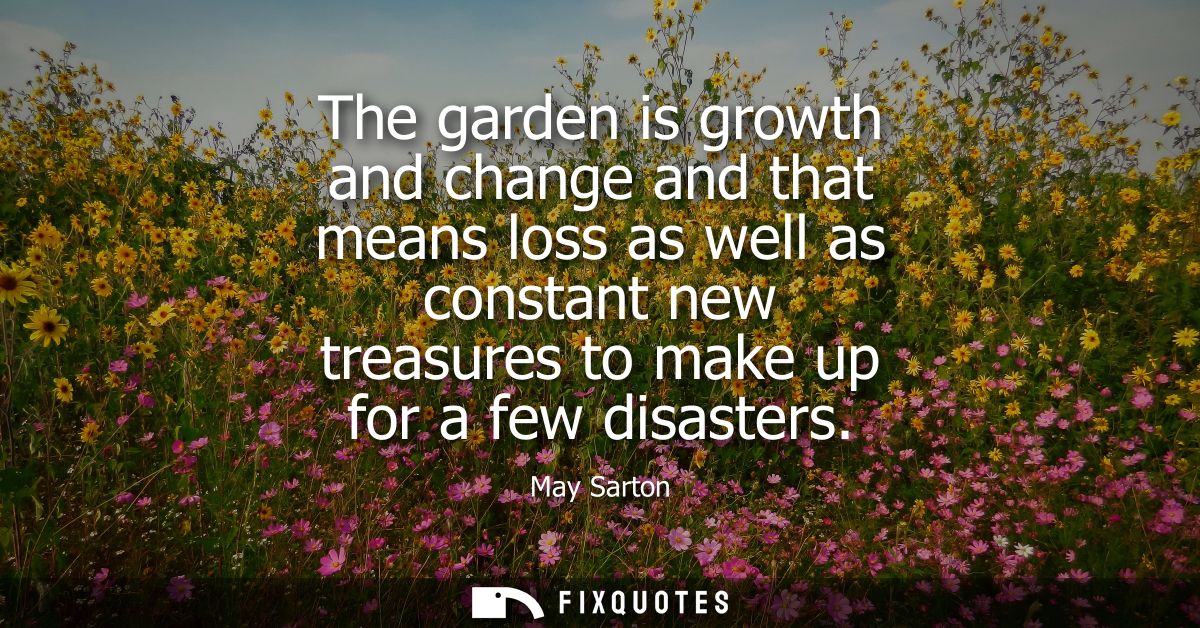
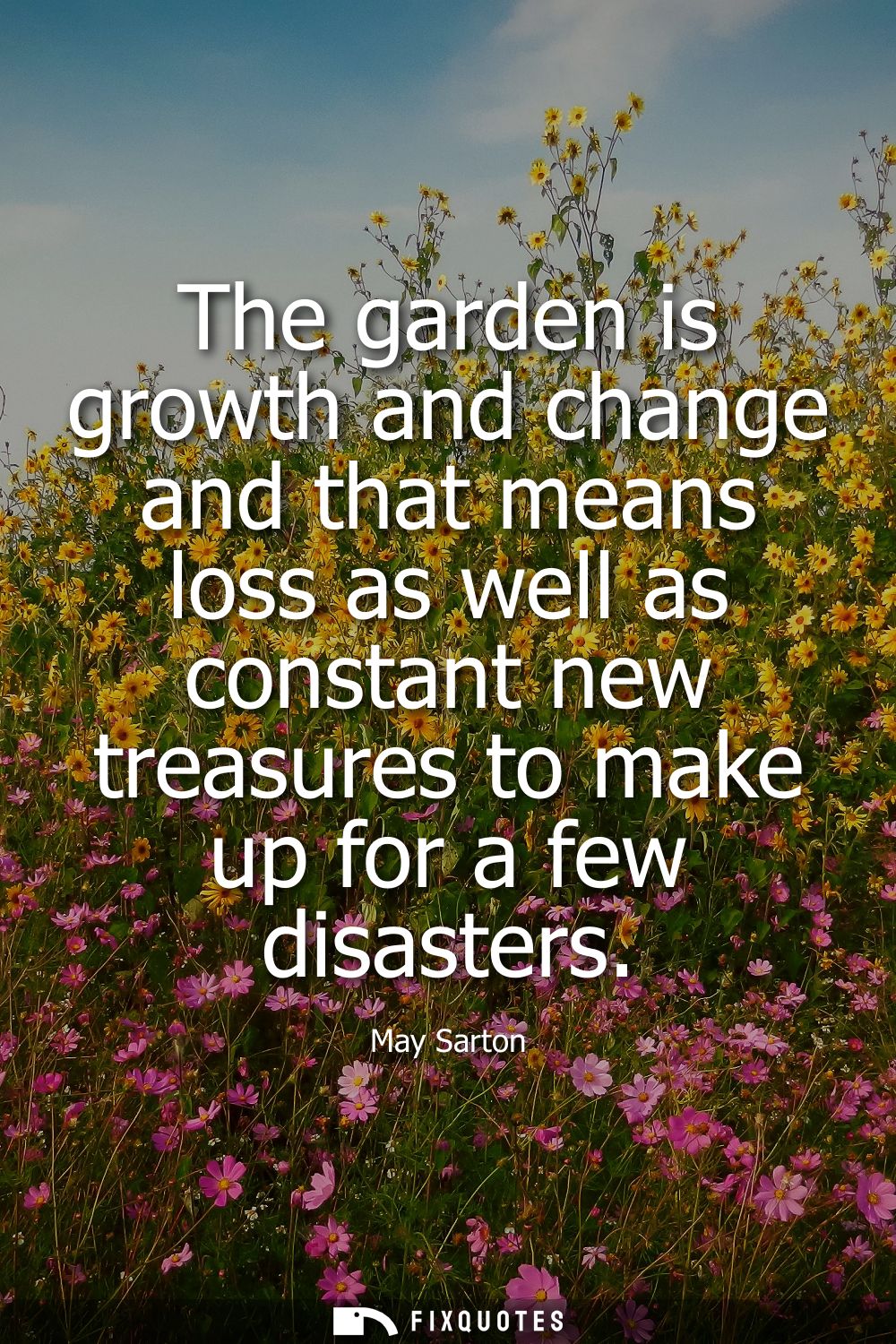
"The garden is growth and change and that means loss as well as constant new treasures to make up for a few disasters"
About this Quote
Sarton’s phrasing keeps the emotional register honest. “Treasures” suggests wonder without demanding grandness; a new bud, a volunteer seedling, a scent after rain can count. Against that, “a few disasters” is deliberately casual, the understatement of someone who has watched blight, frost, pests, and human misjudgment wreck a season. It’s wry in the way gardeners are wry: you can’t cultivate without courting catastrophe. The sentence doesn’t deny pain; it places pain inside a cycle that continues, indifferent but not pointless.
Context matters: Sarton wrote often from the vantage of solitude and domestic rituals, using gardens as both literal practice and psychic mirror. Here the subtext is resilience without heroics. The garden doesn’t “teach” you through moralizing; it trains you through repetition. You learn to mourn what’s gone, then keep tending anyway, because new life is not compensation so much as continuation.
Quote Details
| Topic | Embrace Change |
|---|---|
| Source | Help us find the source |
| Cite |
Citation Formats
APA Style (7th ed.)
Sarton, May. (2026, January 17). The garden is growth and change and that means loss as well as constant new treasures to make up for a few disasters. FixQuotes. https://fixquotes.com/quotes/the-garden-is-growth-and-change-and-that-means-79994/
Chicago Style
Sarton, May. "The garden is growth and change and that means loss as well as constant new treasures to make up for a few disasters." FixQuotes. January 17, 2026. https://fixquotes.com/quotes/the-garden-is-growth-and-change-and-that-means-79994/.
MLA Style (9th ed.)
"The garden is growth and change and that means loss as well as constant new treasures to make up for a few disasters." FixQuotes, 17 Jan. 2026, https://fixquotes.com/quotes/the-garden-is-growth-and-change-and-that-means-79994/. Accessed 12 Feb. 2026.