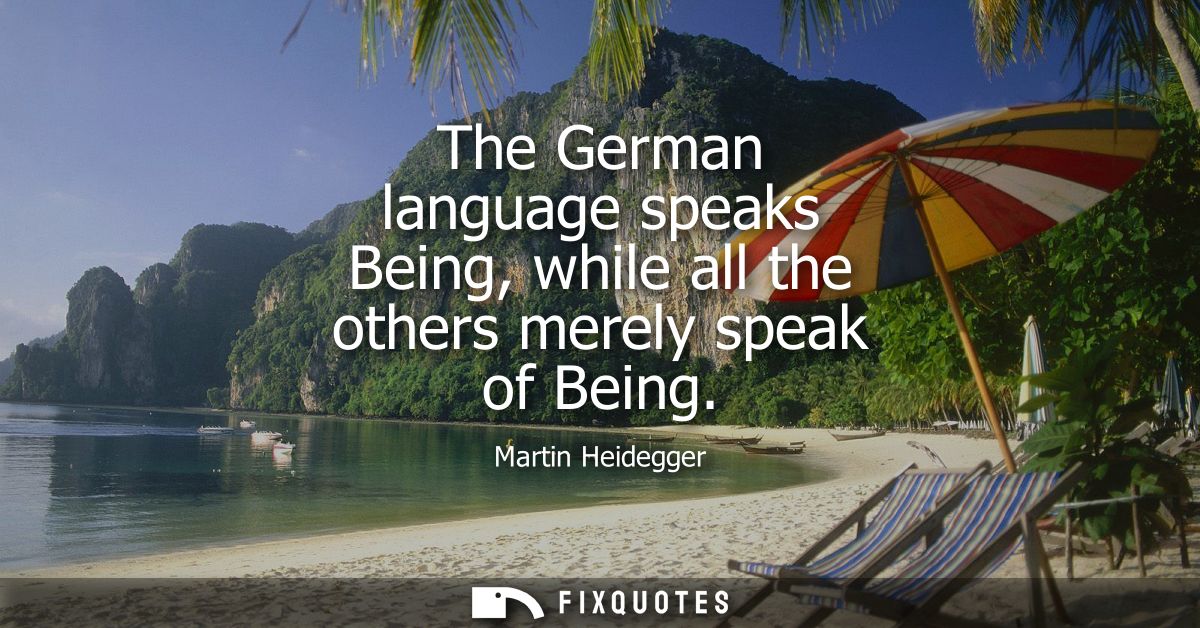
"The German language speaks Being, while all the others merely speak of Being"
About this Quote
The intent is polemical. Heidegger is trying to wrest philosophy away from what he saw as Latinized, technical, “dead” concepts and return it to an older, supposedly more originary relationship between word and world. German, like Greek, becomes his preferred instrument because it can be etymologically excavated and recomposed: he can split, stitch, and torque everyday terms into metaphysical tools. That method depends on the audience believing language isn’t a neutral vehicle but a site where truth happens.
The subtext is gatekeeping with metaphysical stakes: if German uniquely “speaks” Being, then serious ontology starts to look like a provincial club with an entrance exam. Context matters here. Heidegger wrote in a period when German intellectual culture was saturated with arguments about national spirit, destiny, and linguistic essence. His line rhymes uncomfortably with that atmosphere, even when read as a technical claim about philosophical grammar. It works rhetorically because it flatters the initiated while casting rival traditions as derivative, secondhand, merely “about” what German supposedly lets you encounter firsthand.
Quote Details
| Topic | Deep |
|---|---|
| Source | Help us find the source |
| Cite |
Citation Formats
APA Style (7th ed.)
Heidegger, Martin. (2026, January 18). The German language speaks Being, while all the others merely speak of Being. FixQuotes. https://fixquotes.com/quotes/the-german-language-speaks-being-while-all-the-768/
Chicago Style
Heidegger, Martin. "The German language speaks Being, while all the others merely speak of Being." FixQuotes. January 18, 2026. https://fixquotes.com/quotes/the-german-language-speaks-being-while-all-the-768/.
MLA Style (9th ed.)
"The German language speaks Being, while all the others merely speak of Being." FixQuotes, 18 Jan. 2026, https://fixquotes.com/quotes/the-german-language-speaks-being-while-all-the-768/. Accessed 28 Mar. 2026.