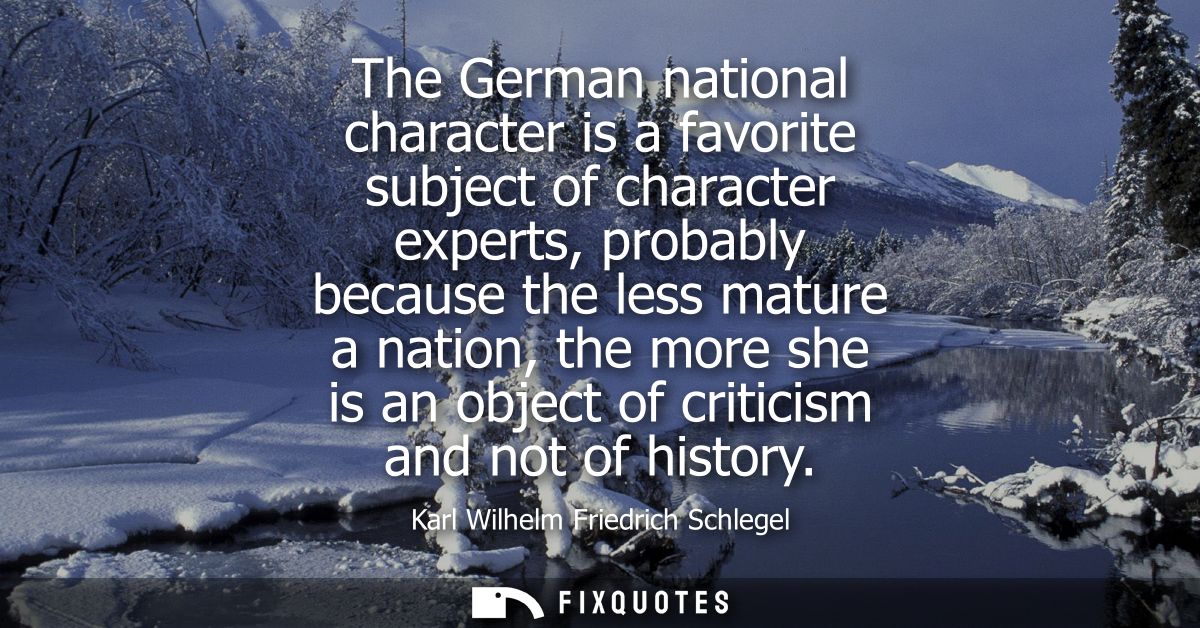
"The German national character is a favorite subject of character experts, probably because the less mature a nation, the more she is an object of criticism and not of history"
About this Quote
The intent is corrective, but not innocent. Schlegel smuggles a hierarchy into the metaphor of maturity. A “less mature” nation, feminized as “she,” gets talked about the way adolescents do: endlessly judged, diagnosed, scolded. That choice of pronoun isn’t decorative; it exposes how the discourse of national character often mirrors the discourse of propriety. The nation is not studied as an actor with consequences, but critiqued as a personality with flaws.
The subtext is a warning about narrative power. When a society is treated as an “object of criticism,” it’s trapped in commentary - in stereotypes, moral audits, and cultural gossip - rather than granted the dignity (and danger) of “history,” where agency matters and events leave scars. Schlegel is prodding readers to notice the political function of cultural criticism: it can be a way to keep emerging peoples in their place, talked about rather than listened to, analyzed rather than allowed to act. He’s also indicting his own milieu: the hunger to define “German-ness” risks producing a mirror, not a country.
Quote Details
| Topic | Wisdom |
|---|---|
| Source | Help us find the source |
| Cite |
Citation Formats
APA Style (7th ed.)
Schlegel, Karl Wilhelm Friedrich. (2026, January 18). The German national character is a favorite subject of character experts, probably because the less mature a nation, the more she is an object of criticism and not of history. FixQuotes. https://fixquotes.com/quotes/the-german-national-character-is-a-favorite-12963/
Chicago Style
Schlegel, Karl Wilhelm Friedrich. "The German national character is a favorite subject of character experts, probably because the less mature a nation, the more she is an object of criticism and not of history." FixQuotes. January 18, 2026. https://fixquotes.com/quotes/the-german-national-character-is-a-favorite-12963/.
MLA Style (9th ed.)
"The German national character is a favorite subject of character experts, probably because the less mature a nation, the more she is an object of criticism and not of history." FixQuotes, 18 Jan. 2026, https://fixquotes.com/quotes/the-german-national-character-is-a-favorite-12963/. Accessed 4 Apr. 2026.