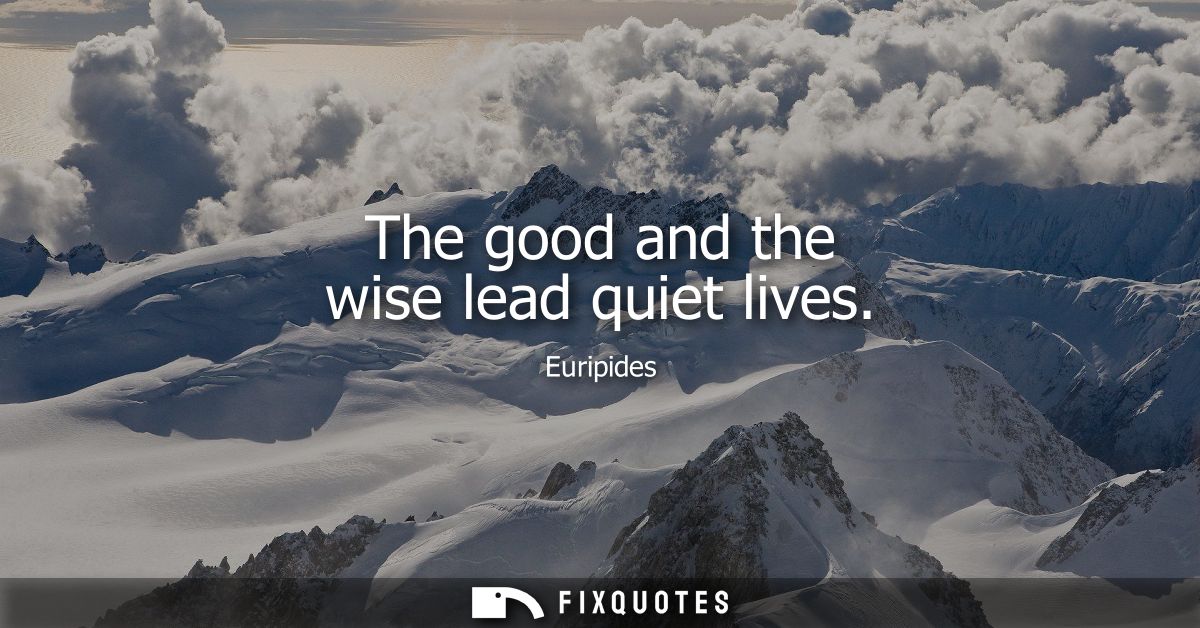
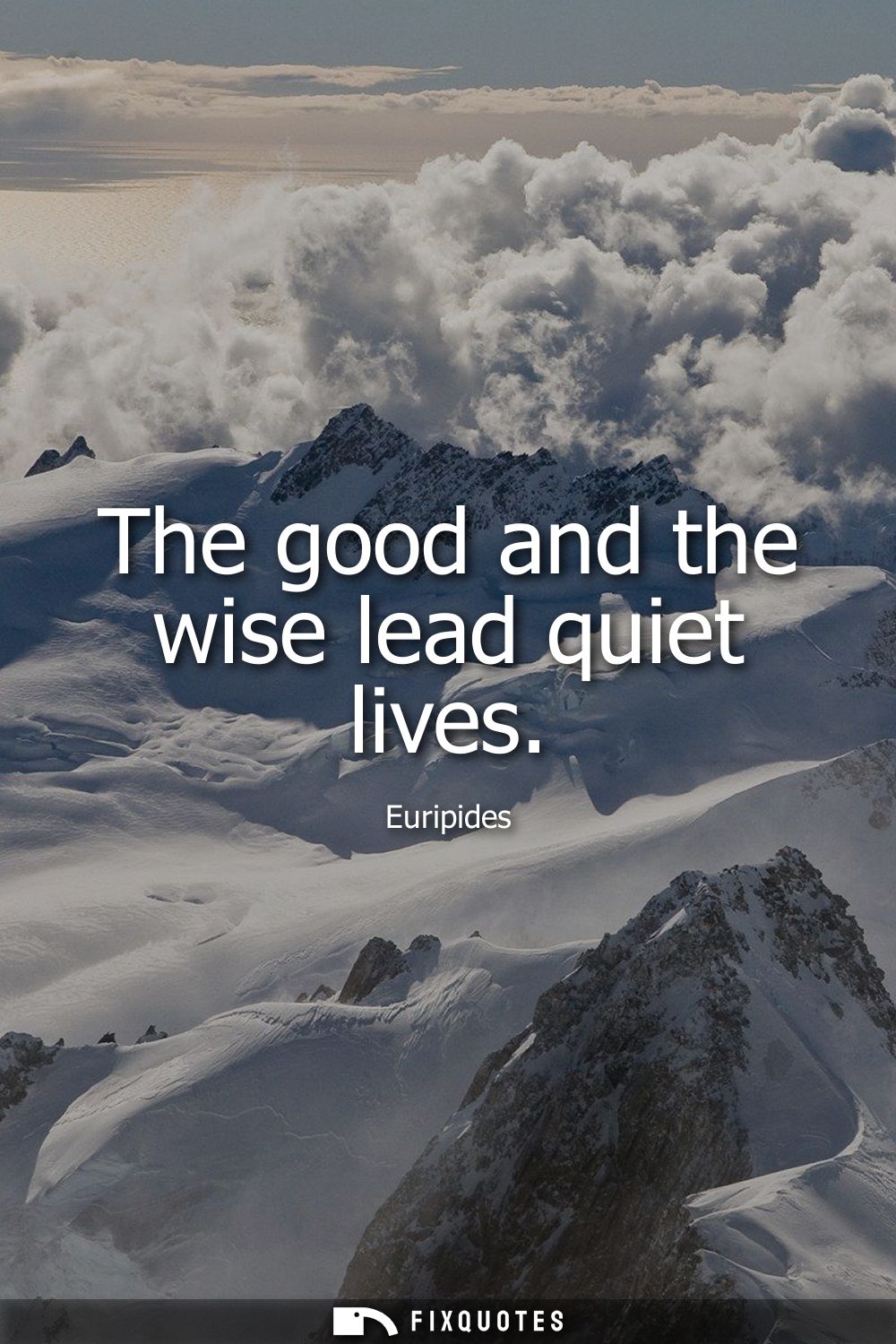
"The good and the wise lead quiet lives"
About this Quote
Quiet isn’t a personality trait here; it’s a survival strategy. Euripides writes in an Athens that loved spectacle as much as it loved virtue, where public life meant exposure to rumor, faction, and the fickle appetites of the crowd. To “lead quiet lives” is less about monkish retreat than about minimizing the blast radius of other people’s passions. In a city where reputation could be built or demolished in a day, goodness and wisdom become forms of self-containment.
The line also carries a faintly bruised cynicism, the kind Euripides threads through tragedies where noble characters don’t get rewarded so much as tested, misread, and punished. “Good” and “wise” are paired as if each needs the other: goodness without prudence becomes martyrdom; wisdom without decency becomes manipulation. Quiet is the third term that protects them both, an implied rebuke to the loud virtues of politics, war-making, and moral grandstanding.
Subtextually, Euripides is arguing that the public sphere is structurally hostile to ethical clarity. The stage Athens built for civic debate and democratic identity is the same stage that turns complex humans into slogans. His intent isn’t to flatter the withdrawn; it’s to diagnose the cost of visibility. When a culture confuses noise with importance, restraint starts to look like a radical ethics: not passive, but deliberately unperformative.
Read now, it lands as a critique of attention economies before attention economies existed. Quiet isn’t innocence. It’s an intelligent refusal to become content.
The line also carries a faintly bruised cynicism, the kind Euripides threads through tragedies where noble characters don’t get rewarded so much as tested, misread, and punished. “Good” and “wise” are paired as if each needs the other: goodness without prudence becomes martyrdom; wisdom without decency becomes manipulation. Quiet is the third term that protects them both, an implied rebuke to the loud virtues of politics, war-making, and moral grandstanding.
Subtextually, Euripides is arguing that the public sphere is structurally hostile to ethical clarity. The stage Athens built for civic debate and democratic identity is the same stage that turns complex humans into slogans. His intent isn’t to flatter the withdrawn; it’s to diagnose the cost of visibility. When a culture confuses noise with importance, restraint starts to look like a radical ethics: not passive, but deliberately unperformative.
Read now, it lands as a critique of attention economies before attention economies existed. Quiet isn’t innocence. It’s an intelligent refusal to become content.
Quote Details
| Topic | Wisdom |
|---|---|
| Source | Later attribution: Telling It Like It Is (Paul Bowden, 2011) modern compilationISBN: 9781461095613 · ID: w8_p1eGVj8gC
Evidence:
... Euripides The best prophet is the one who guesses best. - Euripides The good and the wise lead quiet lives. - Euripides There is no such thing as a free person. All people are slaves - slaves to money, to fate, to the cries of the ... |
| Cite |
Citation Formats
APA Style (7th ed.)
Euripides. (2026, February 20). The good and the wise lead quiet lives. FixQuotes. https://fixquotes.com/quotes/the-good-and-the-wise-lead-quiet-lives-150607/
Chicago Style
Euripides. "The good and the wise lead quiet lives." FixQuotes. February 20, 2026. https://fixquotes.com/quotes/the-good-and-the-wise-lead-quiet-lives-150607/.
MLA Style (9th ed.)
"The good and the wise lead quiet lives." FixQuotes, 20 Feb. 2026, https://fixquotes.com/quotes/the-good-and-the-wise-lead-quiet-lives-150607/. Accessed 30 Mar. 2026.
More Quotes by Euripides
Add to List