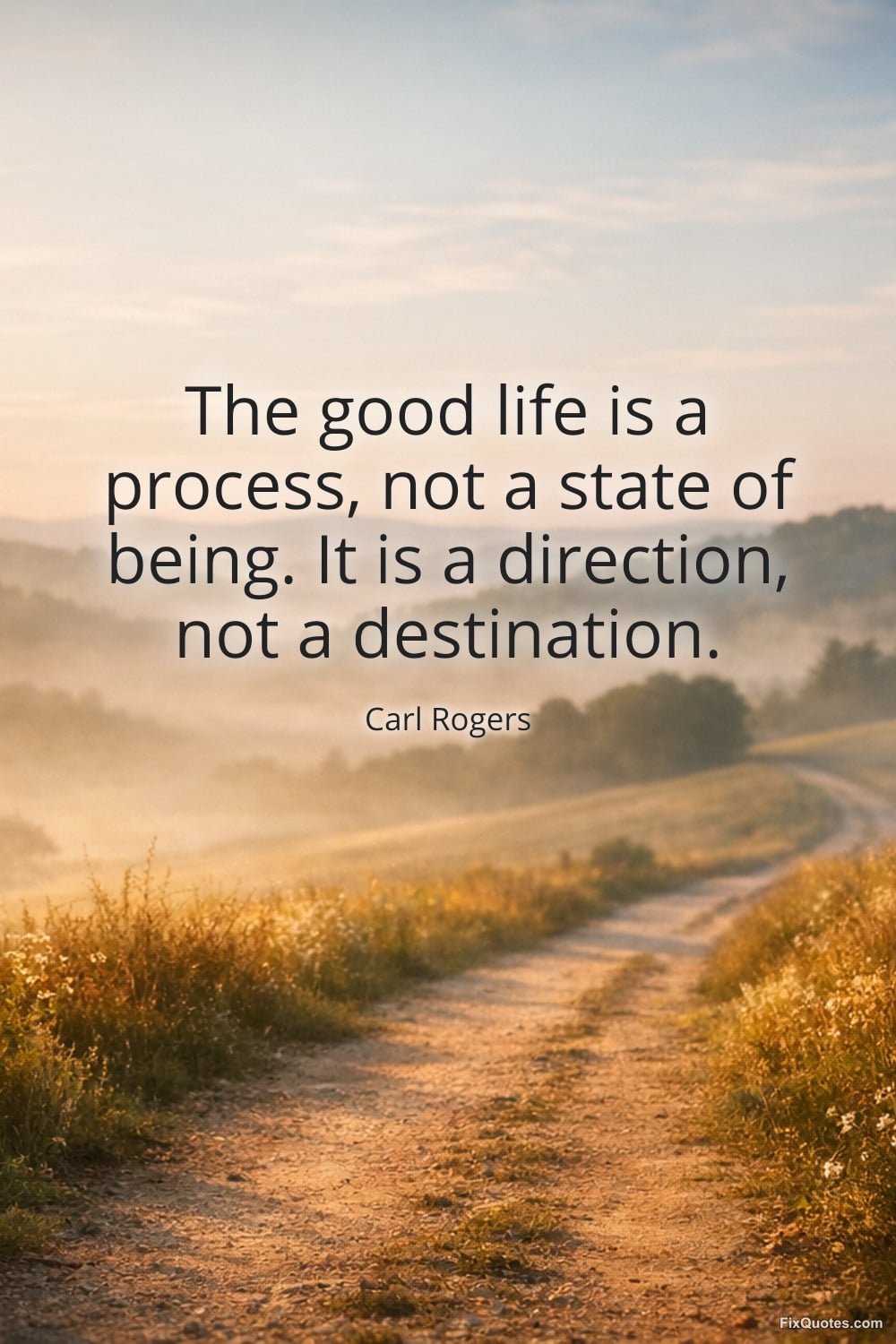
"The good life is a process, not a state of being. It is a direction, not a destination"
About this Quote
The phrasing does double duty. “State of being” sounds clinical, fixed, almost diagnostic - a status you either have or you don’t. Rogers rejects that static model in favor of motion: “process,” “direction.” He’s arguing for an identity that’s less like a credential and more like a practice. The subtext is anti-perfectionist and, in its own calm way, anti-capitalist: no final product, no permanent upgrade, no moment when the self becomes complete and therefore market-ready.
Context matters. Rogers developed client-centered therapy in mid-century America, an era that loved test scores, categories, and authoritative experts. His bet was that growth comes from conditions - empathy, genuineness, unconditional positive regard - not from being corrected into a final form. “Direction” also smuggles in responsibility without moralism: you may not control every circumstance, but you can orient yourself. The good life, for Rogers, isn’t a trophy; it’s a willingness to keep becoming.
Quote Details
| Topic | Meaning of Life |
|---|---|
| Source | Verified source: The Humanist: "A Therapist’s View of the Good Life" (Carl Rogers, 1957)
Evidence: The good life is a process, not a state of being. It is a direction not a destination. (pp. 291–300 (issue no. 5, 1957)). This wording appears in Carl R. Rogers’s essay "A Therapist’s View of the Good Life," which (per the Carl Rogers website’s bibliography page) was published in The Humanist in 1957 (issue no. 5), pp. 291–300, and later expanded/reprinted in Rogers’s 1961 book On Becoming a Person. I was able to verify the quote text in a web reproduction of the relevant passage from On Becoming a Person (a section labeled "The Good Life and the Fully Functioning Person"). However, I could not directly open a scan of the 1957 Humanist article itself in the time available, so the “first publication” claim rests on the Rogers bibliography listing rather than a facsimile of the magazine pages. The best-known primary-source book appearance is Rogers, On Becoming a Person (Houghton Mifflin, 1961), commonly cited at pp. 186–187. See also a reprint of the passage here: https://www.panarchy.org.problemistics.org/rogers/person.html . Other candidates (1) On Becoming a Person (Carl Ransom Rogers, 1995)95.0% A Therapist's View of Psychotherapy Carl Ransom Rogers. It is not , in my estimation , a state of virtue , or ... The... |
| Cite |
Citation Formats
APA Style (7th ed.)
Rogers, Carl. (2026, March 20). The good life is a process, not a state of being. It is a direction, not a destination. FixQuotes. https://fixquotes.com/quotes/the-good-life-is-a-process-not-a-state-of-being-2984/
Chicago Style
Rogers, Carl. "The good life is a process, not a state of being. It is a direction, not a destination." FixQuotes. March 20, 2026. https://fixquotes.com/quotes/the-good-life-is-a-process-not-a-state-of-being-2984/.
MLA Style (9th ed.)
"The good life is a process, not a state of being. It is a direction, not a destination." FixQuotes, 20 Mar. 2026, https://fixquotes.com/quotes/the-good-life-is-a-process-not-a-state-of-being-2984/. Accessed 31 Mar. 2026.