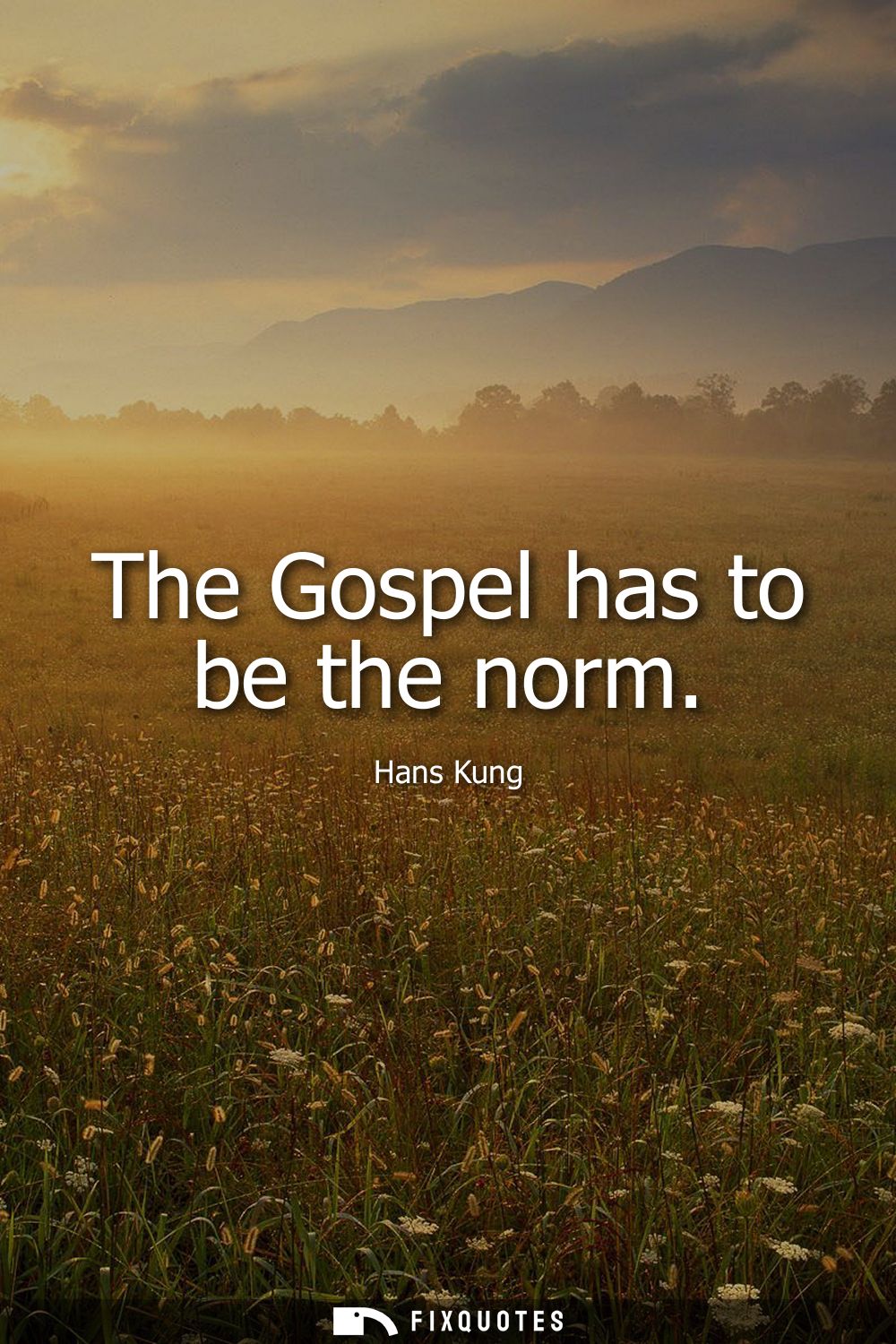
"The Gospel has to be the norm"
About this Quote
Kung’s line lands like a quiet grenade inside Catholic culture: it sounds pious, even obvious, until you notice what it demotes. By insisting that “the Gospel has to be the norm,” he’s not merely praising Scripture; he’s arguing against a rival set of norms that often operate as if they were coequal with, or superior to, the words and practices attributed to Jesus. The target is the self-protecting machinery of institutional religion: canon law, curial habits, clerical privilege, and the long accretions of tradition that can start to feel like the faith itself.
The phrasing matters. “Has to be” is moral compulsion, not suggestion. “Norm” is a juridical word, the language of rules, standards, enforcement. Kung deliberately borrows the Church’s own regulatory vocabulary to flip the hierarchy: if the Church loves norms, fine - let the primary norm be the Gospel’s ethic of mercy, truth-telling, and solidarity with the marginal, not the institution’s instinct for control.
Context sharpens the edge. Kung spent his career as a reform-minded Catholic theologian, celebrated during Vatican II’s opening energy and later disciplined by Rome, famously losing his license to teach as an official Catholic theologian in 1979. Read against that history, the line is less devotional slogan than strategic principle: reform cannot be negotiated on the institution’s terms alone; it must be judged by a source the institution claims to serve.
Subtext: if a teaching, policy, or power structure can’t survive contact with the Gospel’s moral center, it shouldn’t survive at all. That’s why the sentence remains provocative - it dares the Church to measure itself by its own founding story.
The phrasing matters. “Has to be” is moral compulsion, not suggestion. “Norm” is a juridical word, the language of rules, standards, enforcement. Kung deliberately borrows the Church’s own regulatory vocabulary to flip the hierarchy: if the Church loves norms, fine - let the primary norm be the Gospel’s ethic of mercy, truth-telling, and solidarity with the marginal, not the institution’s instinct for control.
Context sharpens the edge. Kung spent his career as a reform-minded Catholic theologian, celebrated during Vatican II’s opening energy and later disciplined by Rome, famously losing his license to teach as an official Catholic theologian in 1979. Read against that history, the line is less devotional slogan than strategic principle: reform cannot be negotiated on the institution’s terms alone; it must be judged by a source the institution claims to serve.
Subtext: if a teaching, policy, or power structure can’t survive contact with the Gospel’s moral center, it shouldn’t survive at all. That’s why the sentence remains provocative - it dares the Church to measure itself by its own founding story.
Quote Details
| Topic | Faith |
|---|---|
| Source | Help us find the source |
| Cite |
Citation Formats
APA Style (7th ed.)
Kung, Hans. (2026, January 16). The Gospel has to be the norm. FixQuotes. https://fixquotes.com/quotes/the-gospel-has-to-be-the-norm-91190/
Chicago Style
Kung, Hans. "The Gospel has to be the norm." FixQuotes. January 16, 2026. https://fixquotes.com/quotes/the-gospel-has-to-be-the-norm-91190/.
MLA Style (9th ed.)
"The Gospel has to be the norm." FixQuotes, 16 Jan. 2026, https://fixquotes.com/quotes/the-gospel-has-to-be-the-norm-91190/. Accessed 21 Mar. 2026.
More Quotes by Hans
Add to List