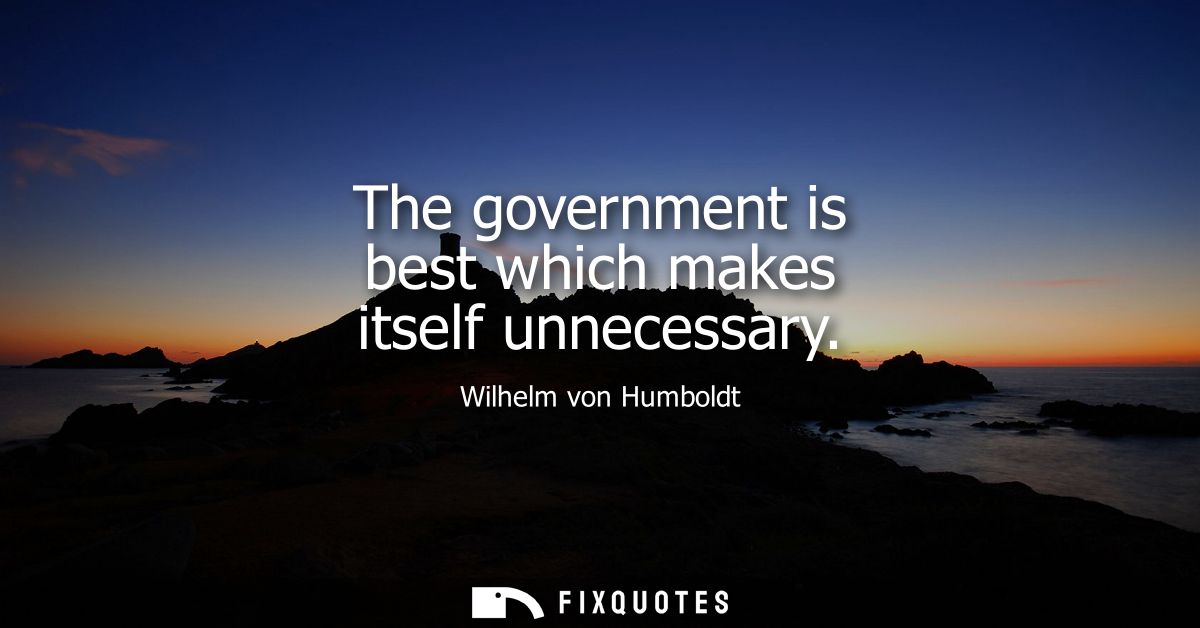
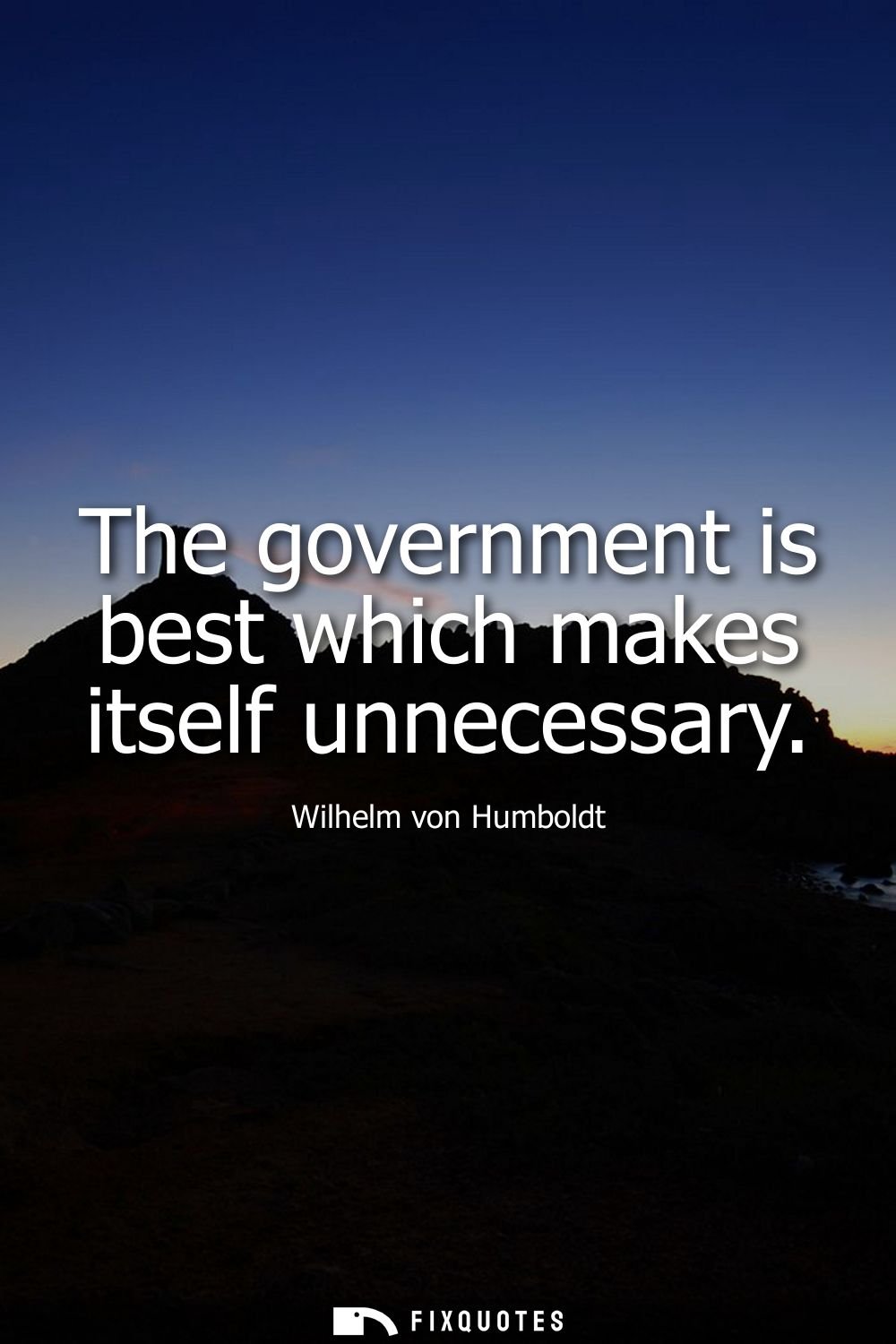
"The government is best which makes itself unnecessary"
About this Quote
A government that aims to disappear is a provocation precisely because it flips the usual sales pitch of the state. Humboldt isn’t praising chaos; he’s accusing power of mission creep. The line works as a moral stress test: if your institutions are healthy, they should produce citizens capable of living without constant supervision. If they can’t, then the “need” for government starts to look less like public safety and more like dependency by design.
Humboldt’s intent sits in the liberal, Enlightenment tradition that treated human development as the core political project. As an educator and theorist of Bildung (self-cultivation), he’s arguing that the best political order is the one that makes room for individuals to grow into autonomy. The state’s job is less to manage lives than to keep conditions stable enough for people to manage their own: protect basic rights, prevent violence, then get out of the way before it infantilizes the public.
The subtext is skeptical, almost parentally disappointed: the state should be a scaffold, not a permanent crutch. Read against the backdrop of late-18th and early-19th century Europe - absolutist monarchies, expanding bureaucracies, and the post-French Revolution argument about how much authority “progress” requires - the quote becomes a warning about paternalism marketed as benevolence.
It also smuggles in a hard question for modern governance: if programs and agencies must justify their existence, can any system built on perpetual administration ever admit it has succeeded? Humboldt’s ideal is not smallness for its own sake, but a politics measured by how little it needs to boss you around.
Humboldt’s intent sits in the liberal, Enlightenment tradition that treated human development as the core political project. As an educator and theorist of Bildung (self-cultivation), he’s arguing that the best political order is the one that makes room for individuals to grow into autonomy. The state’s job is less to manage lives than to keep conditions stable enough for people to manage their own: protect basic rights, prevent violence, then get out of the way before it infantilizes the public.
The subtext is skeptical, almost parentally disappointed: the state should be a scaffold, not a permanent crutch. Read against the backdrop of late-18th and early-19th century Europe - absolutist monarchies, expanding bureaucracies, and the post-French Revolution argument about how much authority “progress” requires - the quote becomes a warning about paternalism marketed as benevolence.
It also smuggles in a hard question for modern governance: if programs and agencies must justify their existence, can any system built on perpetual administration ever admit it has succeeded? Humboldt’s ideal is not smallness for its own sake, but a politics measured by how little it needs to boss you around.
Quote Details
| Topic | Freedom |
|---|---|
| Source | Help us find the source |
| Cite |
Citation Formats
APA Style (7th ed.)
Humboldt, Wilhelm von. (2026, January 16). The government is best which makes itself unnecessary. FixQuotes. https://fixquotes.com/quotes/the-government-is-best-which-makes-itself-94115/
Chicago Style
Humboldt, Wilhelm von. "The government is best which makes itself unnecessary." FixQuotes. January 16, 2026. https://fixquotes.com/quotes/the-government-is-best-which-makes-itself-94115/.
MLA Style (9th ed.)
"The government is best which makes itself unnecessary." FixQuotes, 16 Jan. 2026, https://fixquotes.com/quotes/the-government-is-best-which-makes-itself-94115/. Accessed 12 Feb. 2026.
More Quotes by Wilhelm
Add to List