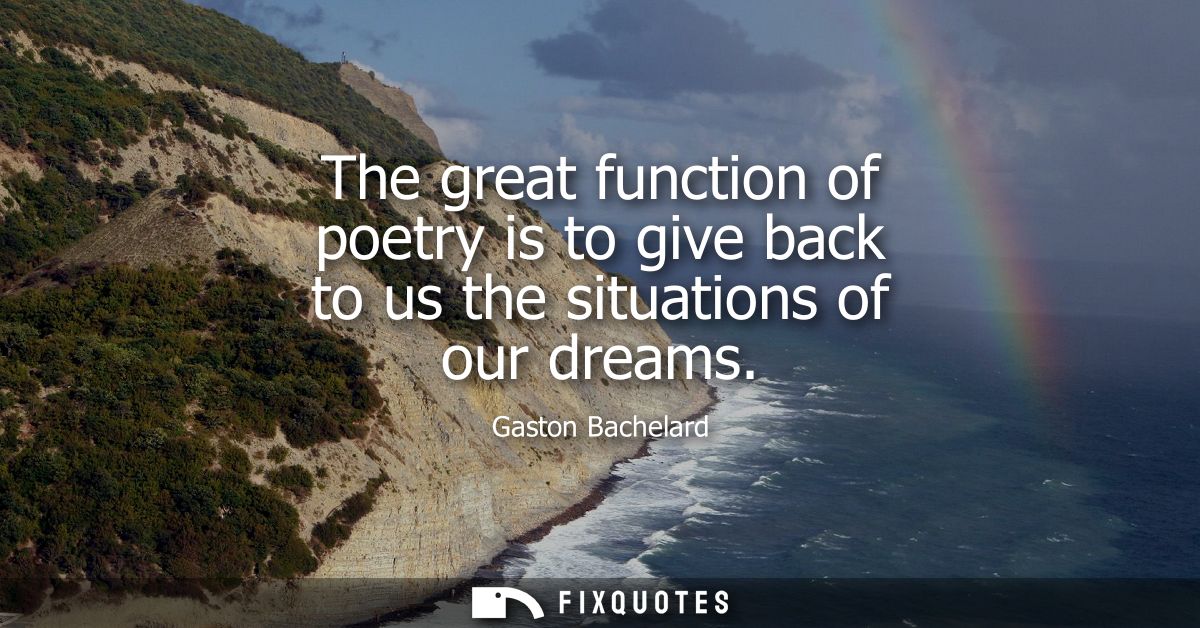
"The great function of poetry is to give back to us the situations of our dreams"
About this Quote
The line lands because it dodges the usual defense of art as “expression” or “beauty.” Function is a blunt, almost technical word, and it quietly frames poetry as a tool with an ethical job to do. He’s arguing against the idea that dreams are merely symbols to decode (the clinical, Freudian stance) or fantasy to outgrow (the industrial, rationalist stance). Instead, dreams are “situations” - lived scenes with texture, atmosphere, and emotional weather. Poetry doesn’t interpret them; it re-situates us inside them.
That emphasis on situation fits Bachelard’s broader project: a phenomenology of imagination attentive to houses, corners, drawers, nests - spaces where memory and reverie braid together. In the shadow of two world wars and accelerating mechanization, his claim reads like cultural resistance. Poetry becomes a way to reclaim interiority from systems that prefer us legible, productive, and awake. Dreams aren’t an escape hatch; they’re a suppressed homeland, and poems are the passport.
Quote Details
| Topic | Poetry |
|---|---|
| Source | Help us find the source |
| Cite |
Citation Formats
APA Style (7th ed.)
Bachelard, Gaston. (2026, January 18). The great function of poetry is to give back to us the situations of our dreams. FixQuotes. https://fixquotes.com/quotes/the-great-function-of-poetry-is-to-give-back-to-22622/
Chicago Style
Bachelard, Gaston. "The great function of poetry is to give back to us the situations of our dreams." FixQuotes. January 18, 2026. https://fixquotes.com/quotes/the-great-function-of-poetry-is-to-give-back-to-22622/.
MLA Style (9th ed.)
"The great function of poetry is to give back to us the situations of our dreams." FixQuotes, 18 Jan. 2026, https://fixquotes.com/quotes/the-great-function-of-poetry-is-to-give-back-to-22622/. Accessed 29 Mar. 2026.