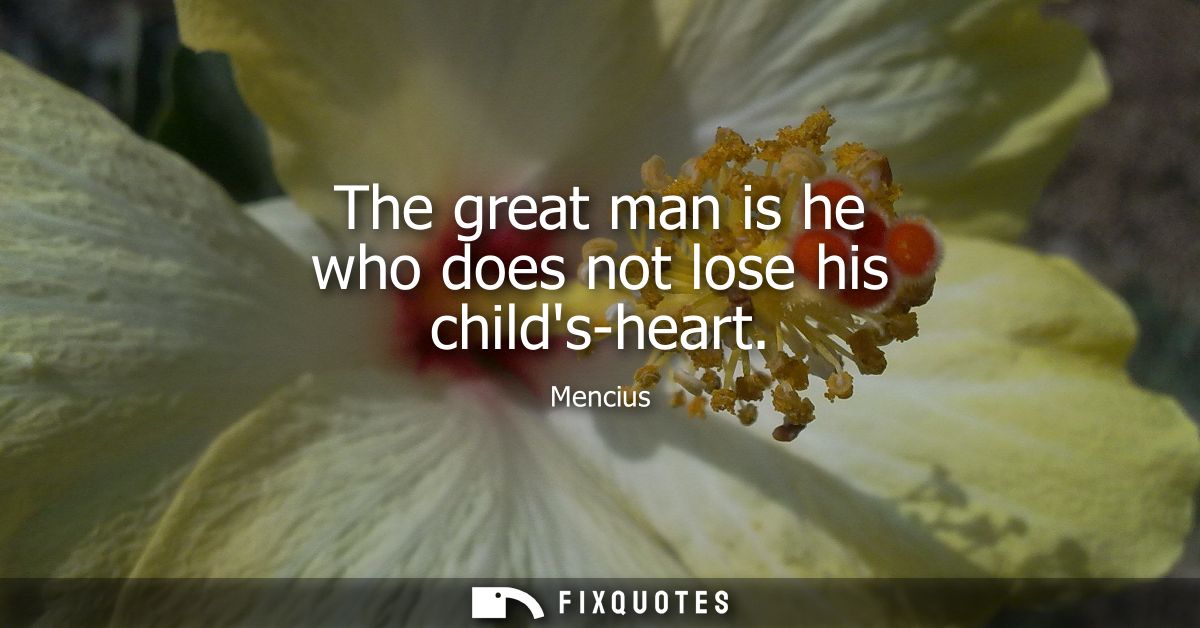
"The great man is he who does not lose his child's-heart"
About this Quote
Greatness, for Mencius, isn’t a matter of conquest or cold self-control; it’s the harder trick of staying morally porous. “Child’s-heart” doesn’t mean naivete or arrested development. It points to an original responsiveness: the quick, uncalculated impulse to care, to feel shame, to flinch at suffering. In Mencius’s moral psychology, those reflexes are the seedlings of virtue. Lose them and you don’t become sophisticated; you become hollow.
The line is also a quiet rebuke to the adult world that prides itself on “realism.” Warlords, bureaucrats, and strivers love to frame compassion as a luxury, something to be postponed until stability arrives. Mencius flips it: the capacity for humane feeling is the very proof of fitness to lead. The “great man” isn’t the one with the hardest shell; it’s the one who can absorb the pressures of power without letting them calcify his instincts.
Context matters. Mencius lived in the Warring States period, when political life rewarded suspicion and ruthlessness. His philosophy argues that human nature tends toward goodness, but only if it’s cultivated rather than crushed. “Not losing” is doing a lot of work here: it acknowledges that the child’s-heart is always under threat from fear, incentives, and social performance.
Subtext: maturity is often just the story we tell about moral compromise. Mencius offers a different ambition - not to outgrow tenderness, but to protect it, then scale it into policy, judgment, and courage.
The line is also a quiet rebuke to the adult world that prides itself on “realism.” Warlords, bureaucrats, and strivers love to frame compassion as a luxury, something to be postponed until stability arrives. Mencius flips it: the capacity for humane feeling is the very proof of fitness to lead. The “great man” isn’t the one with the hardest shell; it’s the one who can absorb the pressures of power without letting them calcify his instincts.
Context matters. Mencius lived in the Warring States period, when political life rewarded suspicion and ruthlessness. His philosophy argues that human nature tends toward goodness, but only if it’s cultivated rather than crushed. “Not losing” is doing a lot of work here: it acknowledges that the child’s-heart is always under threat from fear, incentives, and social performance.
Subtext: maturity is often just the story we tell about moral compromise. Mencius offers a different ambition - not to outgrow tenderness, but to protect it, then scale it into policy, judgment, and courage.
Quote Details
| Topic | Wisdom |
|---|---|
| Source | Help us find the source |
More Quotes by Mencius
Add to List