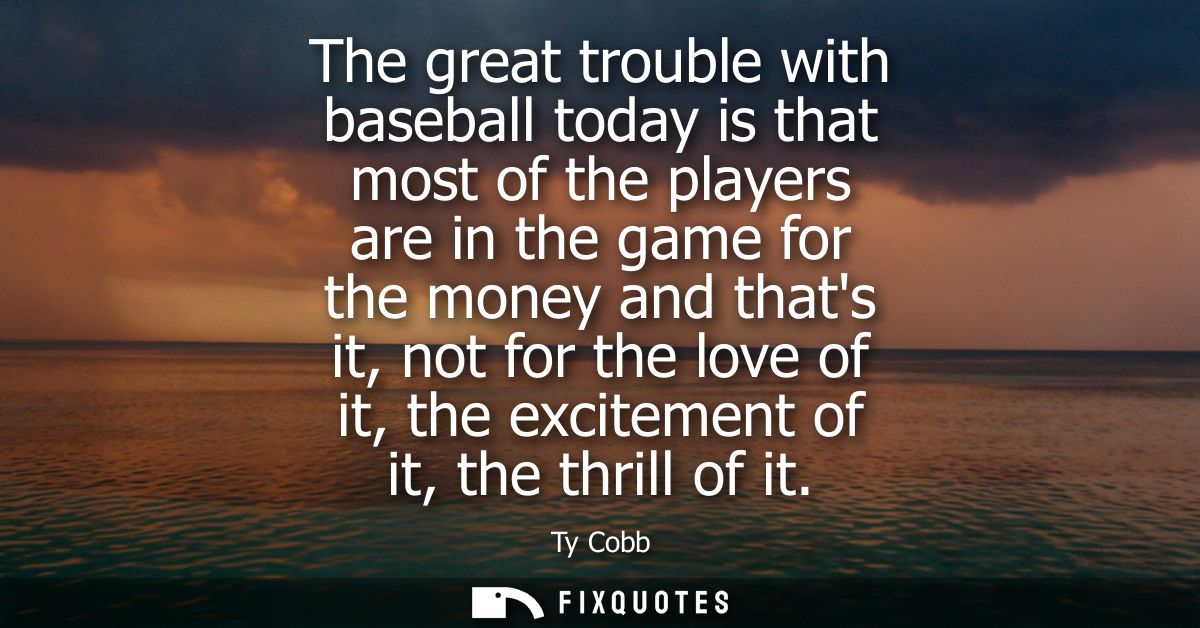
"The great trouble with baseball today is that most of the players are in the game for the money and that's it, not for the love of it, the excitement of it, the thrill of it"
About this Quote
Cobb’s gripe isn’t really about payroll; it’s about legitimacy. When he says the “great trouble” is players being “in the game for the money and that’s it,” he’s drawing a bright moral line between two kinds of athletes: the ones who treat baseball as a calling and the ones who treat it as a job. The rhythm of the sentence does the work. Money is framed as singular and dead-ended (“that’s it”), while devotion gets a three-beat crescendo (“love... excitement... thrill”) that sounds like breathless motion, the kind you’re supposed to feel watching the game. He’s not arguing statistics; he’s trying to shame a culture.
The subtext is older than free agency: nostalgia as a power move. Cobb, a brutal competitor from the early professional era, came up when players had far less leverage and the sport sold itself as gritty purity, even as owners profited handsomely. So the complaint carries a quiet double standard: it’s noble when the institution cashes in, corrupting when the labor does. That tension is the point, whether Cobb admits it or not.
Context matters, too: by mid-century, baseball was becoming a mass entertainment industry with radio, then television, bigger crowds, bigger contracts, bigger celebrity. Cobb is reacting to the sport’s modernization, but he’s also protecting a certain myth of masculinity and sacrifice: the idea that real players don’t talk about money, they prove themselves through “thrill.” It’s less a diagnosis than a demand that the game keep flattering its own romance.
The subtext is older than free agency: nostalgia as a power move. Cobb, a brutal competitor from the early professional era, came up when players had far less leverage and the sport sold itself as gritty purity, even as owners profited handsomely. So the complaint carries a quiet double standard: it’s noble when the institution cashes in, corrupting when the labor does. That tension is the point, whether Cobb admits it or not.
Context matters, too: by mid-century, baseball was becoming a mass entertainment industry with radio, then television, bigger crowds, bigger contracts, bigger celebrity. Cobb is reacting to the sport’s modernization, but he’s also protecting a certain myth of masculinity and sacrifice: the idea that real players don’t talk about money, they prove themselves through “thrill.” It’s less a diagnosis than a demand that the game keep flattering its own romance.
Quote Details
| Topic | Sports |
|---|
More Quotes by Ty
Add to List