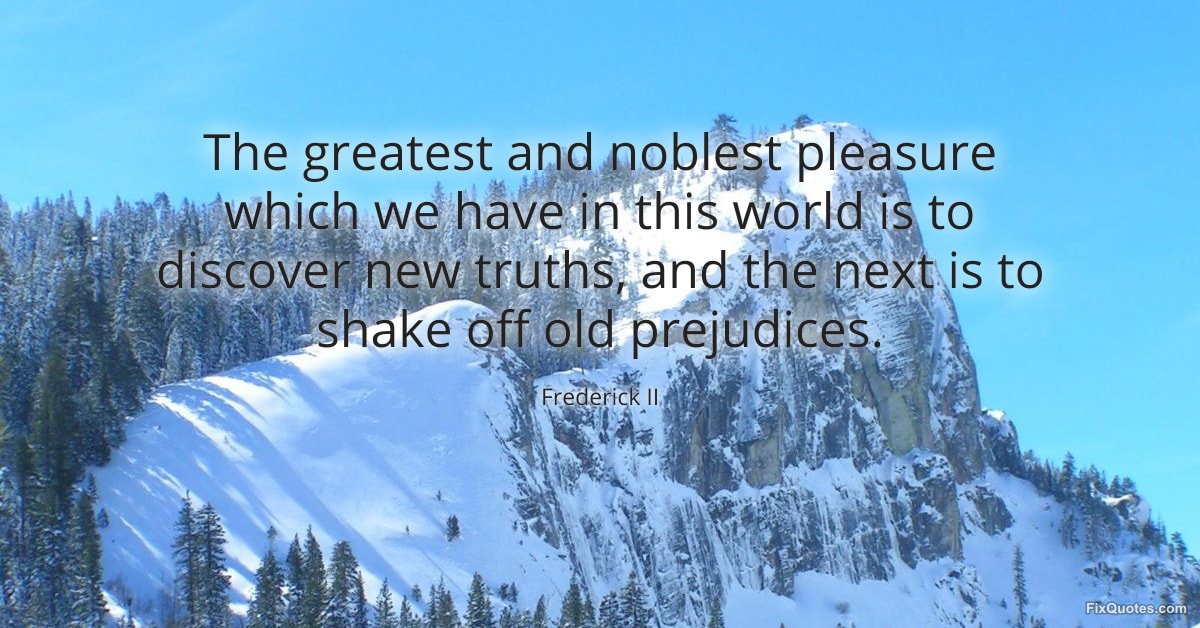
"The greatest and noblest pleasure which we have in this world is to discover new truths, and the next is to shake off old prejudices"
About this Quote
Then comes the sharper move: “the next is to shake off old prejudices.” The phrase is both self-congratulatory and strategic. “Old” makes prejudice sound antique, an inheritance that can be discarded like unfashionable clothing. “Shake off” implies effort but also a briskness, as if superstition and sectarianism are mere dust on a rational sleeve. Underneath is a political argument: modern states need modern minds. A Prussian ruler trying to centralize authority and professionalize governance has incentives to weaken the prestige of traditional gatekeepers - provincial nobles, clergy, inherited dogma - without openly declaring war on them.
Context matters: Frederick styled himself as an “enlightened despot,” corresponding with Voltaire while building a disciplined military machine. The subtext is that reason can be officially sponsored, even weaponized: truth-seeking as both cultural capital and administrative tool. It’s a vision of progress that is sincere, but also carefully managed - liberty for ideas, on terms set by the crown.
Quote Details
| Topic | Knowledge |
|---|---|
| Source | Help us find the source |
| Cite |
Citation Formats
APA Style (7th ed.)
II, Frederick. (2026, January 15). The greatest and noblest pleasure which we have in this world is to discover new truths, and the next is to shake off old prejudices. FixQuotes. https://fixquotes.com/quotes/the-greatest-and-noblest-pleasure-which-we-have-104779/
Chicago Style
II, Frederick. "The greatest and noblest pleasure which we have in this world is to discover new truths, and the next is to shake off old prejudices." FixQuotes. January 15, 2026. https://fixquotes.com/quotes/the-greatest-and-noblest-pleasure-which-we-have-104779/.
MLA Style (9th ed.)
"The greatest and noblest pleasure which we have in this world is to discover new truths, and the next is to shake off old prejudices." FixQuotes, 15 Jan. 2026, https://fixquotes.com/quotes/the-greatest-and-noblest-pleasure-which-we-have-104779/. Accessed 31 Mar. 2026.