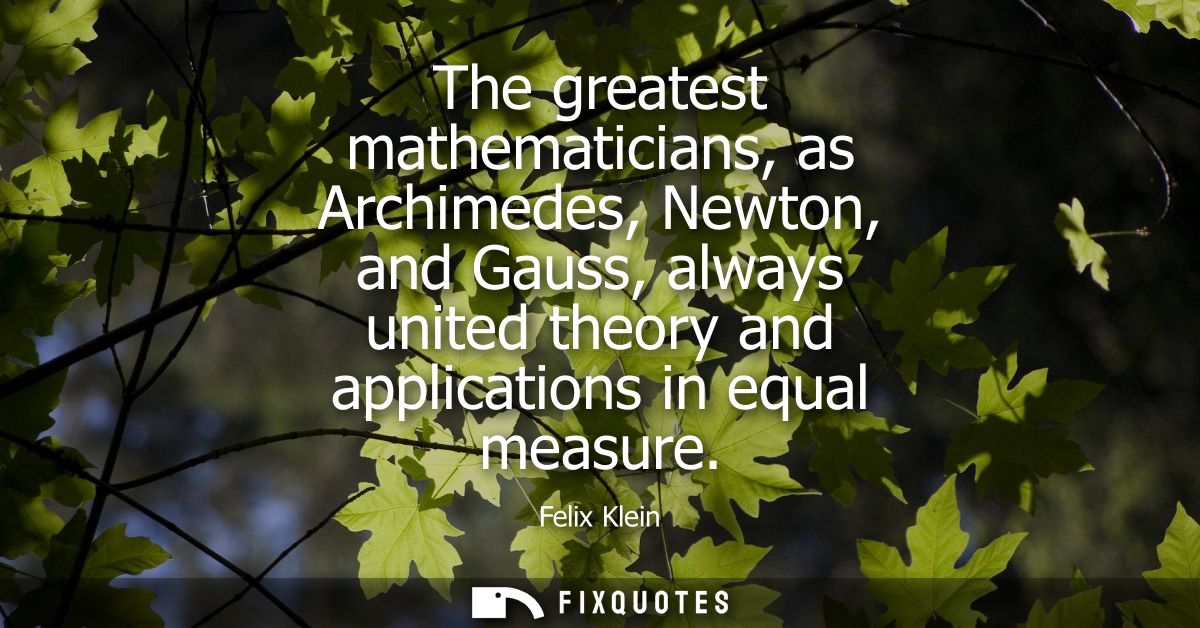
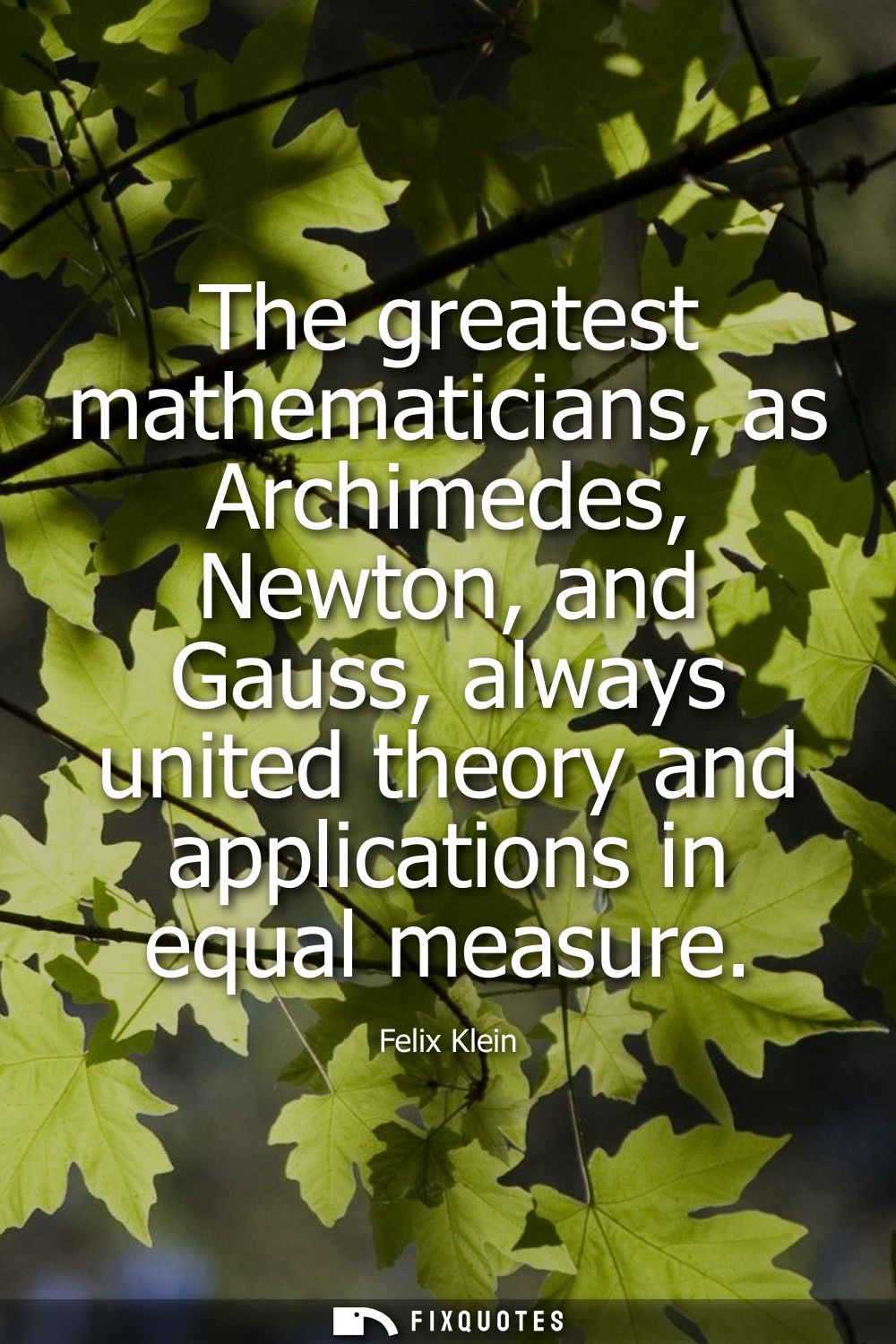
"The greatest mathematicians, as Archimedes, Newton, and Gauss, always united theory and applications in equal measure"
About this Quote
The subtext is aimed at a professional culture that, by Klein’s time, was splintering into specialties and status hierarchies. Late 19th-century German mathematics was busy formalizing itself, building institutions, and rewarding technical purity. Klein, a central architect of modern mathematical education and a bridge-builder between universities and engineering schools, resists a future where application is treated as second-class labor and theory as the only prestige game. His phrase “in equal measure” is the knife twist: not “occasionally applied,” not “useful in the end,” but structurally inseparable.
Rhetorically, it works because it turns history into a norm. If the “greatest” did both, then the division is not sophistication; it’s a narrowing. Klein is arguing that relevance isn’t a concession to industry or pedagogy. It’s part of mathematical greatness itself.
Quote Details
| Topic | Knowledge |
|---|---|
| Source | Help us find the source |
| Cite |
Citation Formats
APA Style (7th ed.)
Klein, Felix. (2026, January 16). The greatest mathematicians, as Archimedes, Newton, and Gauss, always united theory and applications in equal measure. FixQuotes. https://fixquotes.com/quotes/the-greatest-mathematicians-as-archimedes-newton-84068/
Chicago Style
Klein, Felix. "The greatest mathematicians, as Archimedes, Newton, and Gauss, always united theory and applications in equal measure." FixQuotes. January 16, 2026. https://fixquotes.com/quotes/the-greatest-mathematicians-as-archimedes-newton-84068/.
MLA Style (9th ed.)
"The greatest mathematicians, as Archimedes, Newton, and Gauss, always united theory and applications in equal measure." FixQuotes, 16 Jan. 2026, https://fixquotes.com/quotes/the-greatest-mathematicians-as-archimedes-newton-84068/. Accessed 22 Mar. 2026.