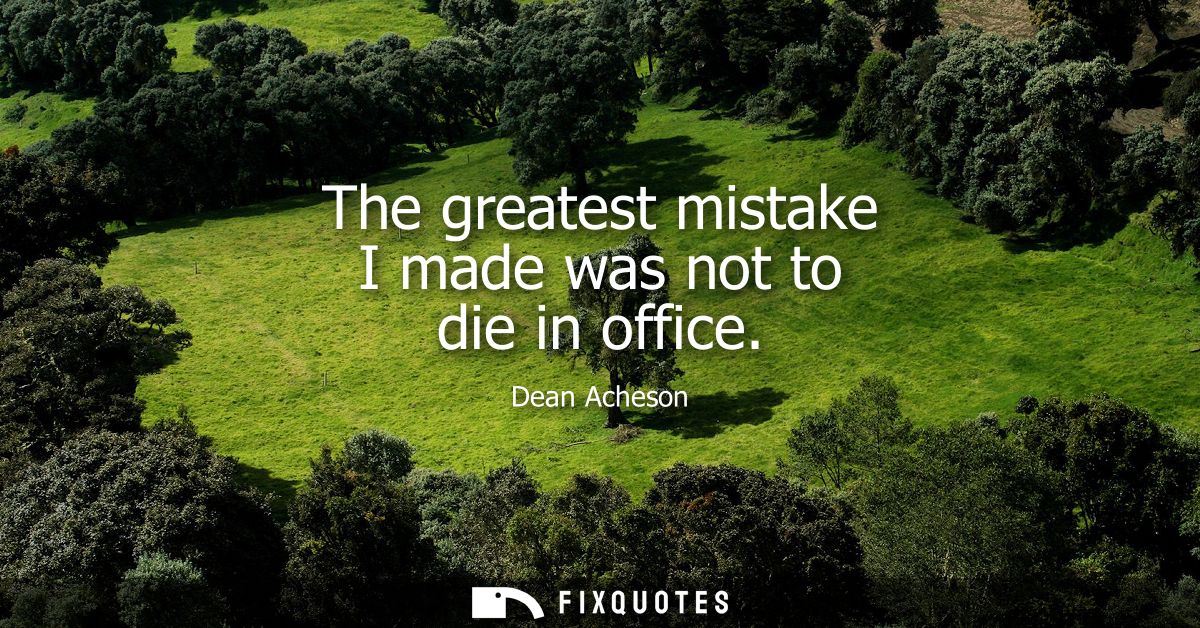
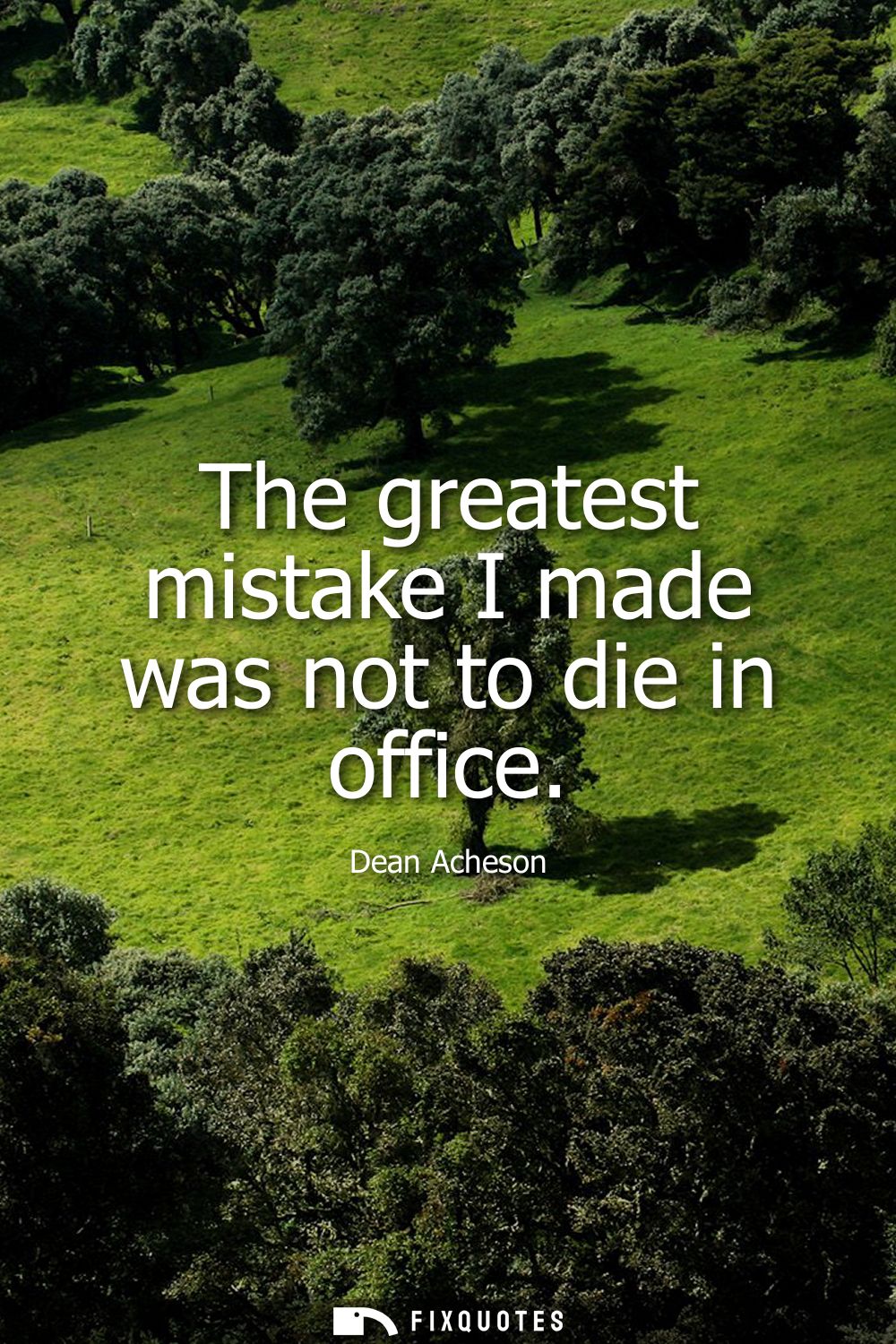
"The greatest mistake I made was not to die in office"
About this Quote
Acheson’s line lands with the dry, almost prosecutorial bite of a man who understood Washington’s most reliable alchemy: turn a living official into a complicated one, but a dead one into a monument. “The greatest mistake” is a lawyerly setup for self-critique, yet the “mistake” he names isn’t a policy failure. It’s survival. That inversion is the joke and the indictment.
As Truman’s Secretary of State and one of the chief architects of the early Cold War order (NATO, containment’s institutional muscle), Acheson spent his career making consequential choices under conditions that rarely permit moral cleanliness. The subtext is that once you’re out of office, history stops being about what you did and becomes about what you’re useful for: a scapegoat for new factions, a symbol for old ones, a convenient villain when the mood turns. Dying “in office” would have frozen his reputation at the peak of official legitimacy, before hindsight, partisan score-settling, and revisionist appetites could sandblast the nuance.
There’s also a darker realism about American political memory. We claim to prize accountability, but we often reward exit narratives: resignation, martyrdom, the tragic arc. Staying alive means staying available to be contradicted by events, subpoenaed by commentators, and judged by standards invented after the fact. Acheson is winking, but not lightly. The line is a veteran’s admission that in politics, legacy is less an earned record than a timing advantage.
As Truman’s Secretary of State and one of the chief architects of the early Cold War order (NATO, containment’s institutional muscle), Acheson spent his career making consequential choices under conditions that rarely permit moral cleanliness. The subtext is that once you’re out of office, history stops being about what you did and becomes about what you’re useful for: a scapegoat for new factions, a symbol for old ones, a convenient villain when the mood turns. Dying “in office” would have frozen his reputation at the peak of official legitimacy, before hindsight, partisan score-settling, and revisionist appetites could sandblast the nuance.
There’s also a darker realism about American political memory. We claim to prize accountability, but we often reward exit narratives: resignation, martyrdom, the tragic arc. Staying alive means staying available to be contradicted by events, subpoenaed by commentators, and judged by standards invented after the fact. Acheson is winking, but not lightly. The line is a veteran’s admission that in politics, legacy is less an earned record than a timing advantage.
Quote Details
| Topic | Dark Humor |
|---|---|
| Source | Help us find the source |
| Cite |
Citation Formats
APA Style (7th ed.)
Acheson, Dean. (2026, January 17). The greatest mistake I made was not to die in office. FixQuotes. https://fixquotes.com/quotes/the-greatest-mistake-i-made-was-not-to-die-in-67470/
Chicago Style
Acheson, Dean. "The greatest mistake I made was not to die in office." FixQuotes. January 17, 2026. https://fixquotes.com/quotes/the-greatest-mistake-i-made-was-not-to-die-in-67470/.
MLA Style (9th ed.)
"The greatest mistake I made was not to die in office." FixQuotes, 17 Jan. 2026, https://fixquotes.com/quotes/the-greatest-mistake-i-made-was-not-to-die-in-67470/. Accessed 14 Mar. 2026.
More Quotes by Dean
Add to List