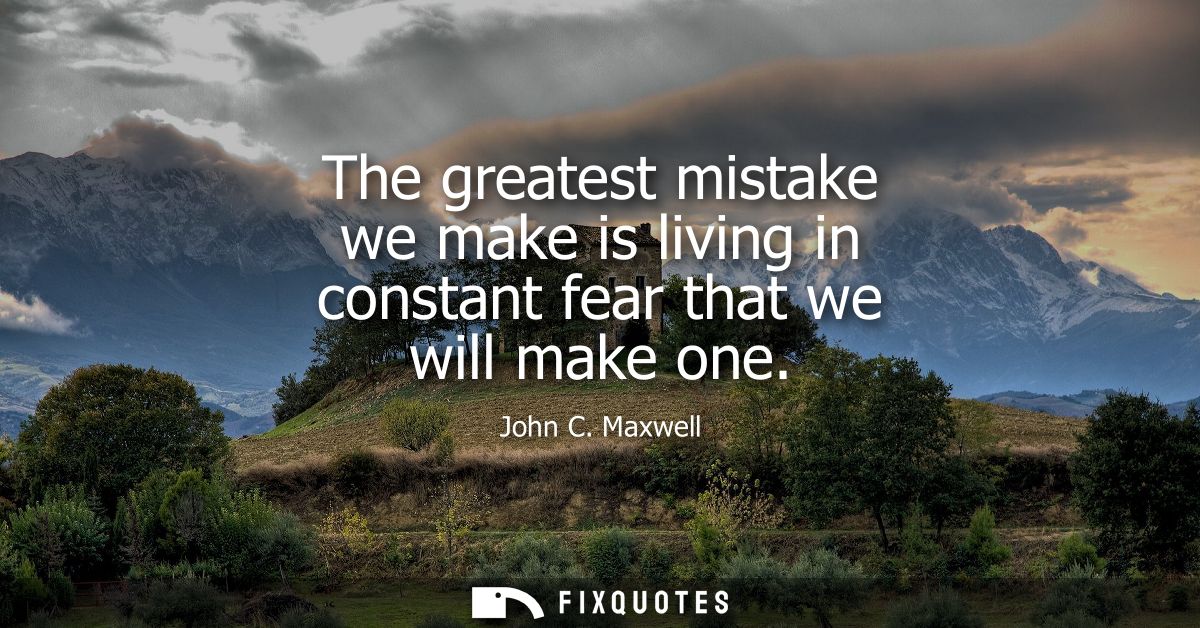
"The greatest mistake we make is living in constant fear that we will make one"
About this Quote
The subtext is about agency and stewardship, two concepts that sit comfortably in a clergyman’s worldview even when the language is boardroom-friendly. Maxwell’s broader brand has long lived at the intersection of church and leadership seminar, so this sentence works as a bridge: it can be read as spiritual counsel (anxiety as a form of unbelief) or as pragmatic coaching (overcaution as the real career killer). Either way, the implied opponent isn’t “sin” or “failure” but paralysis - the kind that lets you stay morally clean while staying small.
Context matters because Maxwell speaks to audiences trained to optimize themselves. In that environment, “mistake” becomes a kind of secular shame, a permanent mark. He flips that script: the catastrophe isn’t messing up; it’s letting the fear of messing up dictate your choices. The line functions like permission, but with a rebuke tucked inside: you’re not being careful, you’re being ruled.
Quote Details
| Topic | Learning from Mistakes |
|---|---|
| Source | Help us find the source |
| Cite |
Citation Formats
APA Style (7th ed.)
Maxwell, John C. (2026, January 17). The greatest mistake we make is living in constant fear that we will make one. FixQuotes. https://fixquotes.com/quotes/the-greatest-mistake-we-make-is-living-in-32111/
Chicago Style
Maxwell, John C. "The greatest mistake we make is living in constant fear that we will make one." FixQuotes. January 17, 2026. https://fixquotes.com/quotes/the-greatest-mistake-we-make-is-living-in-32111/.
MLA Style (9th ed.)
"The greatest mistake we make is living in constant fear that we will make one." FixQuotes, 17 Jan. 2026, https://fixquotes.com/quotes/the-greatest-mistake-we-make-is-living-in-32111/. Accessed 12 Feb. 2026.