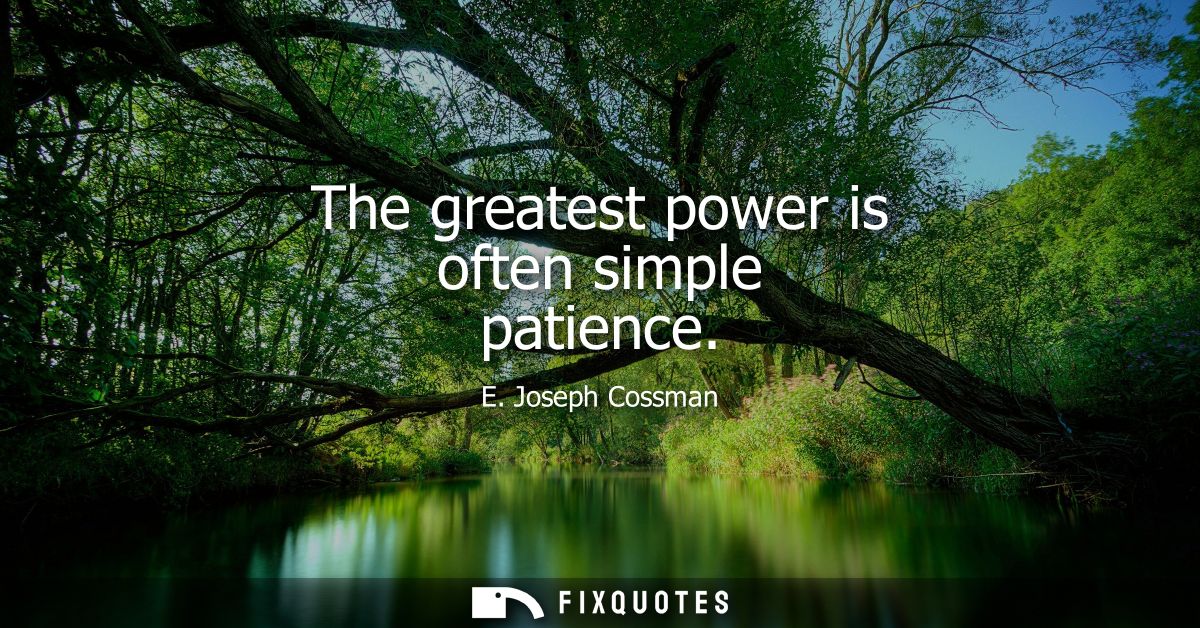
"The greatest power is often simple patience"
About this Quote
“The greatest power” is a deliberately provocative phrase for a businessman to deploy, because it borrows the vocabulary of conquest and reassigns it to restraint. Cossman isn’t praising passivity; he’s reframing patience as an active advantage - a competitive edge disguised as calm. In commerce, “power” usually means capital, leverage, speed, information. Patience sounds like the opposite: waiting around. The line works because it flips that instinct and quietly suggests that the real winners aren’t the loudest or the fastest; they’re the ones who can tolerate discomfort longer than everyone else.
The subtext is about asymmetry. Impatience is expensive: it forces bad deals, premature hires, rushed product launches, reactive leadership. Patience, by contrast, is a way to let other people reveal their motives, let markets clarify, let a negotiation ripen, let a crisis burn off its emotional steam. “Simple” matters here: it implies the tool is available to anyone, but actually practiced by few. That’s the businessman’s sly moral: the barrier isn’t access, it’s temperament.
Contextually, this reads like mid-century American managerial wisdom - the kind of maxim aimed at salespeople, founders, and executives who confuse motion with progress. It’s also a quiet critique of the hustle ethos before it had a name. Patience becomes not a virtue for saints, but a discipline for operators: the capacity to delay gratification, outlast noise, and make time do part of the work.
The subtext is about asymmetry. Impatience is expensive: it forces bad deals, premature hires, rushed product launches, reactive leadership. Patience, by contrast, is a way to let other people reveal their motives, let markets clarify, let a negotiation ripen, let a crisis burn off its emotional steam. “Simple” matters here: it implies the tool is available to anyone, but actually practiced by few. That’s the businessman’s sly moral: the barrier isn’t access, it’s temperament.
Contextually, this reads like mid-century American managerial wisdom - the kind of maxim aimed at salespeople, founders, and executives who confuse motion with progress. It’s also a quiet critique of the hustle ethos before it had a name. Patience becomes not a virtue for saints, but a discipline for operators: the capacity to delay gratification, outlast noise, and make time do part of the work.
Quote Details
| Topic | Wisdom |
|---|---|
| Source | Help us find the source |
| Cite |
Citation Formats
APA Style (7th ed.)
Cossman, E. Joseph. (2026, January 15). The greatest power is often simple patience. FixQuotes. https://fixquotes.com/quotes/the-greatest-power-is-often-simple-patience-155364/
Chicago Style
Cossman, E. Joseph. "The greatest power is often simple patience." FixQuotes. January 15, 2026. https://fixquotes.com/quotes/the-greatest-power-is-often-simple-patience-155364/.
MLA Style (9th ed.)
"The greatest power is often simple patience." FixQuotes, 15 Jan. 2026, https://fixquotes.com/quotes/the-greatest-power-is-often-simple-patience-155364/. Accessed 1 Apr. 2026.
More Quotes by Joseph Cossman
Add to List