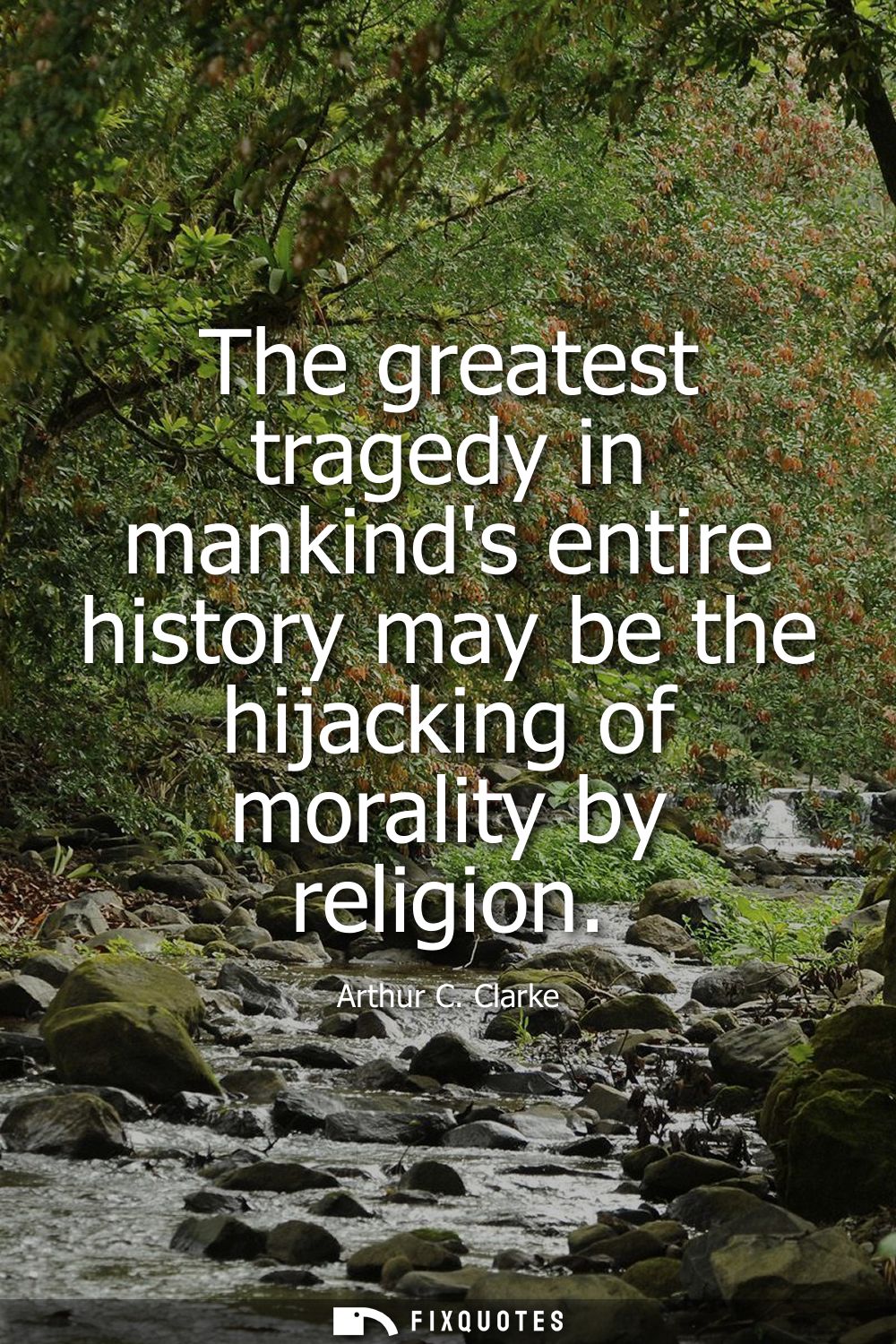
"The greatest tragedy in mankind's entire history may be the hijacking of morality by religion"
About this Quote
The intent is less to dunk on private faith than to indict the historical merger of ethics with clerical power. Once morality is narrated as divine property, dissent becomes sin, and moral debate gets replaced by obedience. That’s the subtextual move: religion isn’t merely a set of beliefs; it becomes a monopolist of conscience, able to launder politics as “truth” and punish rivals as heresy. The tragedy, for Clarke, isn’t that people believe, but that belief can be leveraged to freeze moral evolution - to keep norms anchored to ancient texts while society changes at the speed of science.
Context matters. Clarke wrote in the long shadow of the 20th century: world wars, genocides, nuclear terror - catastrophes often justified with national myths and sometimes sanctified by religious language. At the same time, he watched scientific modernity explode outward: satellites, spaceflight, computing. His worldview bets that ethics should expand with knowledge, guided by empathy and evidence rather than revelation.
The line works because it flips a familiar script. Religion often advertises itself as morality’s guardian; Clarke recasts it as morality’s hostage-taker. It’s a provocation designed to force a hard question: who gets to define “good,” and what happens when that power is treated as untouchable?
Quote Details
| Topic | Ethics & Morality |
|---|---|
| Source | Later attribution: Arthur C. Clarke (Arthur C. Clarke) modern compilation
Evidence: ys 19341998 1999 p 360 the greatest tragedy in mankinds entire history may be the hijacking of morality by religion Other candidates (1) Uprooting the Root of all Evil (John W. Casperson, 2015) compilation95.0% ... Arthur C. Clarke (1917– 2008) rightly noted, “The greatest tragedy in mankind's entire history may be the hijacki... |
| Cite |
Citation Formats
APA Style (7th ed.)
Clarke, Arthur C. (2026, January 13). The greatest tragedy in mankind's entire history may be the hijacking of morality by religion. FixQuotes. https://fixquotes.com/quotes/the-greatest-tragedy-in-mankinds-entire-history-6477/
Chicago Style
Clarke, Arthur C. "The greatest tragedy in mankind's entire history may be the hijacking of morality by religion." FixQuotes. January 13, 2026. https://fixquotes.com/quotes/the-greatest-tragedy-in-mankinds-entire-history-6477/.
MLA Style (9th ed.)
"The greatest tragedy in mankind's entire history may be the hijacking of morality by religion." FixQuotes, 13 Jan. 2026, https://fixquotes.com/quotes/the-greatest-tragedy-in-mankinds-entire-history-6477/. Accessed 24 Mar. 2026.