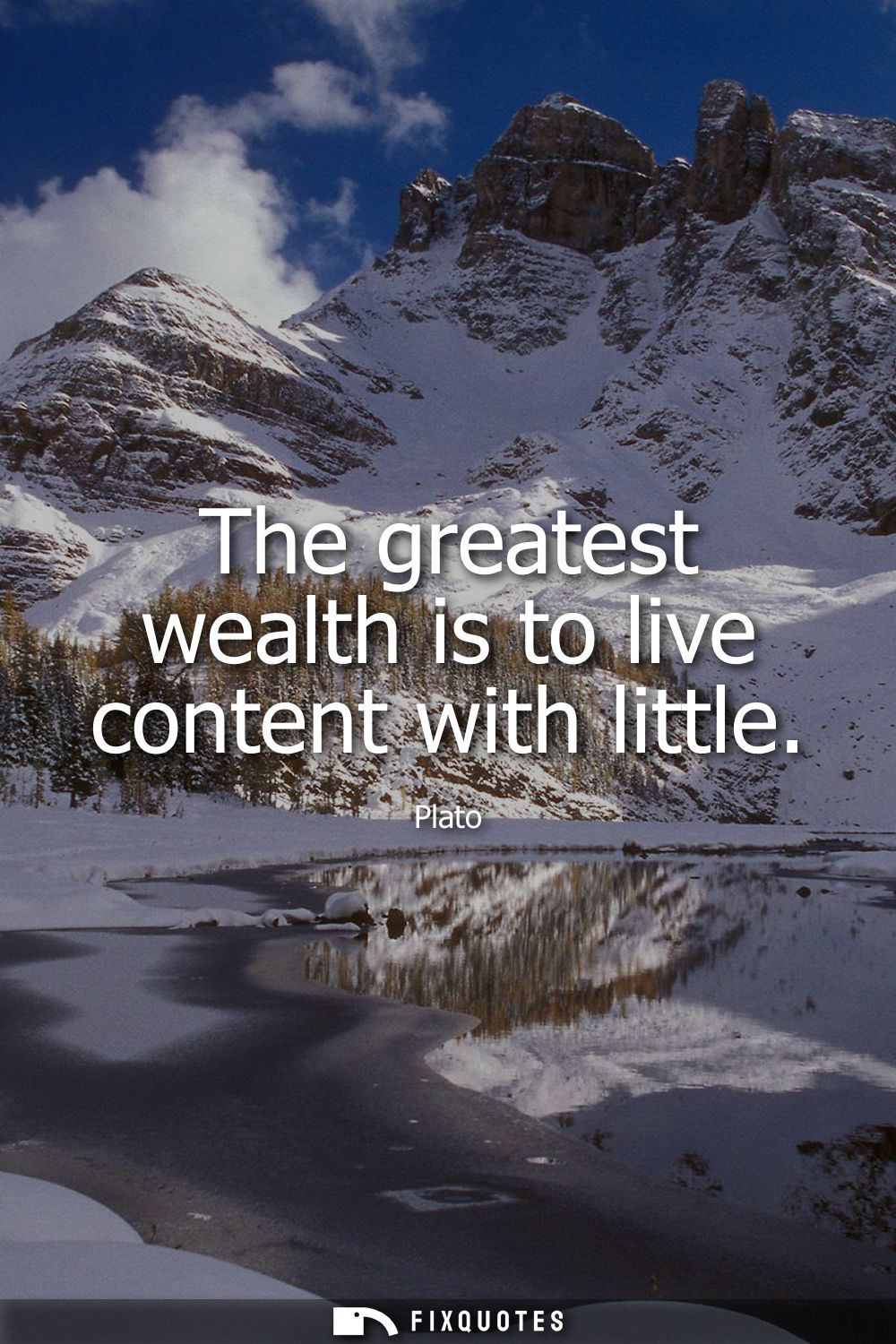
"The greatest wealth is to live content with little"
About this Quote
A culture that treats desire like a gas pedal isn’t going to love Plato’s punchline: real wealth looks suspiciously like restraint. “The greatest wealth is to live content with little” smuggles an argument about power under the guise of a moral aphorism. It’s not praising poverty; it’s demoting possessions from the role of life’s scorecard. Plato’s move is rhetorical judo: he redefines “wealth” away from what can be hoarded and toward what can’t be easily taken - an internal steadiness that makes you harder to govern through bribery, fear, or envy.
The intent is philosophical but also political. In Plato’s Athens, money and public opinion could buy influence, and the city’s democracy often rewarded performance over wisdom. Contentment with little becomes a kind of civic armor: if you don’t need much, you’re less corruptible, less distractible, less likely to confuse appetite with purpose. Subtext: endless acquisition isn’t ambition, it’s dependency. A person who can’t stop wanting is, in Plato’s terms, already impoverished.
The line also echoes his broader suspicion of the body’s cravings and the marketplace’s seductions. Plato doesn’t trust desire because desire doesn’t settle; it escalates. By making “content” the metric, he shifts the battleground from external status to internal order - the same logic behind his ideal of a well-governed soul. The sting is modern: if your happiness requires “more,” you’ve outsourced your freedom to the next purchase.
The intent is philosophical but also political. In Plato’s Athens, money and public opinion could buy influence, and the city’s democracy often rewarded performance over wisdom. Contentment with little becomes a kind of civic armor: if you don’t need much, you’re less corruptible, less distractible, less likely to confuse appetite with purpose. Subtext: endless acquisition isn’t ambition, it’s dependency. A person who can’t stop wanting is, in Plato’s terms, already impoverished.
The line also echoes his broader suspicion of the body’s cravings and the marketplace’s seductions. Plato doesn’t trust desire because desire doesn’t settle; it escalates. By making “content” the metric, he shifts the battleground from external status to internal order - the same logic behind his ideal of a well-governed soul. The sting is modern: if your happiness requires “more,” you’ve outsourced your freedom to the next purchase.
Quote Details
| Topic | Contentment |
|---|
More Quotes by Plato
Add to List