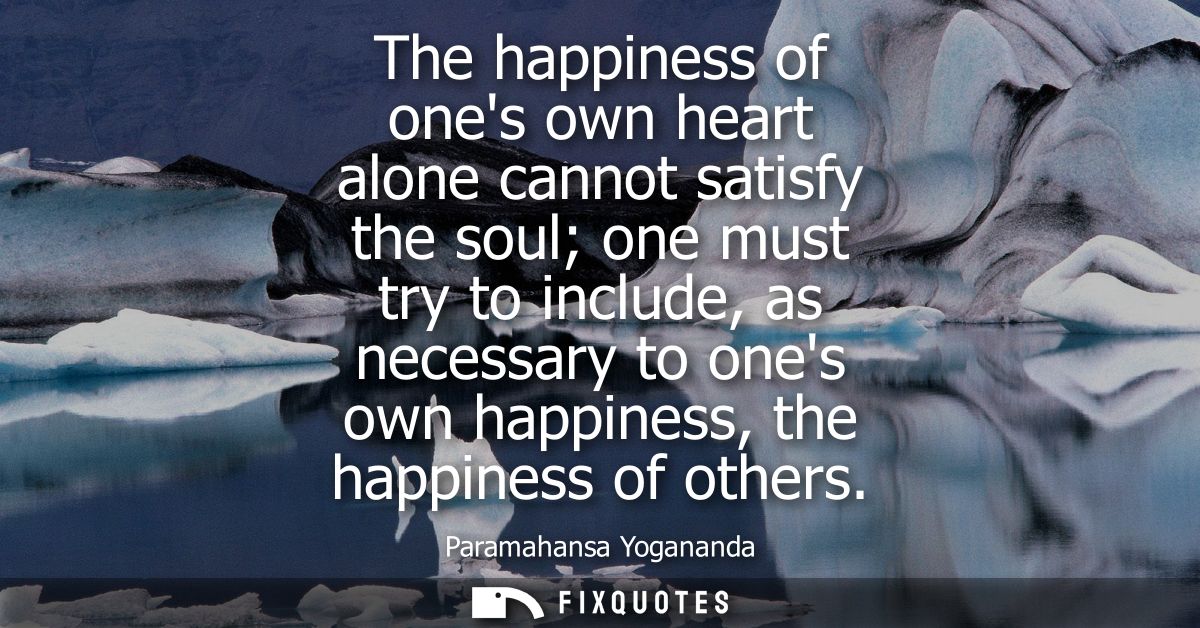
"The happiness of one's own heart alone cannot satisfy the soul; one must try to include, as necessary to one's own happiness, the happiness of others"
About this Quote
The quote’s intent is quietly disciplinary. It doesn’t ask you to be nice; it asks you to re-engineer your definition of happiness. "One must try to include" makes altruism less like charity and more like architecture: you build other people’s well-being into the load-bearing structure of your own. The subtext is that most of us treat compassion as optional, a bonus feature we add when time and bandwidth allow. Yogananda flips that: if you want lasting peace, the joy of others can’t be a side quest, it has to be part of the main story.
Context matters: Yogananda was a spiritual leader who brought yogic philosophy to a modernizing, increasingly individualistic 20th century, especially in the U.S. In that setting, this reads like a counter-program to the cult of personal fulfillment. He’s not condemning happiness; he’s warning that when it’s pursued as a private possession, it curdles into anxiety and isolation. The rhetorical power lies in its calm inevitability: a soul that wants wholeness will keep bumping into other people, whether you planned for it or not.
Quote Details
| Topic | Happiness |
|---|---|
| Source | Help us find the source |
| Cite |
Citation Formats
APA Style (7th ed.)
Yogananda, Paramahansa. (2026, January 17). The happiness of one's own heart alone cannot satisfy the soul; one must try to include, as necessary to one's own happiness, the happiness of others. FixQuotes. https://fixquotes.com/quotes/the-happiness-of-ones-own-heart-alone-cannot-26209/
Chicago Style
Yogananda, Paramahansa. "The happiness of one's own heart alone cannot satisfy the soul; one must try to include, as necessary to one's own happiness, the happiness of others." FixQuotes. January 17, 2026. https://fixquotes.com/quotes/the-happiness-of-ones-own-heart-alone-cannot-26209/.
MLA Style (9th ed.)
"The happiness of one's own heart alone cannot satisfy the soul; one must try to include, as necessary to one's own happiness, the happiness of others." FixQuotes, 17 Jan. 2026, https://fixquotes.com/quotes/the-happiness-of-ones-own-heart-alone-cannot-26209/. Accessed 31 Mar. 2026.