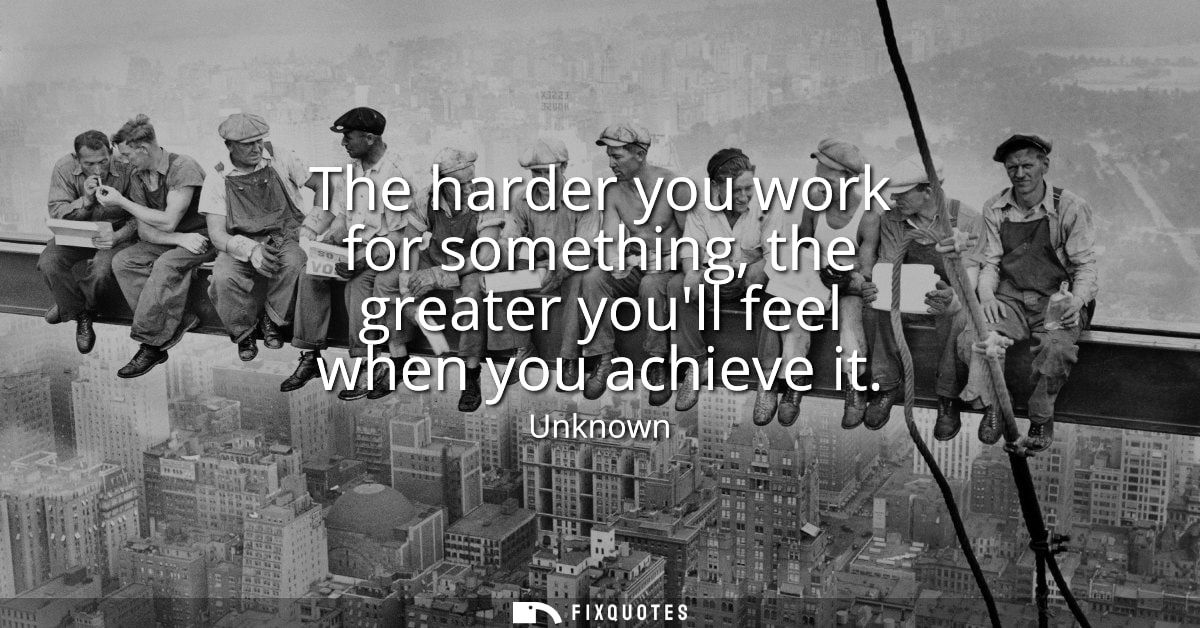
"The harder you work for something, the greater you'll feel when you achieve it"
About this Quote
Meritocracy in a single sentence, polished until it shines. "The harder you work for something, the greater you'll feel when you achieve it" isn’t really offering career advice so much as selling an emotional economy: put in effort now, get a bigger payoff later. The line works because it ties achievement to feeling, not to money, status, or even the thing itself. It’s a promise about interior reward, which is harder to fact-check and easier to believe.
The subtext is quietly moralistic. Hard work isn’t just instrumental; it’s positioned as the correct route to satisfaction, implying that ease cheapens joy. That’s a comforting idea in cultures that glorify hustle, because it turns struggle into proof of worth. If you’re exhausted, at least you’re on the "right" path. The quote also functions as self-defense against envy: if someone else succeeds faster, you can still claim the superior prize - deeper fulfillment.
Its context is the motivational-industrial complex: posters, graduation speeches, gym walls, productivity feeds. That ecosystem thrives on tidy cause-and-effect, and this line is tidy. It skips the messy variables (luck, nepotism, health, timing, discrimination) because acknowledging them would weaken the bargain it’s trying to make. It’s aspiration with the sharp edges sanded off.
As a mantra, it can be useful: effort often does intensify attachment, and earned wins do land differently. As a worldview, it’s risky - it can blame the unsuccessful for not suffering correctly, and romanticize burnout as the price of meaning.
The subtext is quietly moralistic. Hard work isn’t just instrumental; it’s positioned as the correct route to satisfaction, implying that ease cheapens joy. That’s a comforting idea in cultures that glorify hustle, because it turns struggle into proof of worth. If you’re exhausted, at least you’re on the "right" path. The quote also functions as self-defense against envy: if someone else succeeds faster, you can still claim the superior prize - deeper fulfillment.
Its context is the motivational-industrial complex: posters, graduation speeches, gym walls, productivity feeds. That ecosystem thrives on tidy cause-and-effect, and this line is tidy. It skips the messy variables (luck, nepotism, health, timing, discrimination) because acknowledging them would weaken the bargain it’s trying to make. It’s aspiration with the sharp edges sanded off.
As a mantra, it can be useful: effort often does intensify attachment, and earned wins do land differently. As a worldview, it’s risky - it can blame the unsuccessful for not suffering correctly, and romanticize burnout as the price of meaning.
Quote Details
| Topic | Motivational |
|---|---|
| Source | Later attribution: Sacrifice (Unknown) modern compilation
Evidence:
the door in the future so you offer something to the negative goddess so that the positive one |
| Featured | This quote was our Quote of the Day on August 14, 2023 |
More Quotes by Unknown
Add to List