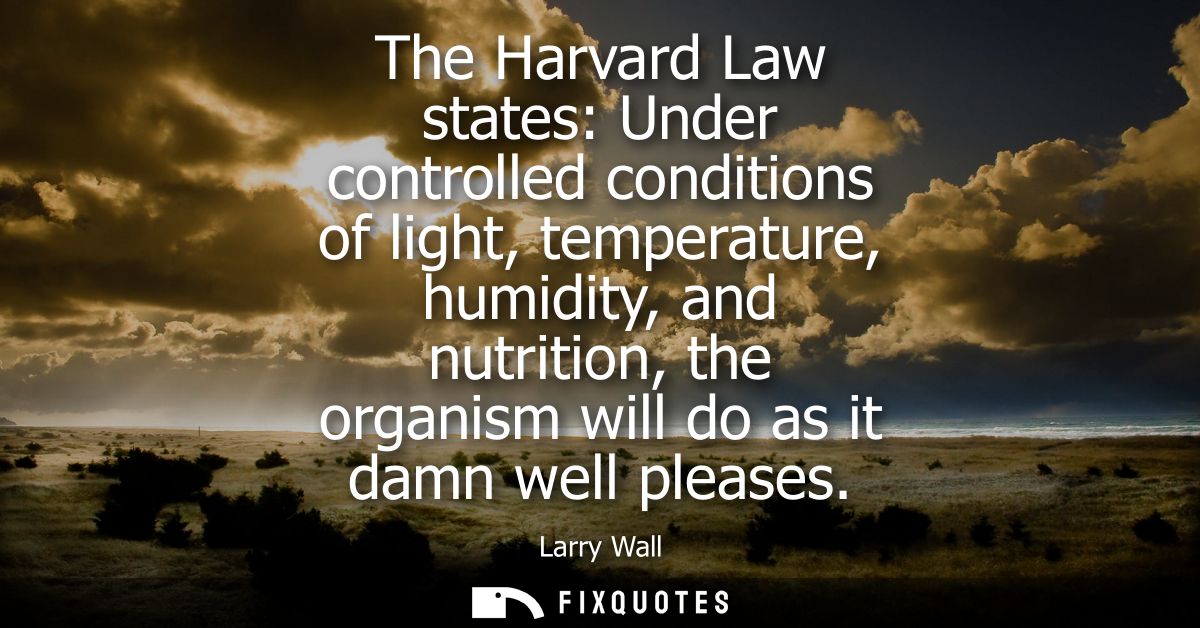
"The Harvard Law states: Under controlled conditions of light, temperature, humidity, and nutrition, the organism will do as it damn well pleases"
About this Quote
The subtext is a critique of systems thinking when it becomes overconfident. You can standardize light, temperature, humidity, and nutrition, but you can’t standardize complexity. Living things, like users and software systems, contain feedback loops, emergent behavior, and edge cases that don’t announce themselves on the spec sheet. The line “will do as it damn well pleases” reframes “failure” as a category error: the organism isn’t malfunctioning; your model of it is incomplete.
Context matters because Wall is best known for creating Perl and for championing practical, human-centered computing. Read through that lens, “Harvard Law” is also a jab at rigid, top-down design philosophies. It’s an argument for humility and adaptability: build tools that expect variability rather than punishing it, design experiments that respect mess, and admit that control is always partial. The joke lands because it’s not cynicism for sport; it’s a survival tip dressed as a one-liner.
Quote Details
| Topic | Witty One-Liners |
|---|---|
| Source | Help us find the source |
| Cite |
Citation Formats
APA Style (7th ed.)
Wall, Larry. (2026, January 16). The Harvard Law states: Under controlled conditions of light, temperature, humidity, and nutrition, the organism will do as it damn well pleases. FixQuotes. https://fixquotes.com/quotes/the-harvard-law-states-under-controlled-107584/
Chicago Style
Wall, Larry. "The Harvard Law states: Under controlled conditions of light, temperature, humidity, and nutrition, the organism will do as it damn well pleases." FixQuotes. January 16, 2026. https://fixquotes.com/quotes/the-harvard-law-states-under-controlled-107584/.
MLA Style (9th ed.)
"The Harvard Law states: Under controlled conditions of light, temperature, humidity, and nutrition, the organism will do as it damn well pleases." FixQuotes, 16 Jan. 2026, https://fixquotes.com/quotes/the-harvard-law-states-under-controlled-107584/. Accessed 12 Feb. 2026.