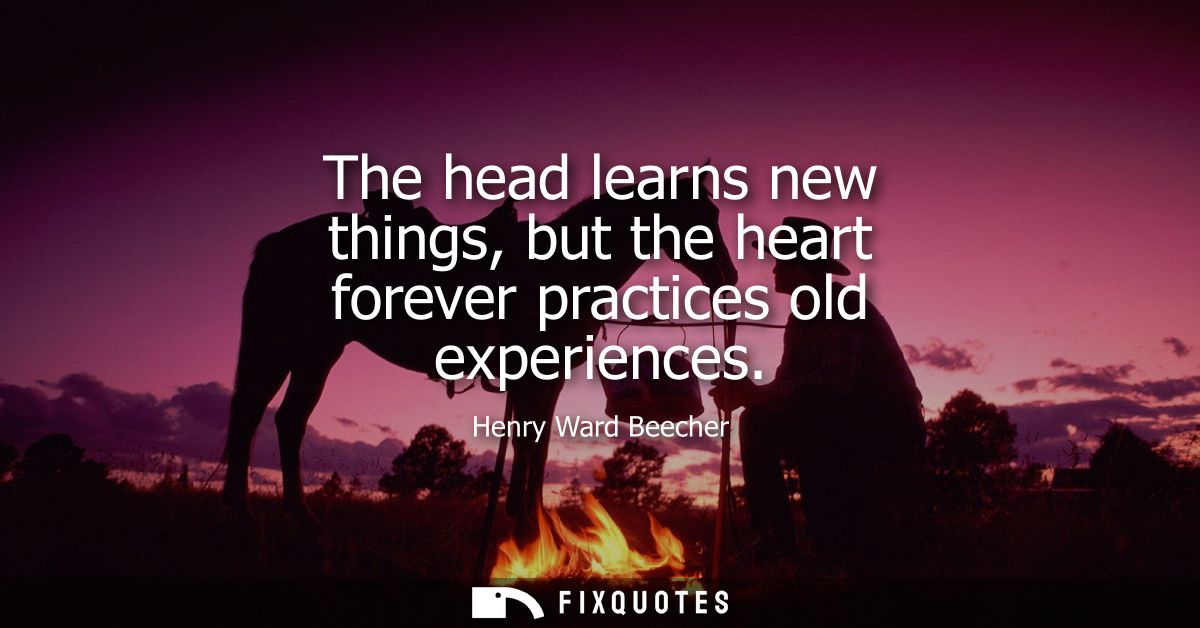
"The head learns new things, but the heart forever practices old experiences"
About this Quote
Beecher was writing and preaching in a 19th-century America intoxicated with “improvement” - new reforms, new sciences, new arguments about what a modern life should be. As a clergyman, he knew the frustrating gap between assent and transformation. People can nod through a sermon, adopt the language of progress, and still return to the same resentments, attachments, and fears. The line flatters the intellect only to undercut it: knowledge accumulates, but the emotional engine runs on older fuel.
The subtext is pastoral and political at once. It validates private grief and longing - you can’t reason yourself out of what shaped you - while also warning how “old experiences” can become tyrants. A society can learn new principles and still practice inherited wounds: prejudice, vengeance, tribal loyalty. Beecher’s genius here is rhetorical economy. He doesn’t moralize directly; he stages a conflict inside the listener, then lets that discomfort do the work of a sermon.
Quote Details
| Topic | Nostalgia |
|---|---|
| Source | Help us find the source |
| Cite |
Citation Formats
APA Style (7th ed.)
Beecher, Henry Ward. (2026, January 17). The head learns new things, but the heart forever practices old experiences. FixQuotes. https://fixquotes.com/quotes/the-head-learns-new-things-but-the-heart-forever-37066/
Chicago Style
Beecher, Henry Ward. "The head learns new things, but the heart forever practices old experiences." FixQuotes. January 17, 2026. https://fixquotes.com/quotes/the-head-learns-new-things-but-the-heart-forever-37066/.
MLA Style (9th ed.)
"The head learns new things, but the heart forever practices old experiences." FixQuotes, 17 Jan. 2026, https://fixquotes.com/quotes/the-head-learns-new-things-but-the-heart-forever-37066/. Accessed 12 Feb. 2026.