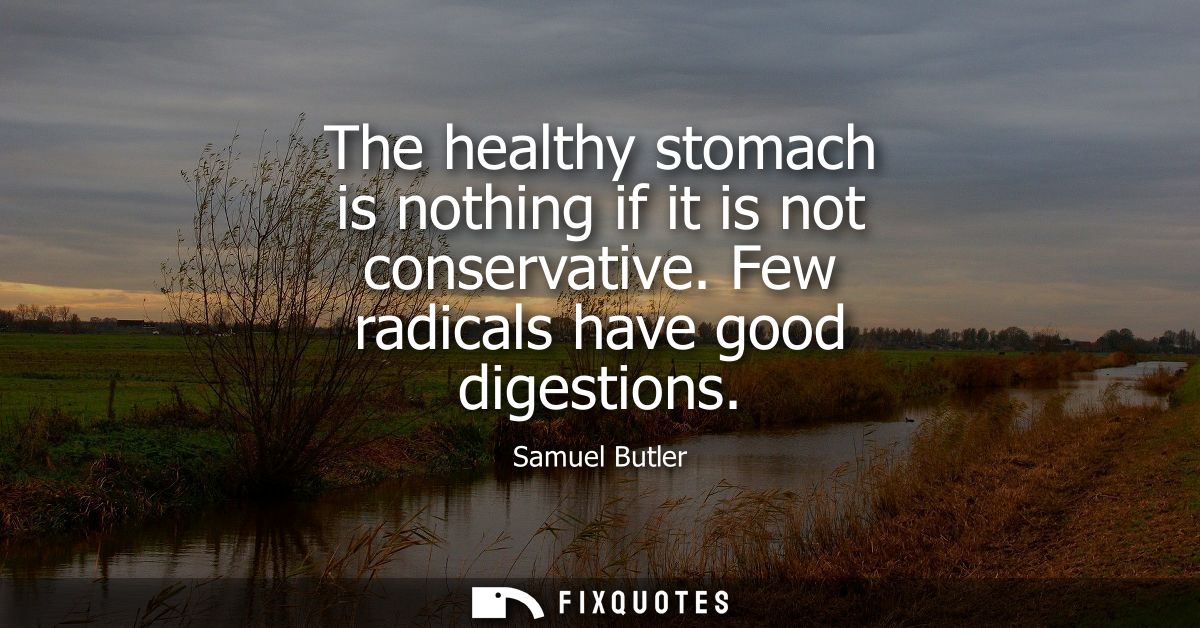
"The healthy stomach is nothing if it is not conservative. Few radicals have good digestions"
About this Quote
The subtext is less about gastronomy than about the psychology of dissent. Radicalism, in this view, isn’t merely a set of ideas; it’s a kind of metabolic stress. To be a radical is to live with irritation, to have your insides at odds with the world. Conservatives, by contrast, are those for whom the existing arrangement “agrees” with them. That framing is funny because it’s bodily, unglamorous, and faintly insulting: your politics might just be your lunch.
Context matters. Butler wrote in a Victorian culture obsessed with health, propriety, and “nervous” modernity, where digestion and morality were often braided together. His work repeatedly skewers earnest certainties and the self-importance of systems, including religious and social orthodoxies. Here he needles both camps at once: radicals as dyspeptics, conservatives as the smug beneficiaries of comfort. The barb isn’t that radicals are wrong, but that the price of seeing clearly can be visceral discomfort, while “health” may simply be the body’s complicity with the status quo.
Quote Details
| Topic | Witty One-Liners |
|---|---|
| Source | Help us find the source |
| Cite |
Citation Formats
APA Style (7th ed.)
Butler, Samuel. (2026, January 17). The healthy stomach is nothing if it is not conservative. Few radicals have good digestions. FixQuotes. https://fixquotes.com/quotes/the-healthy-stomach-is-nothing-if-it-is-not-36552/
Chicago Style
Butler, Samuel. "The healthy stomach is nothing if it is not conservative. Few radicals have good digestions." FixQuotes. January 17, 2026. https://fixquotes.com/quotes/the-healthy-stomach-is-nothing-if-it-is-not-36552/.
MLA Style (9th ed.)
"The healthy stomach is nothing if it is not conservative. Few radicals have good digestions." FixQuotes, 17 Jan. 2026, https://fixquotes.com/quotes/the-healthy-stomach-is-nothing-if-it-is-not-36552/. Accessed 30 Mar. 2026.