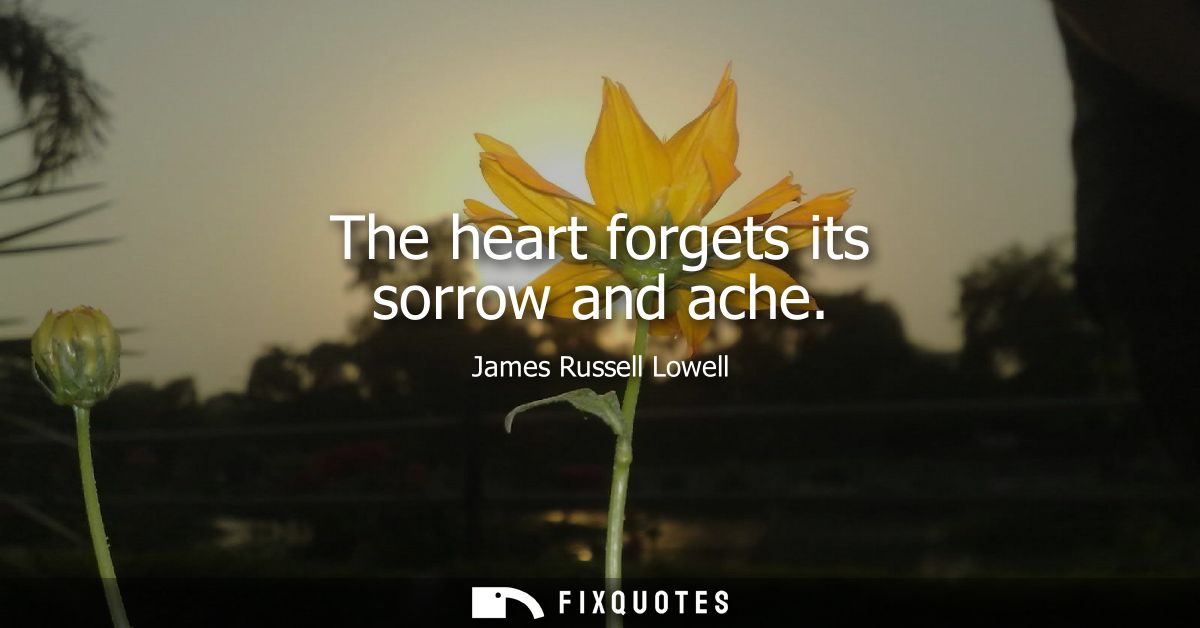
"The heart forgets its sorrow and ache"
About this Quote
The line lands like a quiet provocation: not that sorrow ends, but that the heart has a talent for misplacing it. Lowell’s phrasing makes grief feel less like a moral lesson and more like a bodily process. “Forgets” is doing the sly work here. It’s not “heals,” which would imply progress, virtue, and narrative closure. Forgetting is cheaper, stranger, and a little suspect - the kind of mercy biology grants when philosophy runs out of answers.
The subtext is a negotiation with sentimentality. A 19th-century poet could easily sanctify suffering, turning “ache” into a badge of depth. Lowell instead implies that pain’s authority is temporary. The heart, that supposed shrine of feeling, is also an unreliable archivist. It misfiles; it moves on. That’s comforting, but it also undercuts the romantic idea that love and loss should scar us permanently in some aesthetically meaningful way.
Context matters: Lowell wrote in a century that believed in moral improvement, national purpose, and the educative power of hardship - even as it was soaked in upheaval, war, and private bereavement. Against that backdrop, the line reads as both solace and critique. It offers permission to survive your own emotions without making a doctrine of them. The real intent isn’t to deny sorrow; it’s to demote it, to suggest that endurance may look less like heroic resilience and more like the heart’s ordinary, unglamorous forgetting.
The subtext is a negotiation with sentimentality. A 19th-century poet could easily sanctify suffering, turning “ache” into a badge of depth. Lowell instead implies that pain’s authority is temporary. The heart, that supposed shrine of feeling, is also an unreliable archivist. It misfiles; it moves on. That’s comforting, but it also undercuts the romantic idea that love and loss should scar us permanently in some aesthetically meaningful way.
Context matters: Lowell wrote in a century that believed in moral improvement, national purpose, and the educative power of hardship - even as it was soaked in upheaval, war, and private bereavement. Against that backdrop, the line reads as both solace and critique. It offers permission to survive your own emotions without making a doctrine of them. The real intent isn’t to deny sorrow; it’s to demote it, to suggest that endurance may look less like heroic resilience and more like the heart’s ordinary, unglamorous forgetting.
Quote Details
| Topic | Moving On |
|---|
More Quotes by James
Add to List